This section becomes primarily my reflections and not Mid’s. These are just snippets of memories which have become happily embedded in my own memory bank.
It would be great if each sibling had their story recorded by someone in their family. They all have amazing stories to tell.
Index
Aunty Aileen
Aunty Aileen, the firstborn, is referred to extensively earlier on in Mary’s Story.
Uncle Les
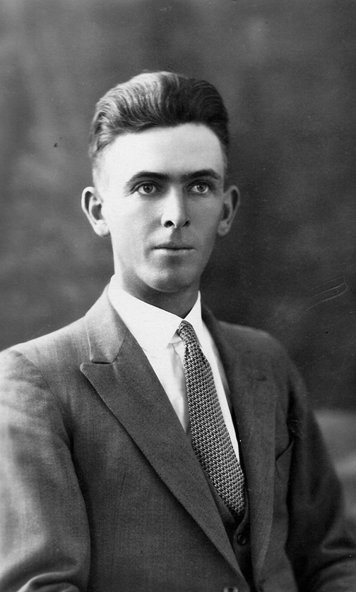
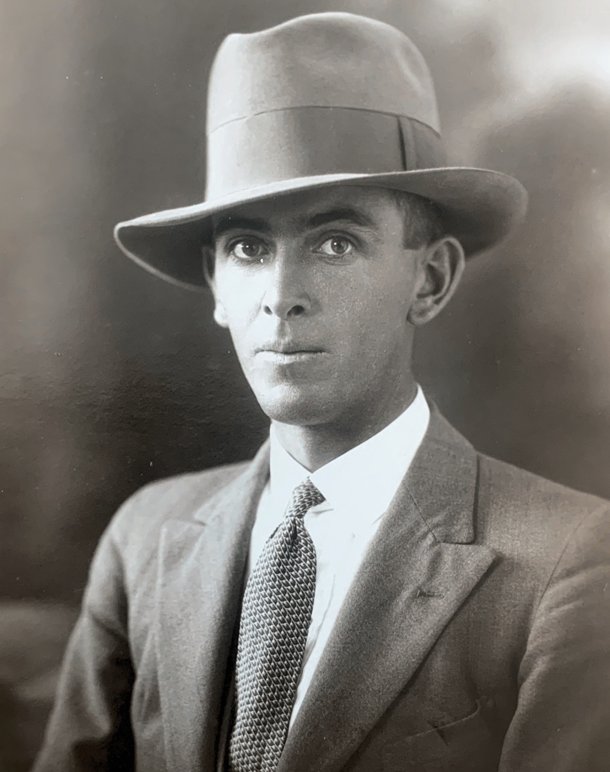
Having talked to Cousin Wendy I now understand some of the responsibilities and issues that faced her father, our Uncle Les .
Here is a brief sketch or our tall, handsome and serious uncle. He was a gentleman and an honourable man.
Les Moyle was born in Jamestown in 1904. He grew up in New Zealand, and moved back to the mid-north with the family in 1917.
His mother Lucy had died in 1918 leaving 8 children. Les was only 14 when his mother died.
Walter Lindo took full responsibility for his whole family.
As Les was the oldest male in the Moyle family he was to eventually be the inheritor of the estate. The patrilineal thus brought with it a sense of deep responsibility.
Les was working closely with his father, Walter Lindo Moyle. Together they wanted to start farming again in the mid north.
NB: Les dictated some notes about the family’s early life and land acquisition in the mid-north and these can be read here. < CLICK
Our grandfather Walter bought the Sheoaks in Watervale, and the family shifted into their new farm in 1923. Together they farmed The Sheoaks and probably did some other paid farmwork, helping their neighbours.
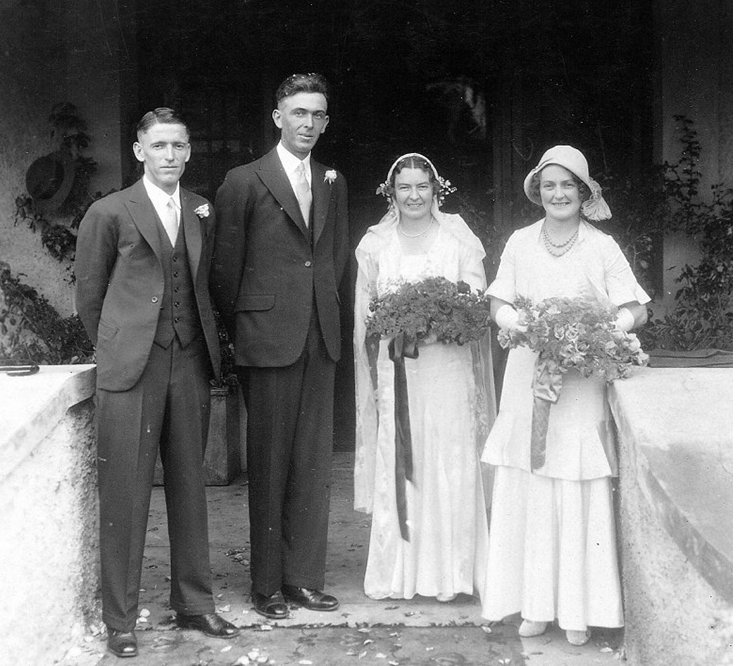
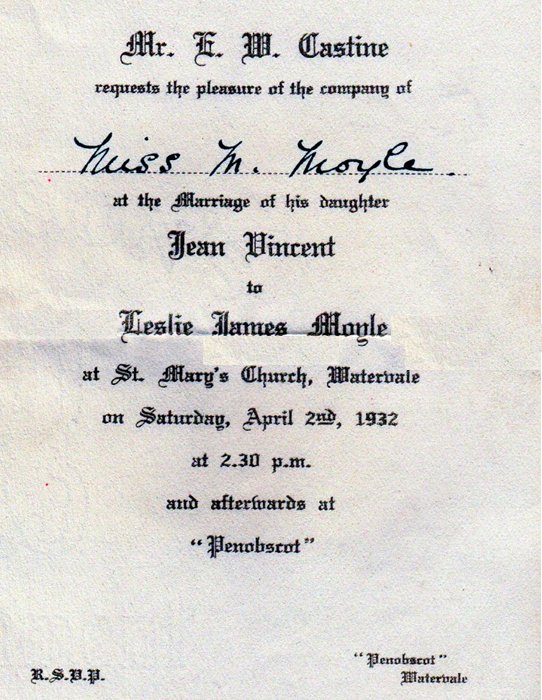
Jean was from a well respected Watervale family – the Castines..
She inherited the farm called Fairield just outside the town of Watervale and together Uncle Les and Aunty Jean moved into their new property.
They had a daughter Wendy in 1933. Wendy was an only child and she was shown how to be a farmer, to work the land and take responsibility for her farm work. As well as all the normal learning to be a woman on the farm…cooking, cleaning, sewing, caring for the chooks and maybe milking the odd cow.
Molly Giles and Helen Burford became close cousins. Molly often remarks that there were just 2 years between each of them, with Molly born in 1931, Wendy in 1933 and Helen in 1935. Molly lived in Clare, Wendy in Watervale and Helen in Leasingham.
They saw each other quite often. Five of the 6 Moyle aunts were still living at The Sheoaks so they would have visited there regularly.
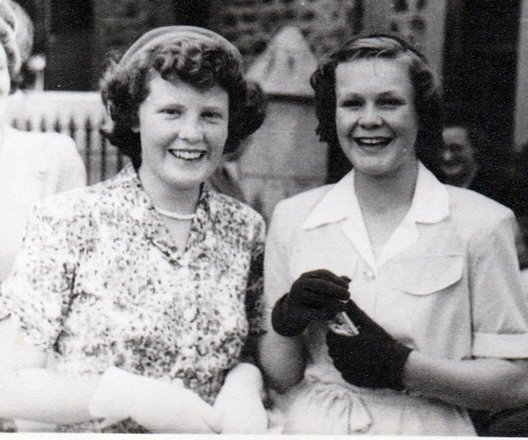
I didn’t see Uncle Les’s family very often as we lived in Largs from 1947. As a very young child we were in Clare but I don’t remember visiting Fairfield, probably because we didn’t have a car.
However when we did visit Fairfield I was quite delighted by the garden. I think it would have been when I used to stay with Aunty Ada in Blyth in the 50s. Occasionally she would call at Fairfield.
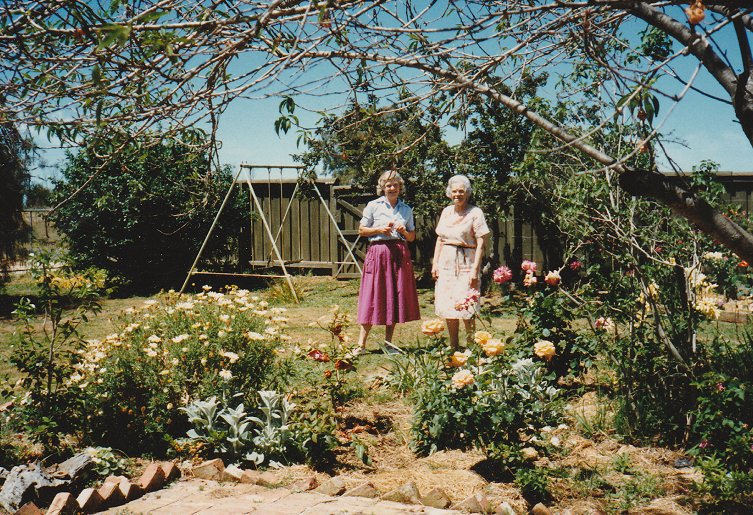
Aunty Jean was a wonderful gardener. She had created a small pocket of a wonderland with wandering pathways, arching trees, orange blossom spreading its sweet perfume through the garden, bulbs bursting out in the spring, a small Lippia lawn alive with the buzz of bees and superb autumn colours once a year. It was an inspiration. It took me decades to have my own garden but the inspiration was definitely Aunty Jean’s and then Wendy’s garden. Aunty Jean told me once to plant a Chinese elm as it doesn’t grow too big and always offers gentle summer shade. I have planted two in two of my houses. I wish I had one again. Aunty Jean was also an artist with a love of native plants and flowers. This was unusual and quite special.
Wendy has told me of the work Uncle Les did with The Army. He was able to join but not to serve overseas because he was a farmer. He had to return home when it was harvesting time and then return to the training programmes. He trained many soldiers, teaching them how to ride horses and to shoot. He was Lance Corporal Les Moyle. Many of his trainees went to Tobruk. There is an interesting letter that Wendy has in which one of his trainees went as a Brigadier to the War Trial in Nuremburg. He acknowledged in this letter to Les the work that he had done in his training and how unfair it was that he wasn’t considered a returned soldier. The rules stated that one couldn’t be regarded as a returned soldier if he hadn’t been been north of the Tropic of Capricorn during his service years. At the end of the war Uncle Les was demobilised but not considered a returned soldier. It was a hurtful lack of recognition of the job well done! Maybe it had financial implications as well.
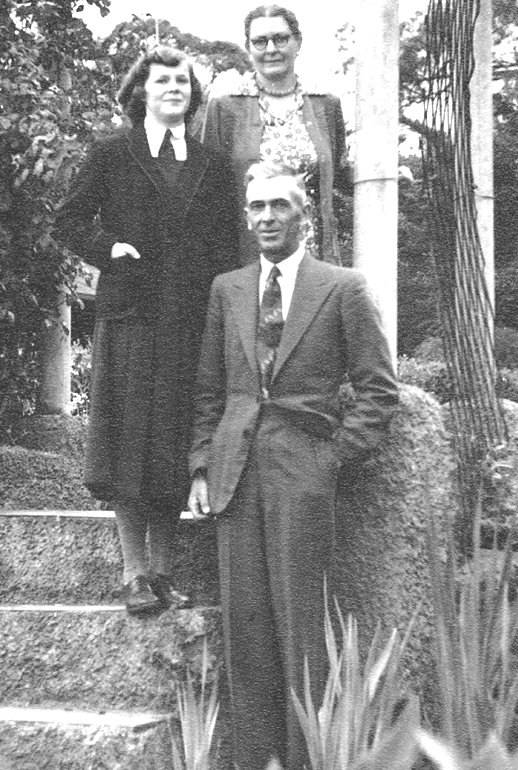
Wendy was a member of the Rural Youth and in 1953 she won the Australian Rural Youth Award. This was huge. It included a trip to the United Kingdom to meet other Rural Youth workers.
This was extraordinary because nobody thought of girls as being rural Youth workers. Wendy broke the drought. She was the first female winner of the Rural Youth award. A young woman leading the charge!
The whole family were delighted. It was 1953, the year of Queen Elizabeth’s Coronation. We were all Royalists at this time and very excited about the Royal Family. And Wendy was going to that very city!
Wendy came back with wonderful stories and a new English boyfriend/ fiancée. We thought he looked just like the Duke of Edinburgh. He was as tall as the Moyle men and Uncle Longy and had a sparkling sense of humour. We were impressed with Nick Crawley! They were married and shifted into The Sheaoks as their new family home. Their children Sandra (born 1956), Margo (b.58) and Grant (b 61) grew up at the Sheoaks.
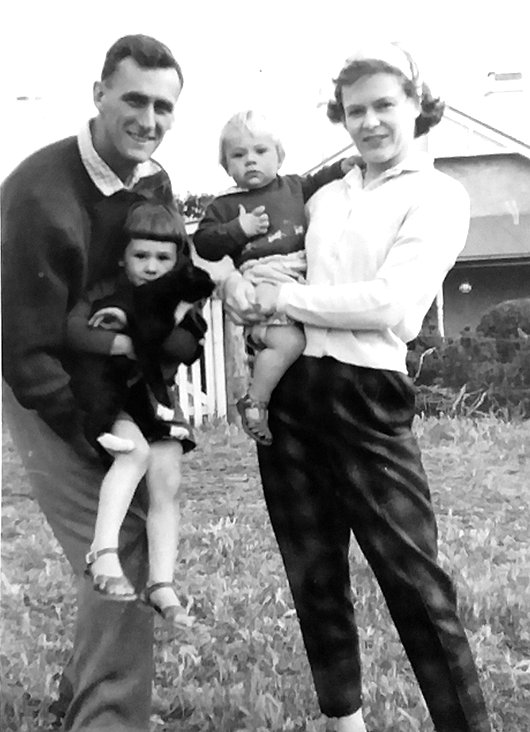
In their older years Aunty Jean and Uncle Les moved to live in Riverton.
This meant that Wendy, Nick and their families shifted from The Sheoaks to live in Fairfield. Our family visited quite often and stayed with them at Fairfield.
The Auburn Players were a great hit and we loved attending these annual performances. Wendy often wrote and directed the works performed and Nick performed in the shows. Wayne actually produced one of the shows in the 80s. Brother May from Seven Hills Monastery was a performer along with many local families.
Little Sandra grew up to be a confident and strikingly beautiful young woman. In 1981 she was entered in the Miss South Australia beauty quest – and won! The family were all very proud of her and eagerly followed the press coverage of her activities as Miss SA.
Sadly Wendy and Nick’s marriage didn’t last. They were eventually divorced and some difficult and lonely years followed. I felt quite close to Wendy as she’d always been good to us and invited us regularly to join the Auburn performances. We had shared stories and enjoyed each other’s company. It felt sisterly and I was keen to be a listener if she needed to have a friendly ear. Wendy is a strong individual and she was determined to get on with her life.
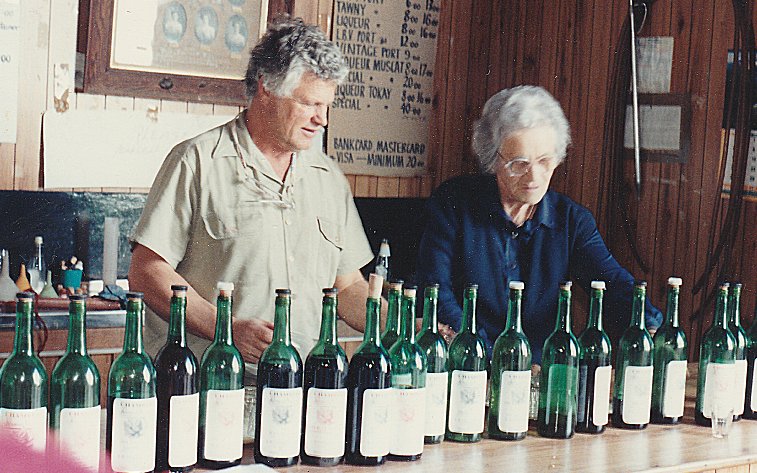
She re-met Bill Chambers from Rutherglen and they decided to marry in the late eighties. He was a vigneron and many years earlier had studied Ag Science and wine making at Roseworthy College – the agricultural arm of the University of Adelaide. They had met all those years ago and were now in a position to start a new chapter. We liked him very much and were pleased for them both.
There was a superb wedding, brilliantly organised by Wendy and including many of the aunts and uncles and cousins. It was a huge family get together. A bus was organised to take guests from SA to Rutherglen, then to their accommodation, then to the wedding and finally home again 2 days later. It was a wonderful celebration.
Wayne dressed as his alter ego Humbolt the Clown and entertained the young ones. We ate, drank, danced and had a wonderful evening.
Wayne wrote a song on the bus trip home and we all sang along. It was a memorable occasion from pick up time to drop off time.
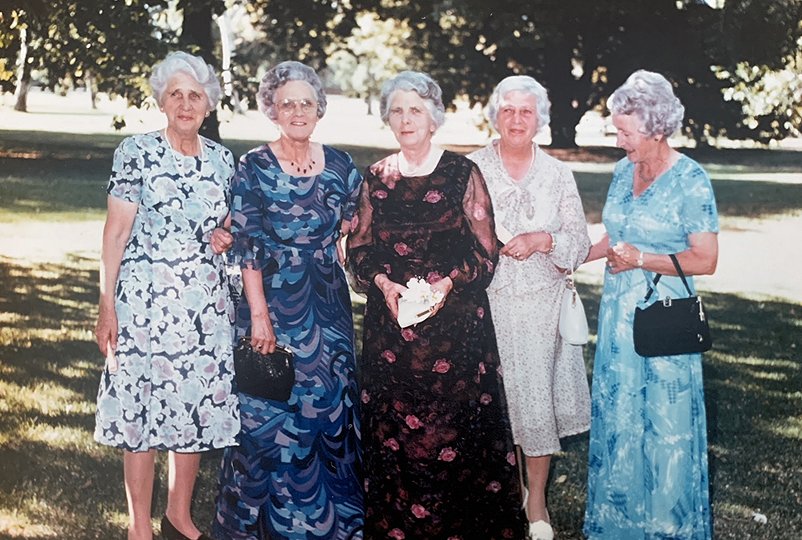
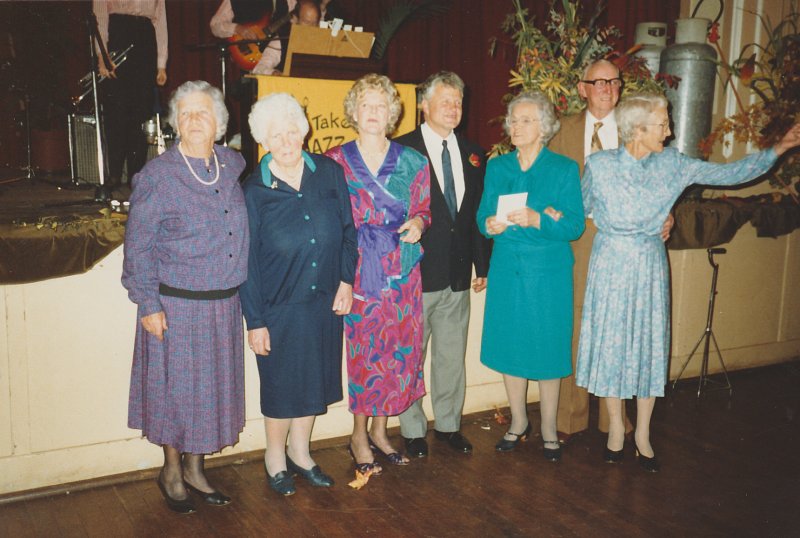
We became familiar with Rutherglen and with the beautiful Rosewood fortified wines at the Chambers winery.
I visited them several times and appreciated Wendy’s support when my marriage floundered in 1990 and when it regained momentum in the early 2000’s.
Wendy and Bill have visited Willunga on several occasions and I have really appreciated our closeness over the years.
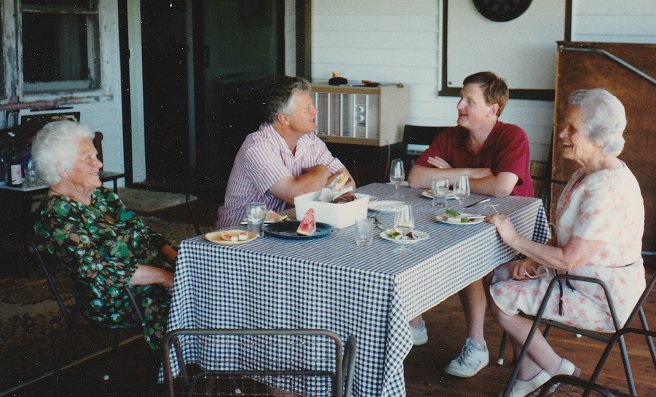
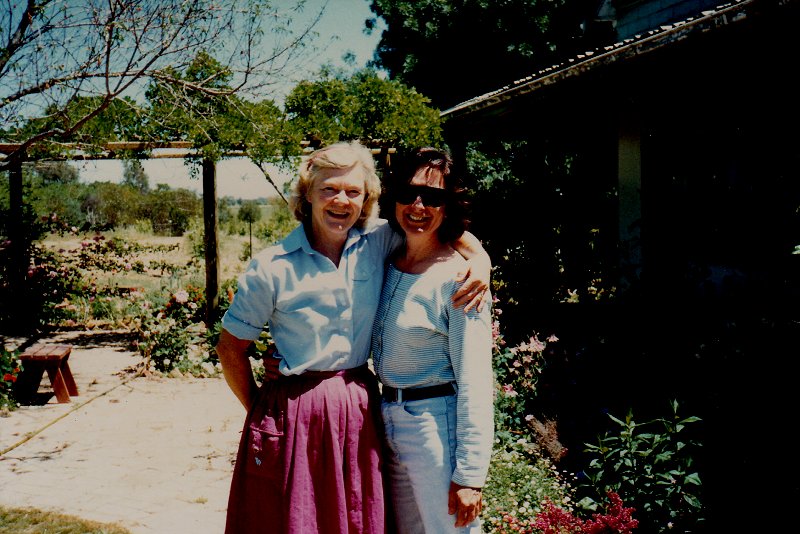
Sandra has been a close cousin and we are in regular contact. She is a foodie of note in the Clare region, having run her own restaurant – Crawley’s – iin Leasingham and been a mover and shaker in all community food and wine events. Annie’s Lane was her base for many years, where she made her famous sauces for company called Tavender’s. She continues to do this from her home in Auburn. Sandra’s great loves are the island of Paros in Greece and all things arctic in Samiland. There are more amazing stories to be heard about her travels to these places.
We sometimes see Grant who lives at the beautiful Fairfield property and it is always delightful to renew contact. Grant is a doppelganger for the young Walter Lindo Moyle, his great grandfather.
Margo lives in England so we hear of her sometimes, but have been unable to renew contact. Our mother Mary had a very soft spot for Margo because on one occasion, Wendy asked her to come and stay at Fairfield and “hold the fort” while she travelled interstate. Margo was a teenager at the time and she and Aunty Mid became firm friends.
Aunty Jean died in 1985. Uncle Les developed renal cancer and died in 1988. Wendy told me that our grandfather Walter Lindo had also died of renal cancer.
I visited Uncle Les in Calvary Hospital when he was very ill. It was a short but memorable time. Vale Uncle Les.
Uncle Bob
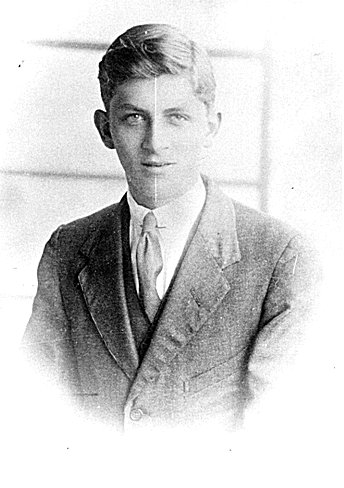
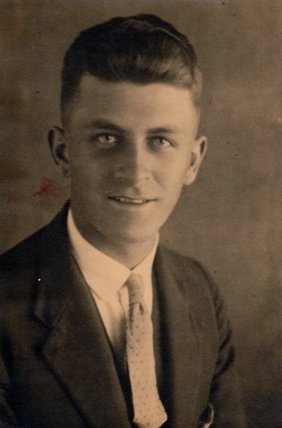
He was born in 1906 in Helensville. He was a handsome young man.
His happy times and cheeky times were in Clare and then at The Sheoaks.
Bob was talented, a clever artist, a good hunter, a charismatic character and good fun.
He and Mid were always close friends as well as siblings. So too with Aunty Nell and Aunty Kath.
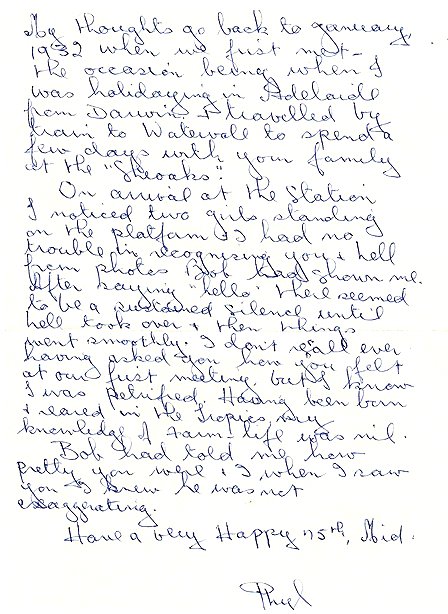
He left home to work at an early age and ended up in Darwin working for the Post Office. In Darwin he met Phyl Osborne.
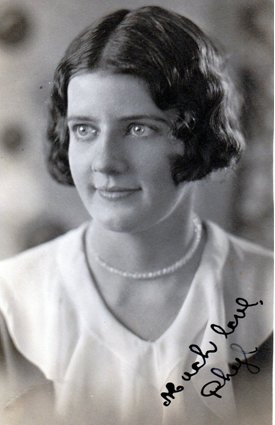
Phyl visited Watervale to meet Bob’s 6 sisters. They were a very attractive group and the sisters attempted to make Phyl feel as comfortable as possible. She was welcomed.
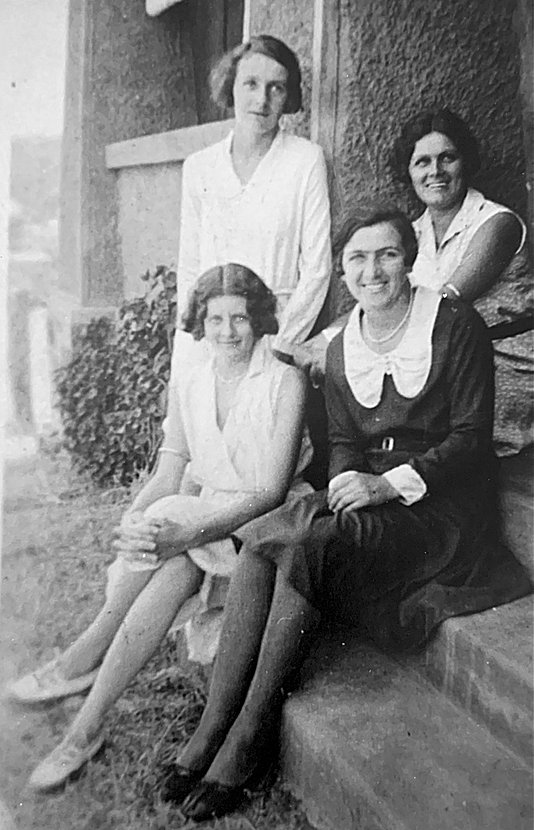
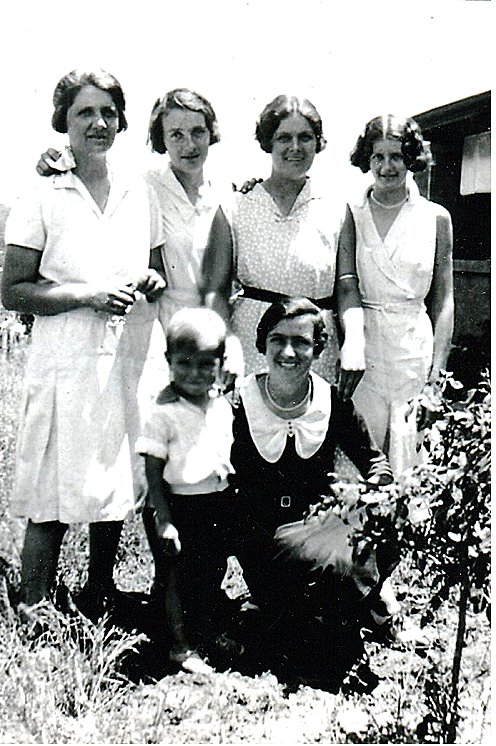
This was a daunting task and she wrote about it in a letter to Mum which was part of Mum’s 75th birthday present with a sealed section at the back.
Uncle Bob and Aunty Phyl had 3 children, John Moyle(born 1935), Robert (Cobber) Moyle(born 1936) and Judith (1939).
They returned to Adelaide from Darwin and lived on a double block in a very desirable part of Unley North.
Uncle Bob continued working with the GPO in Adelaide.
Mum and I spent several weeks on two occasions with Uncle Bob’s family at their Unley park house when Aunty Phyl was ill. These occasions would have been the late 40s and early 50s. Judith taught me the Charleston during this time. She was always good fun. I don’t remember Cobber (Robert) and John when we were staying there.
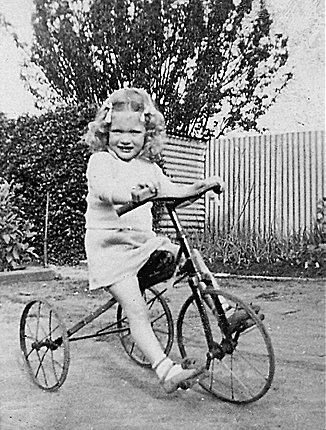
Uncle Les Moyle spent a lot of time with his nephew John as he was the first Moyle male in the patrilineal line.
John was a mechanic and ran a car repair service in Owen SA. He was a very likeable man with a kind heart.
John and his family lived on Kangaroo Island for many years and towards the end of his time there he was able to attend Mum’s funeral in 2001. This meant a lot to us as we hadn’t kept in close touch with him. His kindness showed through again. They shifted to Tasmania from KI and he died in 2019?
Jim tells me that Cobber often went to stay with them at Kybunga and he fitted in very well. He loved being on the farm and helping there.
Speaking to Cobber these days he tells me that Uncle Bob spent lots of time in his big back shed where he made and fixed many pieces of carpentry and machinery. “He was very clever” according to Cobber and Judy.
Uncle Bob loved going on holidays to Aunty Nell’s where he could help on the farm, ride horses and hunt rabbits etc. His demons were related to alcohol and Aunty Nell said there was to be no drinking when he stayed with her. It really worked for everyone and was always a happy time.
I remember him staying once with us at Largs but it didn’t have the freedom of the open spaces of the country that he had at the Bagshaw farms. The Largs Pier Hotel was very close to Alexander St.
In 2018 Wayne and I went on a holiday to Hobart and there we looked up Judy Moyle, who had a lovely little house where she entertained us and delighted us with many funny stories. Her sense of humour was as sharp as ever. Colin Giles always enjoyed talking to Judy on the phone because of her sense of humour.
The latest news (December 2022) is that Judy is returning to Adelaide and will be living in an ECH house in Glenelg. Cobber is very pleased to have her back in SA. Welcome home Judy.
Uncle Bob died of cancer in 1974
Aunty Phyl died in 2003.
Aunty Win
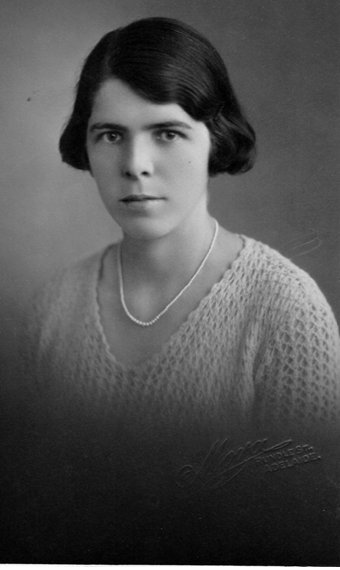
Aunty Win was born in 1908 in Helensville NZ
She married Oliver Burford in 1934.
Aunty Win and Uncle Oliver had 3 children.
Helen was born in 1935, Bruce born in 1938 and Roger in 1948
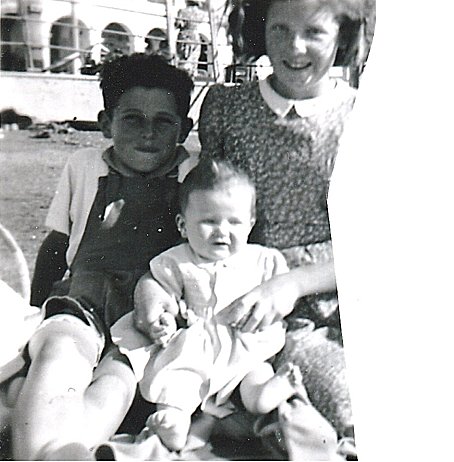
Aunty Win and Uncle Oliver settled in a cottage in Leasingham with a very large block covered in fruit trees, currant grapes, vegetable gardens par excellence and a milking cow and chooks. It was a dream come true of our hippie generation.
There was a creek with a swinging bridge which led to the drying racks for currants and eventually the main road to Clare. The produce of the property was outstanding.
We cousins would be visiting in the summer when the peaches were dropping off the overladen trees. We ate as many as we could and then looked for the apricots and nectarines. Heaven.
The cottage had a large pantry just outside their back door. It was like a wee house with a little gable roof and it went downstairs into the cool.
It was packed with every kind of preserve.
In May we would go gathering mushrooms up the hill and into some adjoining paddocks. The paddocks were thick with mushrooms which we picked in our baskets and some of them we cooked that night. They were deliciously buttery, to our delight.
When staying at Aunty Win’s there was a lovely disciplined order of morning activity. Uncle Oliver got up first to light the stove in the kitchen. The kettle would be ready for our breakfast and the room was gradually getting warmer. Everybody would be up and seated around the kitchen table near the fire. Porridge with creamy milk was so delicious that it has been unforgettable. It was the best breakfast ever.
Uncle Oliver worked in the wine industry but also ran a superb garden at home.
In the lounge we would often have a slide show evening. Uncle Oliver had a good new camera and enjoyed taking photos of beautiful scenes which were processed as slides and became the central focus of a slide night entertainment. He was a very good photographer and it became a strong hobby for him. He won several prizes for his slides.
He had portable equipment with a slide machine and a screen and sometimes (on special occasions) there would be a slide show at Kybunga. His artistic photos were quite excellent. But a full stomach from dinner, a darkened room and hundreds of photos meant…..
Uncle Longy just couldn’t keep awake and he would be quietly nudged in the dark to Shhhh! Stop snoring Ssssh !
One such occasion I remember was when Wendy returned from her Rural Youth scholarship trip to the UK. I think she had slides to show us of the trip. Does anyone else remember that? How exciting it was.
Helen trained as a Primary School teacher and was posted to Spalding . I thought this sounded like a great career move especially as I knew how much my mother loved teaching, especially in the country. Maybe Helen had the same skills. I intended following the same path when I finished my schooling. She was happy teaching.
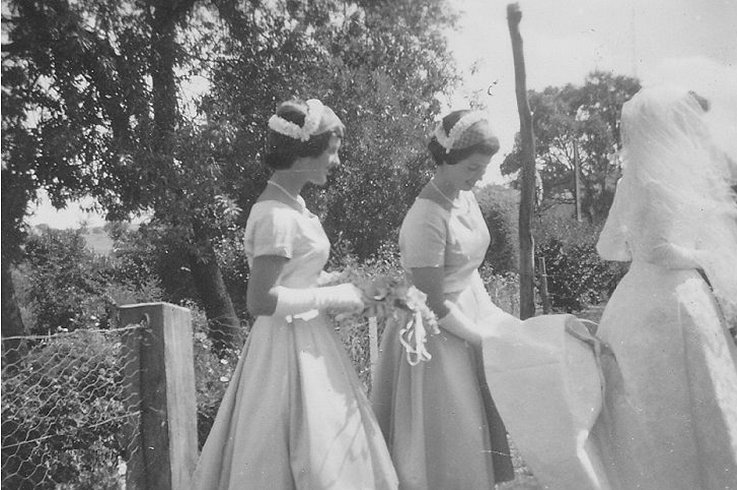
In 1959 Jan and I were invited to be bridesmaids at Helen and Sandy Friar’s wedding. This was indeed very special. We had satin dresses made and were very excited to join the wedding party. On the wedding day, we left from Helen’s home, the Leasingham property, and then drove as the wedding party members to the Methodist Church in Watervale. I think the reception was at the Watervale Town Hall. Helen looked serenely beautiful.
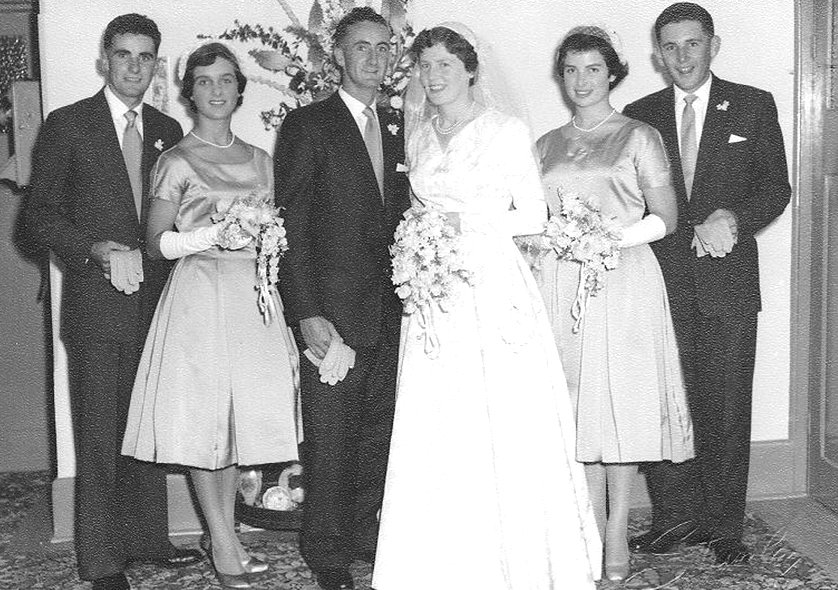
I had no idea what bridesmaids were expected to do, but Jan was a bit more knowledgeable and seemed to help by lifting the veil out of the dirt etc. I smiled a lot and hoped that was enough.
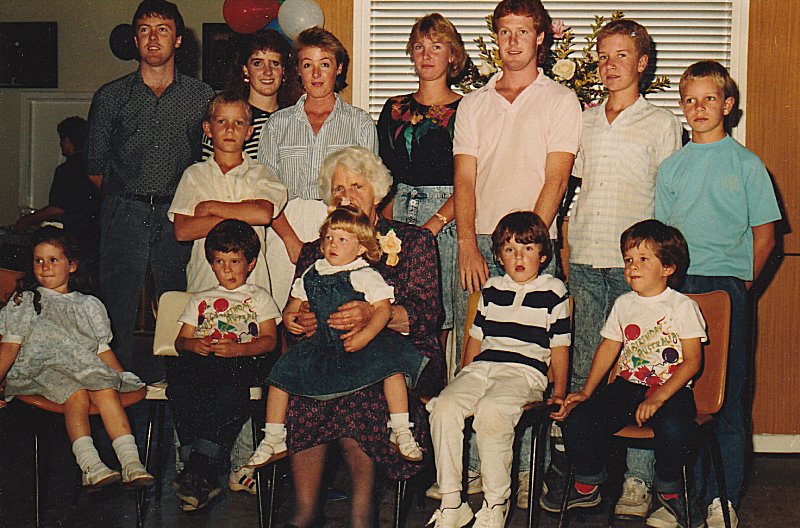
Cathy’s Memories of Aunty Win
My sister Cathy often went to stay at the Burford’s because she and Roger were the two youngest cousins and got on quite well. Roger was just 3 years older than Cathy.
(Diversion for information about Cathy’s name. She was named Cathrine when she was born . i.e. Cathrine spelt without the “er” in the middle because our mother thought it sounded better without the “er”. But she immediately became Cathy and remained as such until late adolescence when she decided to be called Kate)
Back to Kate’s memories of staying with Auntie Win and Roger during school holidays.
She remembers a red metal pedal car. In this she could go hurtling from the back garden gate right down to the chook house at breakneck speed. Good fun! Quite dangerous. A long way at speed. She was probably only 4 years old!
She also remembers how Aunty Win would be milking the cow and then squirt the milk straight into her mouth. Aunty Win had been milking cows from the Sheoak days into forever. So impressive!
Next door was Mrs Vivienne and Cathy could play there until Aunty Win “banged the gong”. That was the call to return home immediately.
On one occasion Cathy didn’t hear the gong. Aunty Win was very cross with her as it was dinner time and she should have been home.
“She chased me around the table. I’ve never forgotten it.”
Cathy had bad ears as a child so it may be that she didn’t hear the gong. Everyone else did obviously. Never mind, the mood changed with a hearty meal ….but Cathy hasn’t forgotten it.
We all remember the sound of the bathroom heater charging up. It seemed to explode into action and was almost enough to put us all off having a bath. No fire ever happened apparently but it seemed to be imminent when lighting it up! And it worked very well once it got cracking.
What happened in the next few decades?
Helen and Sandy moved to Seviceton in the South East and just over the border into Victoria. Sandy was working with the railway and Serviceton was an important station linking SA with Victoria.
Helen was diagnosed with lung cancer in the early 1990s. It was a cruel blow to so many in her family. I was travelling through to Melbourne in 1992 at a time when she was very unwell. We spent an hour or so together. Helen was courageous and gentle even at this final stage of her disease.
Helen died in 1992 at the age of 54 and was buried in the Bordertown cemetery. Many of our extended family joined her close family at this ceremony.
Vale Cousin Helen
Bruce and Roger trained as teachers. And both have taught until retirement. Teaching is certainly in our blood.
Roger actually lived in the flat at 18 Alexander St Largs Bay when he was teaching at Fulham Gardens Primary School. He and our mother, his Aunty Mid, were good friends. They were both full-time teachers and off to work in the mornings.
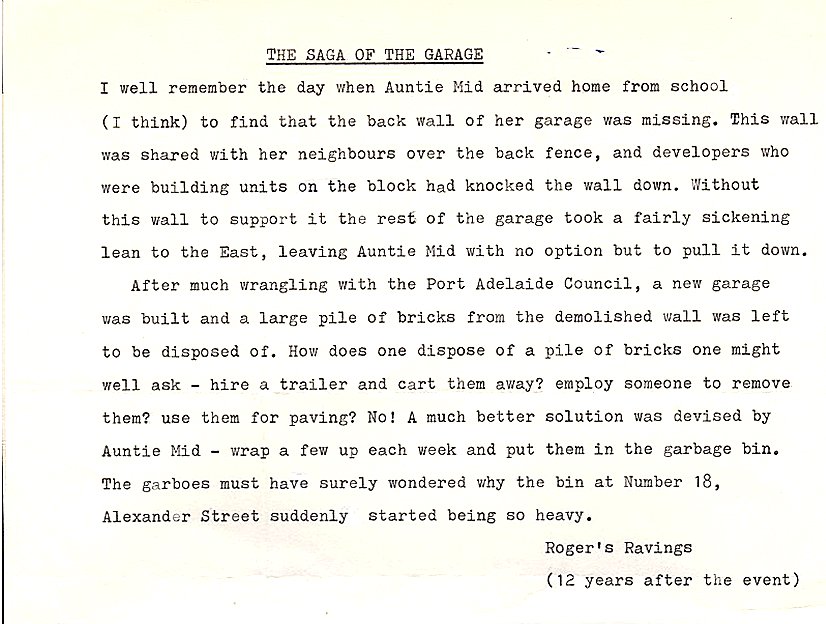
He wrote a little piece of memorabilia for our mother’s 75th birthday present. (This present was an album of photos of her youth and family and had a “sealed section” at the back where many added letters or poems for Mid to read later).
Here is Roger’s story.
Uncle Oliver and Aunty Win eventually sold their Leasingham property and shifted into a house in Clare, quite close to the hospital. Another beautiful garden was developed there of course.
Uncle died in 1979 and Aunty Win shifted to a unit in Bordertown which was close to Helen and Sandy and their family.
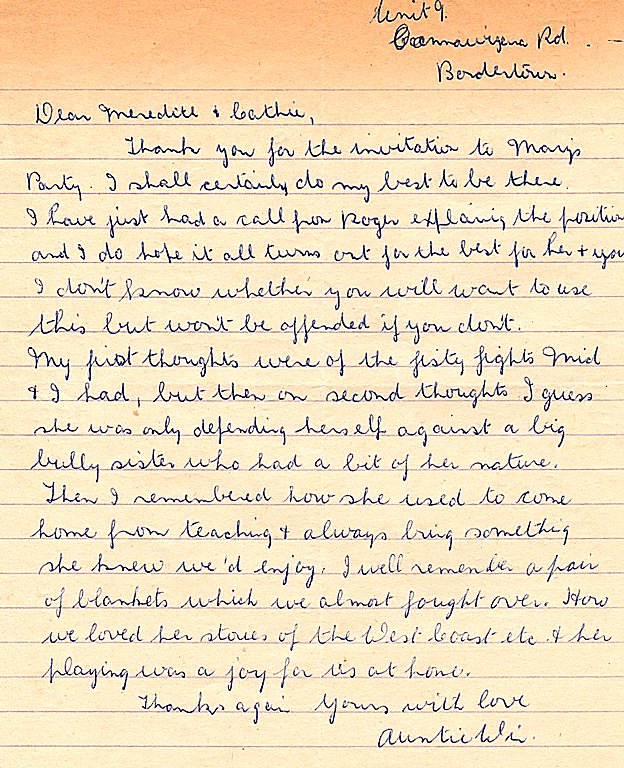
As mentioned above, Kate and I had planned a 75th birthday for our mother Granny Parker and I suggested some might like to write their memories of Mary/Mid for a sealed section at the back. It’s no longer a sealed section and here is Aunty Win’s letter.
Aunty Win moved to an aged care home called Alwyndor in Brighton and died there in 1992, before Helen’s death.
Her funeral was held in Watervale and she is buried in the Watervale cemetery. There was a magpie singing in the trees as she was buried.
Vale Aunty Win
NB: In the 1980’s Aunty Win wrote an excellent account of her memories of growing up at The Sheoaks. It is to be found here.<CLICK
Aunty Ada
School Holidays = farm visiting time
The parents of all the cousins were busy living their weekly family life either on the farm or in the city but some of us were lucky enough to be visiting and staying with each other in our school holidays. This was possible in our Infant, Primary and Secondary School years. And so exciting!
I remember the many times when one of these aunts would be visiting us at Largs and as they were about to leave asking “Meredith, would you like to come up to the farm with us?”
It was always school holidays. On reflection I have no doubt that the whole thing had been pre-planned but it seemed quite spontaneous to me at the time and of course I would jump with joy at the thought of it. “Oh can I Mum? Please?”
“Mmm well Oh OK”.
And I was packed in a few minutes and we were off on our way.
This certainly happened a lot with Aunty Ada when I was very young and Primary School age, then with Aunty Nell during my Upper Primary and Secondary school years and then with Aunty Kath at late Secondary and Uni days
Aunty Ada –
Ada Moyle was born in January 1910 In Helensville NZ
Ada married Reg Mugge in April 1935
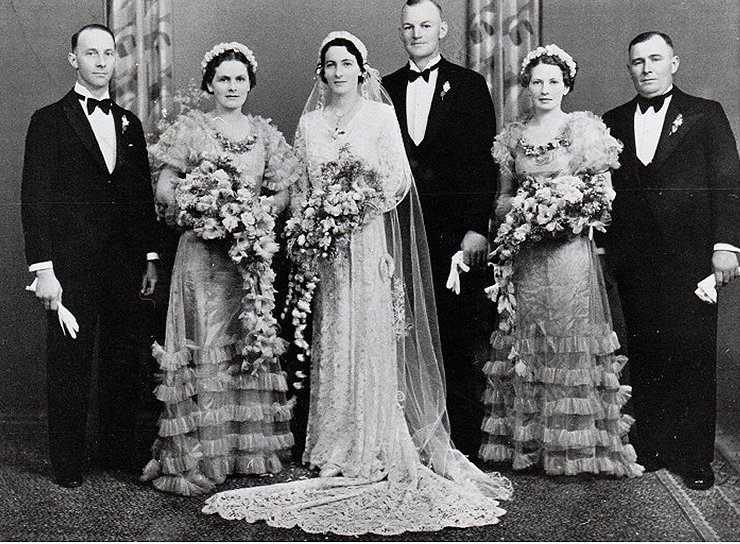
Mum was a bridesmaid. She and Ada were very close friends and sisters.
They married couple moved into a beautifully renovated Mugge homestead called Kelvin Grove, near Blyth in the mid-north of South Australia.
My memories of Kelvin Grove are very vivid and other cousins would feel the same I am sure.
From a very young age, I spent a lot of time with Aunty Ada at Blyth in “Kelvin Grove”. It was like a second home to me.
The house would have been a Villa originally but it was upgraded into a very commodious 4 bedroom home with a modern farm kitchen, a lounge and dining room, a study annex, a sunroom and an entrance hall (which was never used as an entrance – most farmhouses were entered through the backdoor). At some stage a new bathroom was added but there was always an outdoor toilet.
There was a large chiming clock in the entrance hall. Every hour and half hour there were distinctive bongs from the grandfather clock. It was close to my bedroom and I loved hearing it whenever I woke,
There was a large underground tank out the back with a galvanised iron top and steps leading up to a hand pump.
We were sternly advised, “NEVER EVER stand on that tank’s roof!!!”
There was a little engine room with a generator charged by a Starlite windmill nearby.
The laundry was a large separate room with washing troughs, a copper, a separator for the cream and benches which were used for the wash or the plucking of chooks or whatever else might be happening and a mangle for ironing out the sheets brought in fresh from the washing line.
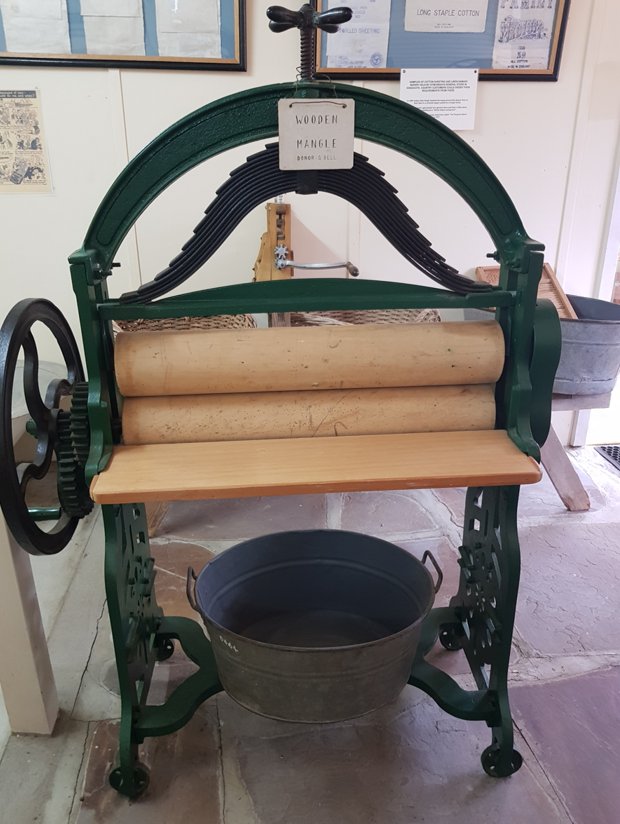
Kelvin Grove had a very large farm kitchen which Aunty Ada chose to decorate with blue and white crockery. This was quite daring as kitchens were normally green and bedrooms were blue.
Aunty Ada had a green quilt on their bed!! Boldly, daringly artistic I thought!
The kitchen was made for a large family which would have been large enough for their original Moyle family of 8 children and 2 parents. Sadly Aunty Ada and Uncle Reg had no children to share this beautiful kitchen.
There was a 1940s kitchen cupboard with four drawers and the second drawer down was FULL of lollies. It had Jaffas and peppermints for well behaved children.
I don’t remember ever nicking any but I must have been tempted.
There were benches and built-in kitchen cupboards under the kitchen window wall with 2 enormous bins which could be swung open with a hopper action … one was for flour and one for sugar.
I recall many German cakes being made, especially when we were preparing for the next footy match. Grandma Mugge (Uncle Reg’s mother) was a very good German cook and showed Aunty Ada how to make the famous German cake.
On a Saturday in winter, the thermos and cake tins were packed into the car boot along with cups and mugs, a rug and a couple of folding chairs. It was Blyth Football time. We would drive on the Saturday to wherever the footy was on – Gulnare or Brinkworth or Blyth etc. Uncle Reg and Uncle Longy were playing in the early days and then the Longy boys in later days. The girls would be playing basketball (ie netball as we know it now) and the locals would parade around between the footy and the basketball.
The cars were lined up around the oval and at half time, the boots would be lifted up and out would come the picnic cuppas and cake. It was a major event.
After the footy the cars would drive to the Blyth pub and the men would go to the bar, but the ladies weren’t allowed in, so the men would bring them out a sherry and the kids would get a lemonade if we were lucky. This was a bit tedious.
Back to the kitchen –
The blue laminex table and blue leather swing back chairs were state of the 50s art. We used the table for eating and playing cards, drawing, writing and sitting listening to the radio.
The cards Aunty Ada taught me to play were Coo-and-Can and Crib and the board game we played a lot was Chinese Chequers. Her set had quondongs for the moving coloured pieces.
At 10.00 we would sit at the table with a cup of tea each and a slice of German cake and listen to the wireless. At 10.00 5PI was broadcasting “When a Girl Marries” followed by “Dr Paul”.
We listened every weekday morning except for golf day!
In the hall was the telephone wind-up style attached to the wall –just like this museum exhibit.
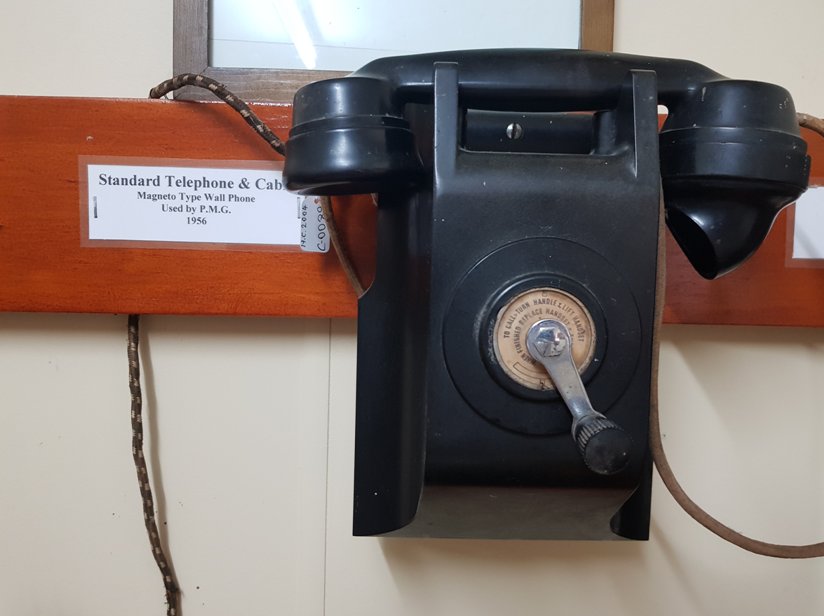
There was a beautiful lounge with a piano and a radiogram. Yes a Radiogram with one or two new childrens’ records. Very special . “Lambert The Sheepish Lion” was a favourite and Cathy and I knew its every word.
In the passage was a large built-in cupboard with 2 huge drawers containing toys and the board games.
The visitor’s bedroom (my bedroom) had a very comfortable bed and many a night and morning I would lie and listen for the crows and other farm noises. There were dogs barking, chooks, roosters and turkeys cawing, gobbling and creating bedlam and the grandfather clock reliably bonging each hour
At Kelvin Grove the crows were always cawing and calling. Dozens of them. To hear a crow today transports me straight back to Blyth especially when the morning sky is clear and blue and the crows have that urgent calling.
The scrub surrounded the entrance to the property .It was a treasure trove of old sticks and stones for cubby making .And there were a couple of piles of hard rubbish like old glass bottles. They were blue and green and weird shapes.
There was danger I was told. No doubt snakes were there but I never saw one and they weren’t specifically mentioned .I remember the “Be careful” warnings. “There might be a bull nearby”. I don’t remember ever seeing one in the scrub but I was always watching for them.
Significant events happened at Kelvin Grove.
I think I was 5 when I had my tonsils out at the Blyth Hospital and Aunty Ada was looking after me. She was on the committee for the Blyth Hospital and there were several events as money raisers for this important facility.
We also had a couple of beautiful Christmases at Kelvin Grove.
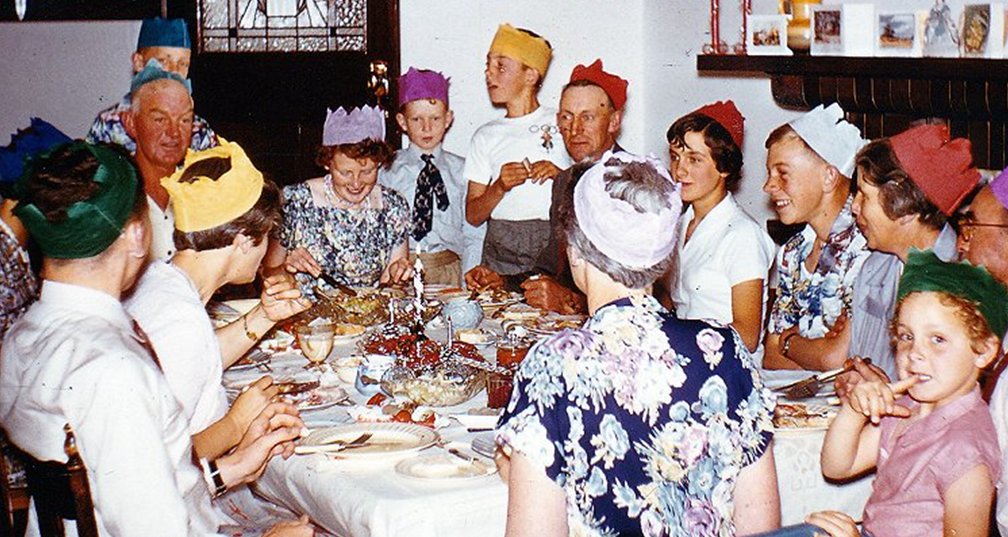
Going around the group from the left are Bruce, Mum, Aunty Kath hidden, Uncle Reg, Bill behind Uncle Reg, Helen, Roger, Jim, Uncle Longy, Me, Ian, Aunty Win, Ralph , Cathy and Aunty Ada.
Another milestone in my eyes was the buying of my first suspender belt and new nylon stockings. Mum had asked Aunty Ada to do that for me and it was quite exciting. The local Elders shop in Blyth (is that right? Was it Elders?) had the lingerie I needed and Aunty Ada showed me how to get dressed without snagging the stockings and adjusting the paraphernalia in order to feel as comfortable as possible. I thought I looked quite swish and felt very grown up. I must have been in Grade 7 I think.
We were going to an event in Blyth. I think it might have been the concert with the blind violinist. He toured all the country halls and played superbly. It was a full house every time.
We sometimes went to the local pictures in the Blyth Institute. The Longies would often be coming too. The kids sat on rugs in the front and the adults on moveable chairs in rows behind us. (The floor had to be looked after because it was also the ballroom and a good dance floor was a priority.)
On one unforgettable occasion I remember going in to Blyth to see the most terrifying movie called ‘The Thing’!!!
We kids in the front were frozen in wide eyed horror as we watched it through. We were just old enough not to want to look like sookies so we didn’t run to be cuddled by our relatives.
That was the last movie I agreed to going to in the Blyth Institute
We would sometimes go to golf which I found a bit tedious as I didn’t have a hit and we seemed to walk for miles over gravelly ground on the Blyth foothills.
Going to the bowling greens was much more fun.
Aunty Ada would be playing croquet and always winning, Uncle Reg would be playing bowls and we were given the freedom to play around anywhere nearby. The mounds of freshly mown grass were fun and the smell is firmly recorded in my olfactory memory.
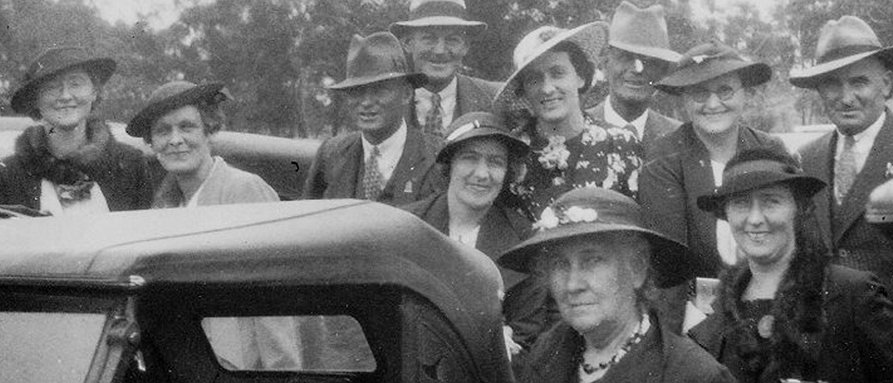
The others here include Mum, Lawrie Bagshaw, Aunty Nell, Uncle Reg, Aunty Ada, Aunty Grace and 4 I can’t name.
One Easter, about 1958 I played in the Easter tennis tournament with Peter Pratt as my tennis partner. We actually won the mixed doubles in our age group. The trophy was a small box of 4 plastic egg cups. We felt triumphant! Neither of us has forgotten that!
Life was very busy on the farm during the September holidays. It was shearing time. I was allowed to help throw out the fleeces and pull off the ragged bits .and jump in the wool bale to squash down the wool. This changed when I turned about 13. Then I was expected to help in the kitchen and leave the men to the shearing shed.
It was so sad to be a girl and to start growing up!! I didn’t understand why the 13 year old boys didn’t have to stop going to the shearing shed?? They were growing up too???
It was the first time I was confronted with how different a girl’s world could be from a boy’s world. And I wished I was a boy!
Uncle Reg was always willing to play the piano for a singalong after a day’s work and a “good feed” had been had. He was a magic musician. I think he invented Swing. He used to play the piano at the local dances and was certainly locally famous! There would usually be a drummer and a violinist playing with him at these dances.
We all learned to waltz and do the Military 2 Step and the Canadian Barn dance and the Pride of Erin.
Saturday night at the Kybunga Hall was fantastic fun.
But the great news was that Uncle Reg loved playing for family singalongs…with us all doing the vocals!” I still love all those old war-time songs like “Lilli Marlene” “Don’t Fence Me In”, “You made me Love You ” ,‘Cruising Down the River,” “Those Far away Places” etc etc
When I was an adolescent we had one adventure which we thought was particularly dangerous and brave. I don’t think I thought it up but I was happy to follow along.
There was an old disused header on the edge of the scrub facing the farmhouse. (Like this exhibit in the KI museum but in a much worse state of repair.)
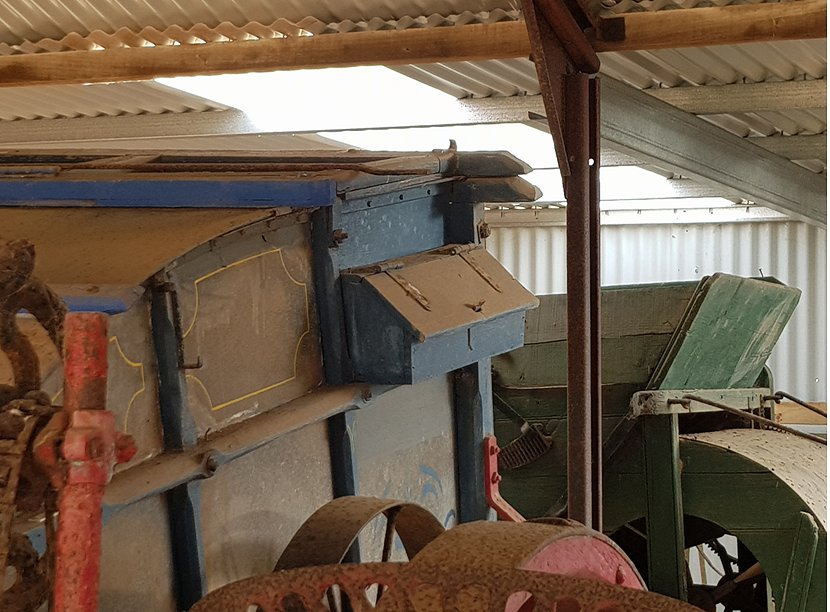
One afternoon my cousins Bill and Bruce and I nicked some cigarettes (CravenA) and headed to the old header.
One person was on duty watching the back gate through the tool box. And we puffed away. Happy as ! Nobody caught us.
We never considered how much smoke must have been billowing out of the header, nor what we must have smelt like. We were never reprimanded.???
Thoughts about Aunty Ada.
Aunty Ada was always beautifully dressed. She had STYLE. She was a very elegant woman.
She hated pretension and snobbery. I remember shopping with her in Rundle St when she was trying on clothes at one of the posh women’s fashion shops Judells. The attendant kept calling her “Modom” “Yes Modom’.. “You look beautiful in that Modom.” And Aunty Ada would look at me with her eyes wide eyed and rolling. No comment was necessary. She didn’t buy anything on that occasion.
She was an outstanding sportswoman which was mentioned earlier. In playing sport and in playing cards she played to win. There were no concessions given because I was decades younger! I learned a lot from her and had to meet her expectations.
She loved the Australian Womens Weekly and she had all the copies of them going back to the first edition I think. They were originally piled in the Engine Room and then later transferred to one of the front rooms in the original entrance to the first Kelvin Grove villa. These front rooms were almost never used. One was a spare bedroom and the other a storeroom.
In this store room there were many boxes of goods including the Womens Weeklies. I loved these mags because they had lots of photos of the Royal Family and the young princesses.
One day I opened a case in the storeroom and found it was full of brand new baby clothes – handknits and layettes. I closed it fairly quickly and wondered why it was there. There had been no mention of a baby. I never asked nor told anyone what I’d seen. I thought maybe they were presents Aunty Ada had knitted. I felt I had intruded on something private. And I had!
It was decades later when I found that Aunty Ada and Uncle Reg had lost a baby boy called John at full term. He was stillborn.
I never saw Aunty Ada pregnant and it was never mentioned to me.
I felt so sad for them and even now it makes me feel the same.
I now know he was John Mugge and born in 1949. Aunty Ada apparently had something like preeclampsia very late in her pregnancy. It could have been fatal for them both but it was only fatal for her little boy.
Aunty Ada was in Mum’s wedding to Ralph Parker in 1950.
It was only 2 years later. Auntie Ada then looked so radiant and happy but there must have been a terrible sadness inside.
I wish we had been told.
I never heard Mum speak about it. I only found out about this since she died.
I understand baby John is buried in the Blyth Cemetery with Aunty Ada.
Aunty Ada developed breast cancer – like her mother Lucy Moyle (Nee Moreton). Again we were not included in the information of her sickness until it was quite late in its development, I guess because the family found it so tragic and sad.
I do remember visiting with Mum, the Osmond Tce Hospital Norwood where she was being cared for at the end. I don’t believe I went in to see her or speak with her. I waited in the car.
She died soon after and it was the most terrible sadness I have ever felt. March 26th 1961. She was only 51!
We went to Blyth for the funeral but I think the little Anglican Church was expected to be full and so we of the younger generation stayed with the cousins at Kelvin Grove. We wept and held each other. I remember hugging Bill and crying together.
This was so emotional that I may be remembering this incorrectly. We certainly didn’t attend the burial at the cemetery. I wish we had.
Cousin Jim Longmire feels that when Auny Ada died and we no longer visited Kelvin Grove and no longer enjoyed Uncle Reg at the piano, was “the day the music died”.
It certainly was a huge ending. Many beautiful things stopped but the loving memories are very strong.
I was lucky that we still had singing around the piano at Largs, but no longer with the Uncle Reg’s Swing and all the cousins singing along.
Aunty Nell
Aunty Nell was born in Helensville NZ in Feb 1914.
She married Lawrence Bagshaw in 1938 and they settled in their first farmhouse at Saddleworth.
Her bridesmaids were Aunty Kath and Grace Bagshaw her sister in law.
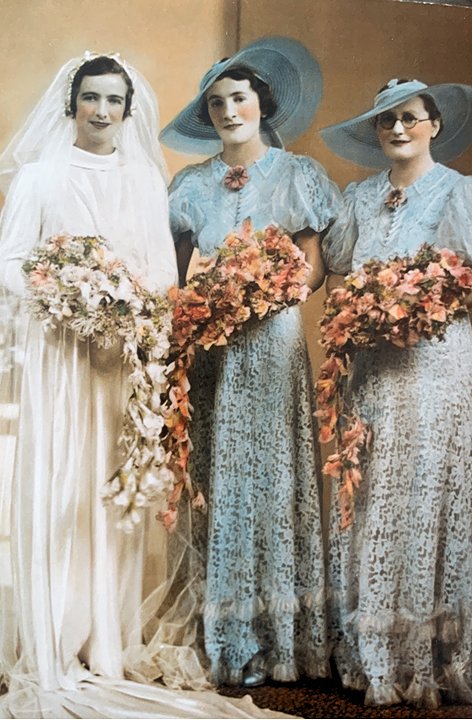
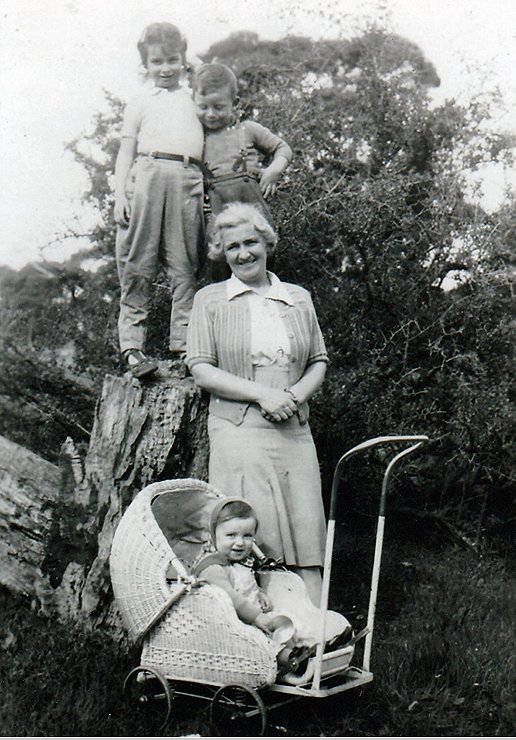
They had 3 children – Jan born in July 1940, Richard born in January 1943 and Julie born in May 1946.
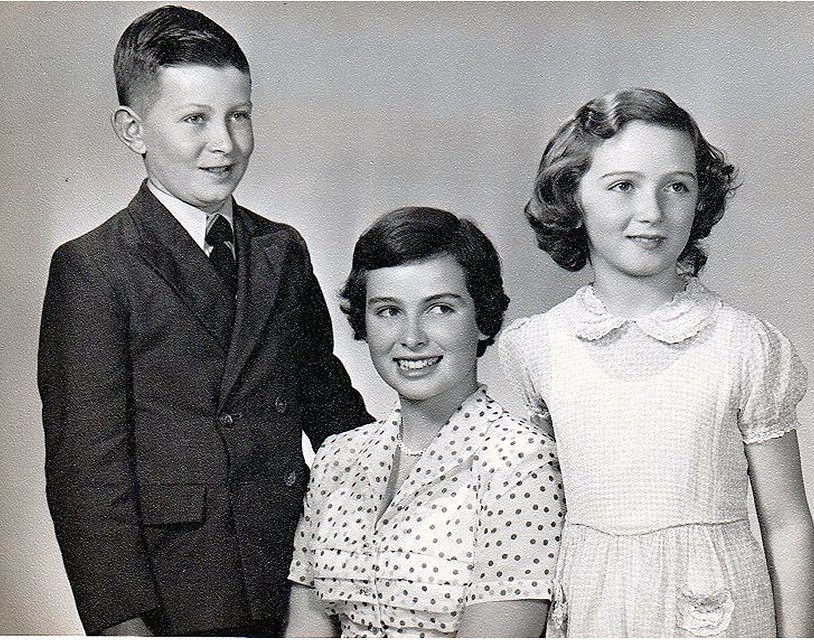
The charming photo below has graced the shelves of many of the Moyle family homes. The photographer deserves to be congratulated. No doubt he was!
It was said by me and others, that the middle-aged Nell could name and know someone from all the large towns in the Australian farmlands. They had shifted many times and this helped extend her extraordinary contact list. Her memory was phenomenal and she kept notes in her old age so as not to forget the names of people she’d recently met….and their children!
She was very popular with all the cousins and friends and relations. Her humour was infectious.
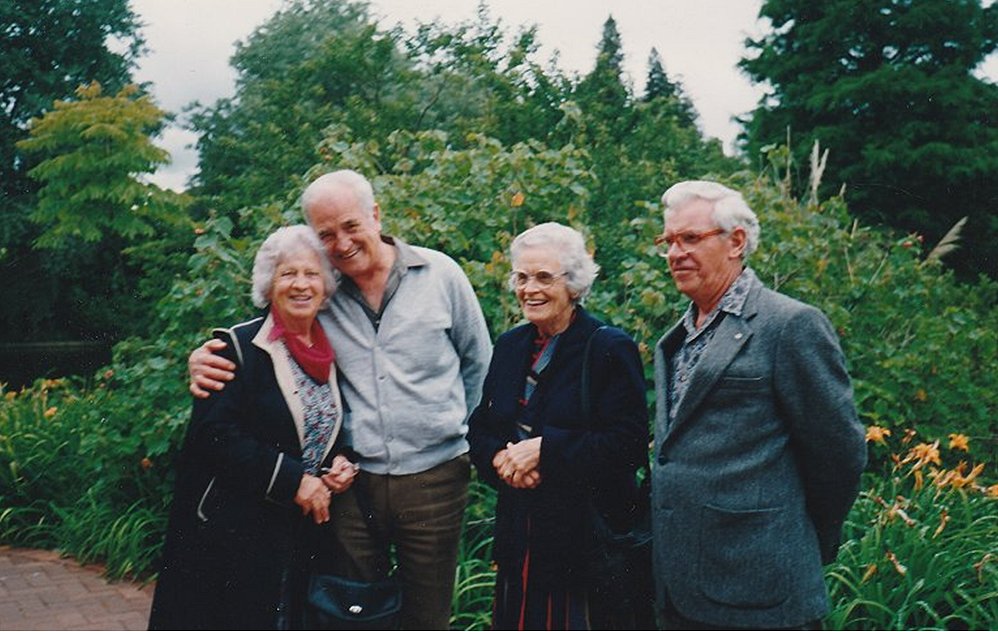
I can recall the sound of her laughing in many of the photographs – even in her old age.
For example this one which was at Christmas time in the late 1990s at Norwood.
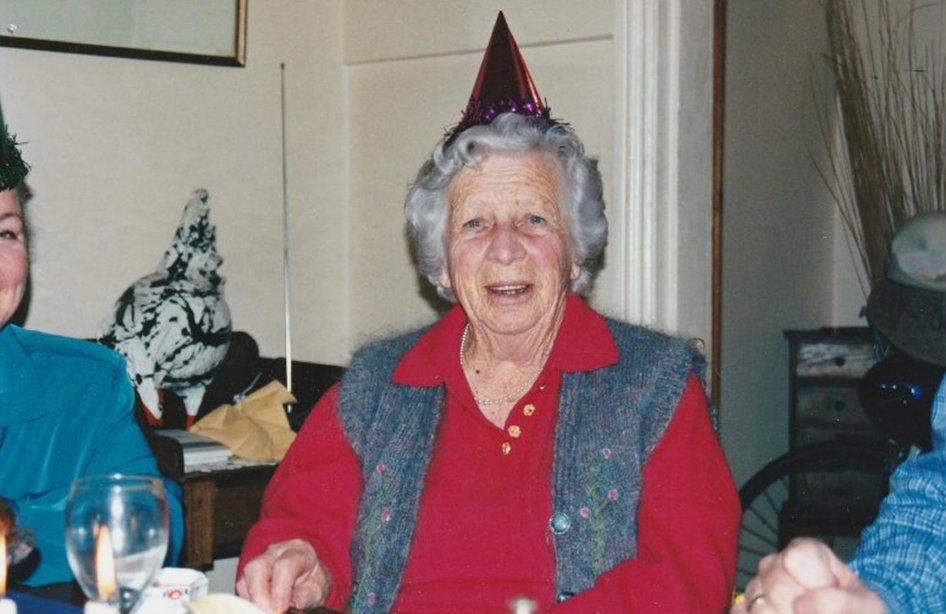
Her love of the family knew no bounds. Cousins were invited over and again and were always welcome. Aunty Nell loved people of all ages and all children. And we loved her in return.
These photos show the beauty of Aunty Nell. She went prematurely white and it was always stunning. Many of the aunts had similarly white hair including Aunty Charlie in NZ.
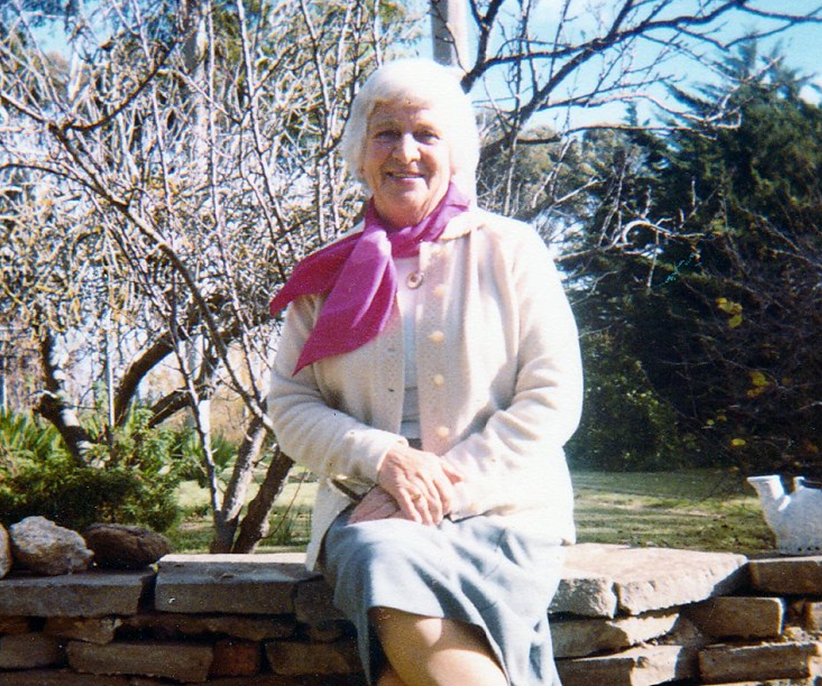
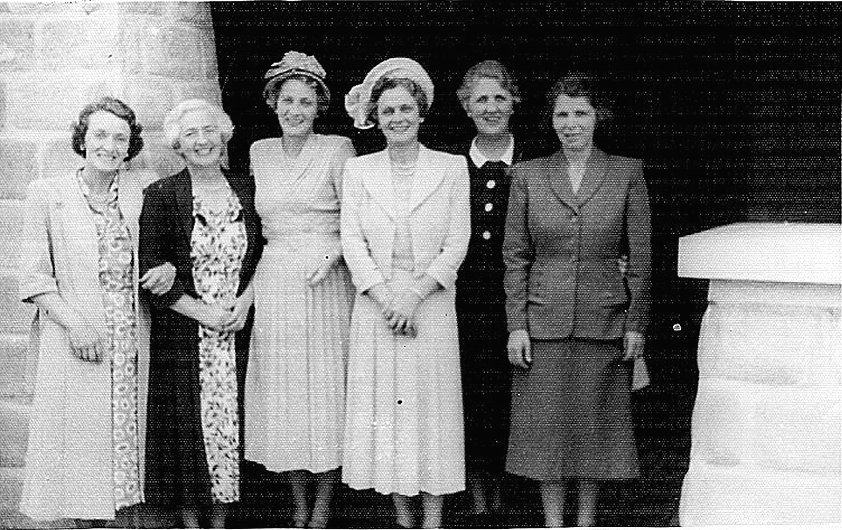
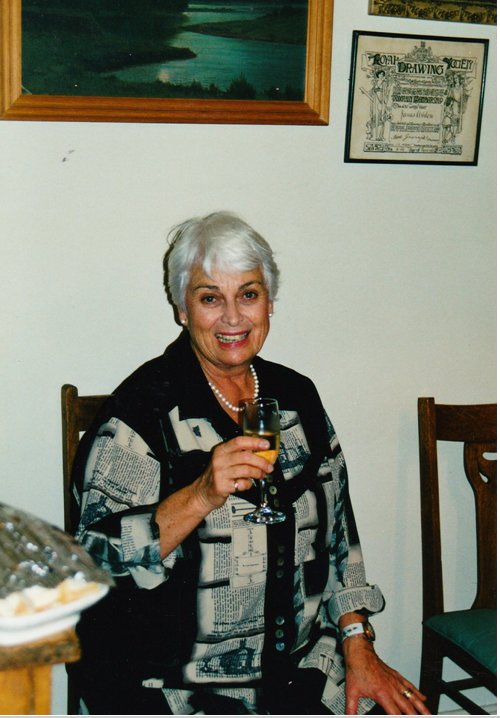
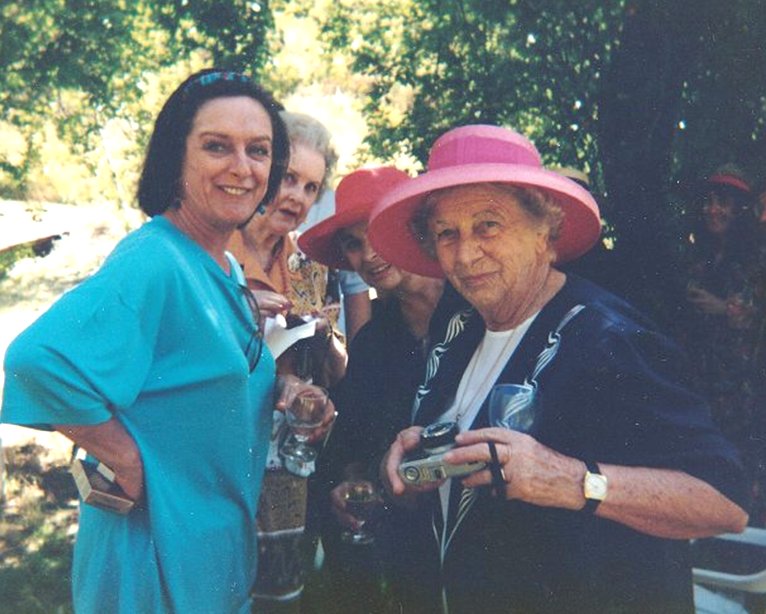
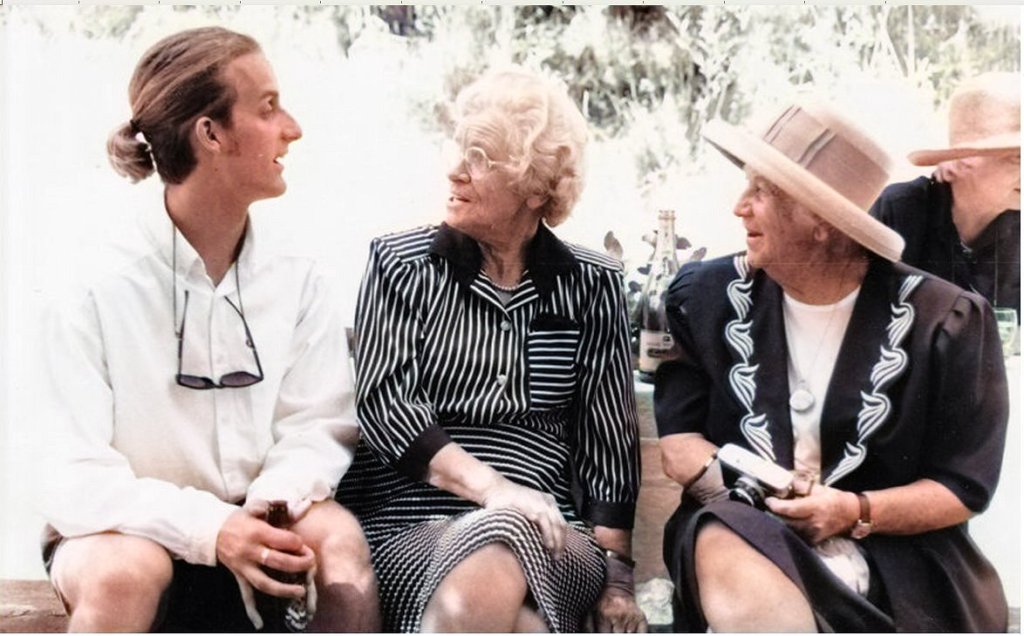
If she couldn’t make it then Jan was there to stand in for her. This photo of Jan was taken in 2002 at a farewell party to 11 The Parade Norwood – a lovely old house which we’d owned since 1974. Aunty Nell and Jan felt it was significant and I was delighted that Jan and Sally were able to fly in from Melbourne and share the event with us.
When I then moved to Willunga in 2002, Granny Parker had died and Aunty Nell flew to be with me and to stay in the new house. We visited cousin Bruce Burford at Inman Valley and she enjoyed the grape vines, the gardens, the views and the beaches. She was 88 years old and flying on her own. That was her last big trip.. It was a VERY special time. Thankyou Aunty Nell.
Back to the young Nell.
Family holidays were invariably spent in Victor Harbour. The Longmires (who we always called the Longies) and the Bagshaws (aka Baggies) hired somewhere to stay and loved enjoying the beach together.
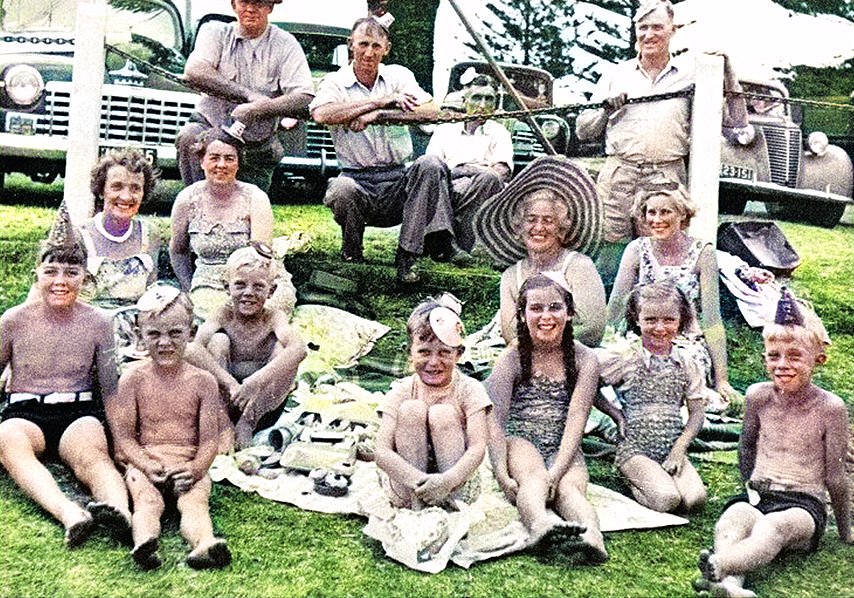
A few I can’t name but the cousins are from the left – Jim grimacing in the sun, then Bill, Rick, Jan, Julie and Ian.
What fun was had by everybody! Note Aunty Nell’s white hair at this young age. What a beauty she was!
Mum and I had one holiday with them but the Longies and The Baggies managed several Christmas holidays at Victor. The small of the pine trees, the essential fish and chips, the squawking seagulls and the fun on the beach are instantly brought to mind.
The Bagshaws kept moving properties and we, the visitors, became familiar with many areas in western Victoria and the South East of South Australia. Their friends became our friends as well.
They started with the first farm at Saddleworth in the mid-north of South Australia. I remember it as being a farmhouse with an organ in the lounge! Very little else in my memory-bank of this farm.
Rick was close to me in age and we had many good times together over the years. The following is a classic yarn in the Bagshaw/Bowman/ Saddleworth era. We have been told this but I don’t actually remember it.
The farm was very close to Lawrences parents’ farm and Aunty Nell would often walk with the kids over to Grandpa Bagshaw’s to collect some farm goods and bring them home. On one occasion, Rick and I were very young and we tagged along with our Mums to collect some recently butchered meat. On the way home, one of us would say to the other “It’s your turn to carry the bloody meat”…and then vice-versa, over and over. Aunty Nell and Mum would have been quietly exploding with laughter.
Their next farm was in Bessiebelle in Western Victoria. This was a huge shift from the mid north but we always found a way to visit them. Invariably it was because the Bagshaws were visiting Adelaide and it would be suggested that perhaps I’d like to go back with them to Bessiebelle. Would I ever!!! I was in Grade 6 when I had a wonderful holiday on this farm.
It was about this time. Jan was in secondary school in Melbourne, Rick would have been about 12 and Julie about 9.
It was a typical Victorian timber farm house with a narrow dining extension from the kitchen. It was windows on all sides and had a long table and benches that filled the space. Once in you couldn’t get out again.(I wonder if I’ve remembered this accurately). Julie was still in SA. I imagine she must have been staying in Blyth with Aunty Ada for her school holiday.
Back on the farm there were 2 horses –ponies really. Rick showed me how to saddle up the horses and to gently ride i.e. walk old Tommy while he rode Trixie. Trixie was more frisky. Tommy was old and careful with his walking which was perfect for a fairly timid city girl. Aunty Nell would come out and check us and I can hear her now. “Keep your back straight Meredith” “Ohh yes your posture is excellent. Time to try trotting Meredith.” Poor Tommy. I loved it and Tommy gave me great confidence.
On one occasion later in that holiday, Aunty Nell allowed me to ride Tommy down through the paddock to the next paddock’s gate. Rick must have been helping his Dad. Aunty Nell had confidence that I would be all right and as long as I closed the gate once through, I could keep going on. I guess there were sheep in the paddocks. I recall that I went through several paddocks and then found myself in the most glorious unforgettable billabong.
It was so quiet.
I stopped and hardly dared to breathe.
It was overwhelmingly beautiful. No noise. Just silence and stillness.
I felt slightly awkward as if I was interrupting something or out of place. I didn’t stay and returned to the farmhouse. What an extraordinary experience.
I have looked at the maps since and I felt I was heading away from the house towards the west. Only a few paddocks away. There was a little township over towards the coast which had a beautiful name. Tyrendarra. It has always been my favourite place name since that time. To me the name means “Stop and stay a while”.
On reading Bruce Pascoe’s book Dark Emu I searched for some information about our close friend Heather Builth’s research. I knew it was in the Portland area. It was actually at Lake Condor. Her research was about aboriginal eel farming. She gained a doctorate from Flinders University in the 80s for this work. On checking it out on the map, Lake Condor is surprisingly close to Bessiebelle.
The billabong I remember is probably typical of the watery world around Lake Condor.
There was no mention of aboriginal people while I was staying there.
There were many friends Aunty Nell had made in the town, including the Jewells.
Julie and Richard were winning some medals for riding at the local Show and Julie was learning Highland dancing. I think Jan had started boarding at The Hermitage by this time. It was a full life for them all and so different from the city life I knew.
Rick was becoming a good farmer by helping Uncle Lawrence. It was a sheep farm and I do remember that many of the sheep suffered from foot-rot because it was damp under foot and there was a high annual rainfall. The cutting of their diseased hooves was an unpleasant task -especially for the sheep!
There was great energy in this house and the area at Bessibelle.
They eventually sold this farm and moved to a glorious home called The Apples just outside of Portland on the road to Heywood. It was a large homestead with grand gardens and glorious light-filled rooms. I loved staying with the family here. Rick was keen on buying beef calves and caring for them. He developed quite a stud of cattle and enjoyed the challenge and its financial rewards.
I wish I had photos of The Apples to put in here
There were new friends made in this area, including the Malseeds and the Adamsons. I enjoyed meeting many interesting people through Aunty Nell and I wrote to Chris Malseed for some time. He was boarding at Wesley in Melbourne. And Ian Adamson I recall very well. “High Society” was the most popular musical of the time and we knew every word. Grace Kelly and Bing Crosby and Frank Sinatra were singing just for us!
.
What did we do all day when there on holidays? Aunty Nell would have ideas for this. At this stage I would have been in year 7 and was in very early adolescence. Aunty Nell taught me to sew on the sewing machine and we planned simple sewing exercises which included making a dress.
And we would sometimes go for a swim at The ? Way but it was so cold. The water was actually the Southern Ocean coming straight from Antarctica, and very much rougher than Largs Bay. (Every sea was rougher than Largs Bay.)
Their next farm was at Heywood. They seem to be slowly creeping a bit closer to the SA border but still a long way from Adelaide and the mid north.
At my St Albans school I had become friends with Merilyn Bagshaw. (She was distantly related to our Bagshaws.) We had a happy time dancing and being together in grades 6 and 7. In Year 8 Aunty Nell suggested that maybe Merilyn would like to join me for a holiday at Heywood. Her parents had a caravan and decided to bring us to Heywood, drop us off at the farm and then go to Portland for a holiday week or so. They would then pick us up and bring us back to Adelaide. Julie was home and Richard but Jan was at school in Melbourne.
We had a great time. Merilyn is now 80- as am I, but we haven’t forgotten the week we shared at Aunty Nell’s.
I recall a time at Heywood when there were several guests staying. There was a new little pet duckling called Lucky Ducky and somehow it got squashed under the rocking chair…Oh dear it became Unlucky Duckling …and wasn’t replaced. Whoever was rocking in the chair was instantly forgiven. No questions were asked about that. Nobody would have chosen for that to happen so no blame needed to be attached. But I’m glad it wasn’t me! It did make Julie sad for a while.
The aunts were not sentimental about animals. It is amazing that the duckling was given a name. Animals were not to be treated as humans or pets.
I had two papier mache chooks as art works at Norwood and decided to name them Arabella and ???/ So I asked Mum “What did you call your chooks at the farm Mum?” She replied coolly “Chooks Meredith”. I lost interest in naming them after that
The attitude was –
On the farm cats are to catch mice, dogs are to stay outside as they are working animals, no animals are welcomed inside. Cows ae allowed to be named as they are girls and helpful, and the ponies at Aunty Nell’s Bessiebelle property, Tommy and Trixie, were treated as though they were close to being human.
Dogs were working animals but with real personalities and their names were vitally important.
In 2009, Merilyn sent me the programme which we had created for our big concert. Just the family were invited, It took us ages to plan the concert, practise it and write out all the programmes. I will enclose Merilyn’s letter to me and also the amazing programme.
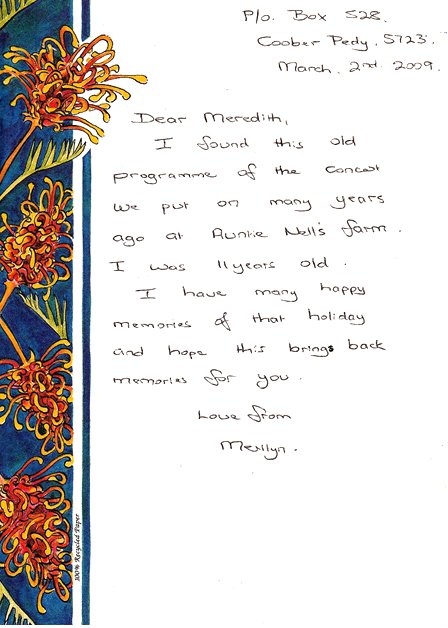
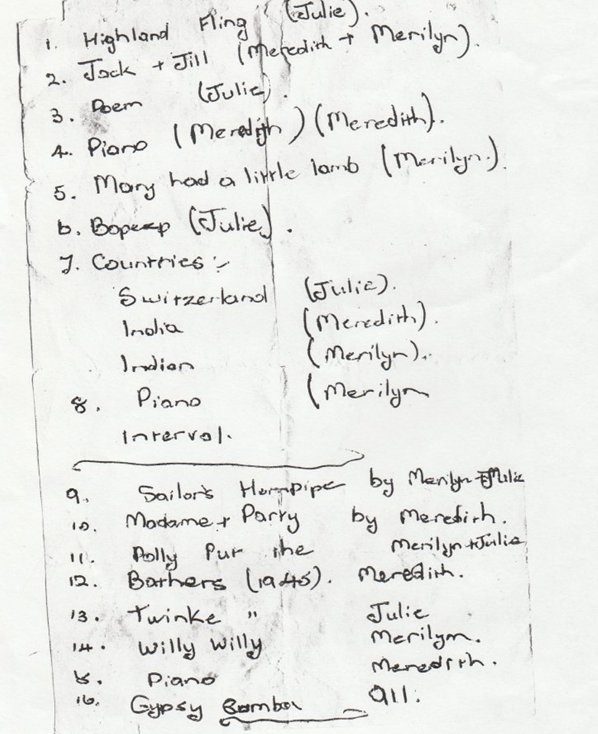
The mind boggles trying to imagine what on earth we did for these astounding numbers. Sophisticated I think not, but remembered 69 years later!
Merilyn reminds me of a very interesting ride that Richard took us on. He saddled up the horse which pulled a smallish jinker and took us out to a bush block which they had recently bought. It was wild country, uncleared and dense. On the road was a snake which Rick felt should be killed as the horse was vulnerable. We watched and were quite impressed with his certainty of how to handle such situations.
There were some other visitors coming and Aunty Nell asked me to pick some flowers from the garden and make a pleasant floral arrangement for the lounge. This was not plonking the flowers in a vase. On no. It had to be a special arrangement. I explained I didn’t know how to do it and Aunty Nell said she was sure I’d work out what looked balanced and attractive. I did my best but was very uncertain. When Aunty Nell saw it she said “Oh that is wonderful Meredith. You have a gift for such things”. I was amazed. What an aunt!! No wonder we all loved her so much.
The next farm, “Bonnie Doone”, was at Kingston. The Bagshaws had crossed the border into South Australia.
Suddenly we had all grown up. It must have been in 1964. I was out teaching and was engaged to Wayne Anthoney. It was a special time, with Jan and Mark Roberts about to be married. They were married in Lucindale and then we all went back to Bonnie Doone for a reception.
Visitors and cousins brought sleeping bags. There was a cottage where everyone could spread out their bags. We had another wonderful and memorable event.
Wayne recalls the next morning seeing a pinkish grey mushroom mornay on the table, the only thing that hadn’t been eaten and Wayne felt decidedly unwell at the sight of it.
I explained to Wayne that I could ride a horse, having learned in Bessiebelle.
Richard gave me his big steed to go for a ride. I managed to get up on it and started going for a ride but I had no control of the horse which had decided to take me on a whirlwind tour of the paddock. I was terrified. Trees were approaching and I pulled the reins to go right but no, the horse had decided to go left. Never again!
The next farm house was at Avenue Range near Lucindale. This was a lovely house. Granny Parker took our 2 children Christie (aged 6) and Tom (aged 4) for a holiday there. Tom loved farms and he loved cows. The Bagshaws had a small herd of milking cows and Tom spent a great deal of time up on the rungs of the cow fence watching them. For a small lad who loved cows, the next move was quite cruel. A cow ignored Tom, backed up towards him, lifted her tail and shat all over him.
His face, his arms,his whole body was covered. The two sisters tried not to laugh and said “No you can’t come inside like that.” They had to hose him down outside. Poor Tom. To add insult to injury the water would have been very cold as well.
He now lives very close to the Willunga dairy and at 51 he still likes cows and farms and gardens.
Tragedy struck when Julie was travelling overseas. She was killed in a motor accident in southern Greece in 1977. Everyone was devastated. Julie was a beautiful young woman, a nurse, a friend of so many and a dearly loved daughter, sister and cousin.
Mark (Jan’s husband) went to Greece to finalise official arrangements and bring her body home. The funeral was in the Anglican church in Lucindale. It was a hauntingly sad time.
Uncle Lawrence died in 1988 and was also buried in Lucindale.
Richard had married Trish Wilson and they had bought a property in Goondiwindi Queensland. There was room for Aunty Nell to live in a small cottage next to them.
It was still a beautiful life for Aunty Nell.
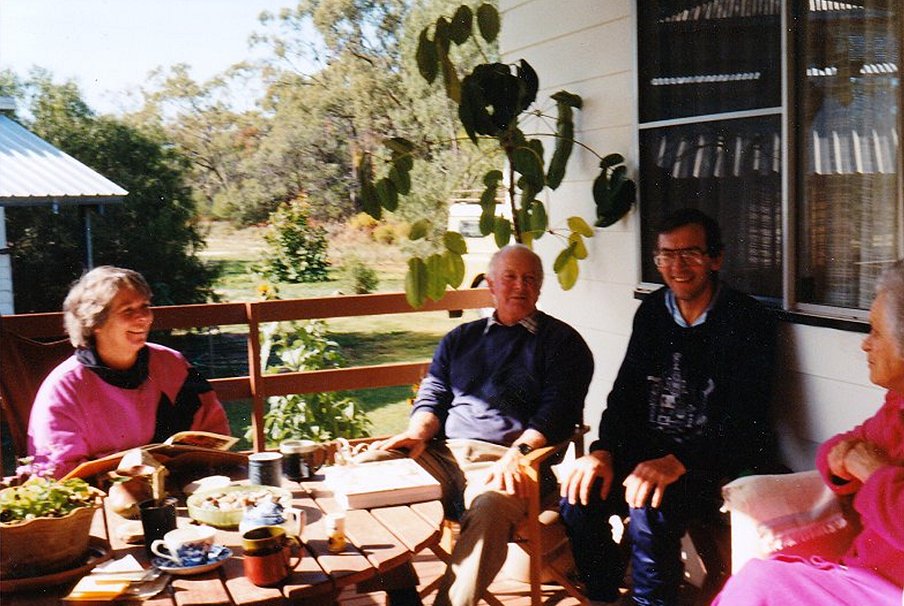
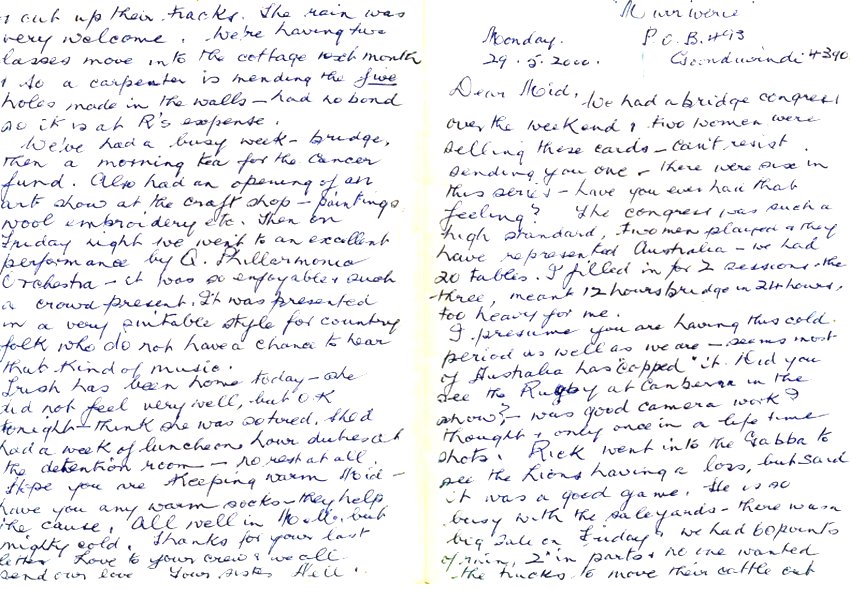
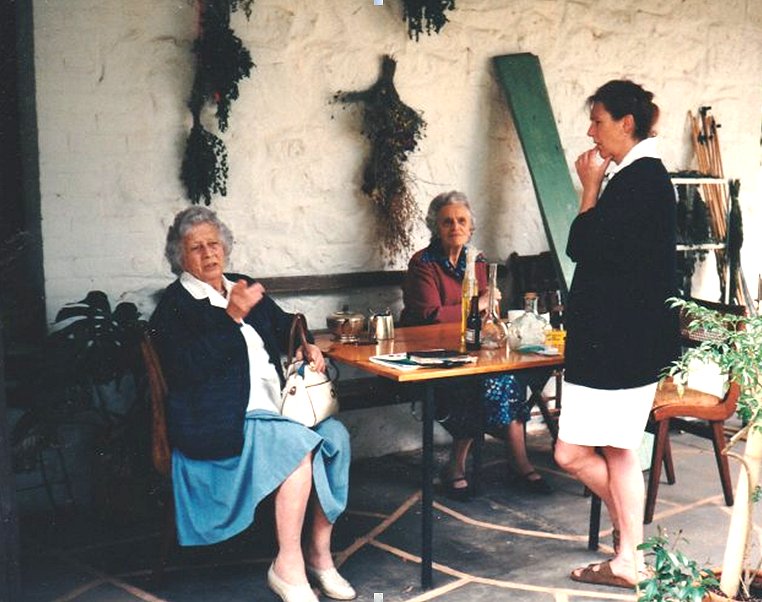
I will return soon to Mary Parker’s story because the last decade of their lives was spent with Nell and Mid being in constant touch and always visiting each other.
Granny died in 2001 and Aunty Nell died in 2011 at Maleny Queensland.
They have both given love and confidence to so many in their lives.
Vale Aunty Nell.
Aunty Kath
Aunty Kath was born in 1915 in Helensville NZ.
In 1940 she married Leslie Veitch Longmire (affectionately known as Uncle Longy).
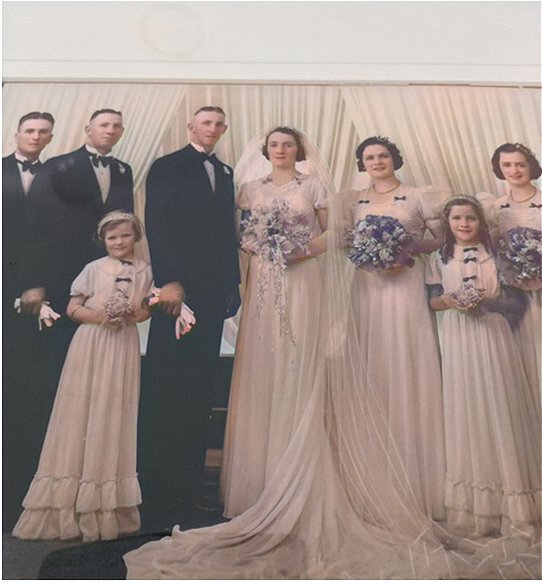
I asked cousin Jim Longmire who the men were in the bridal party and it reminded him of the following Clydesdale story.
There are stories about the Clydesdales in the Longmire file of the web page. But this famous story is worth repeating. I use the words as Jim wrote them.
There’s a long story about Uncle Stan going to the West Coast.
Dad went there in the late 1920s with the Pratts with draught horses. The Pratts had bought land there too. It was mallee country.
Dad told me that the Longies (i.e. Uncle Stan and Uncle Longy) and the Pratts walked draught horses to Wallaroo from Kybunga and Blyth respectively. I think he said they did six miles a day, so a fair few days before catching the boat at Wallaroo. To Cowell.
And a fair few teams of horses too. Probably 4 teams apiece, i.e. 32 x 2 so roughly 60 odd Clydesdale horses walking to Wallaroo. Going aboard etc.
Anyway they got to Lock and must have pulled down Mallee and planted crops.
On their return, while on the boat, one of the Pratt Clydesdales went overboard. Dad didn’t explain how it happened.
However he did describe how one of the crew was sent out by the long plank and swam under the horse. He put a big rope and doubled it under the Clydesdale and they yanked the horse back aboard.
Dad said he could not believe it – but it happened.
This is the beginning of many stories which sprang from the Longmire family at Kybunga.
Uncle Longy and Aunty Kath had 3 sons –
Ian born in Nov 1941,
William (Bill) born in Dec 1943 and
James (Jim) born in July 1946.
They were / and are my brothers. As little boys and even today.
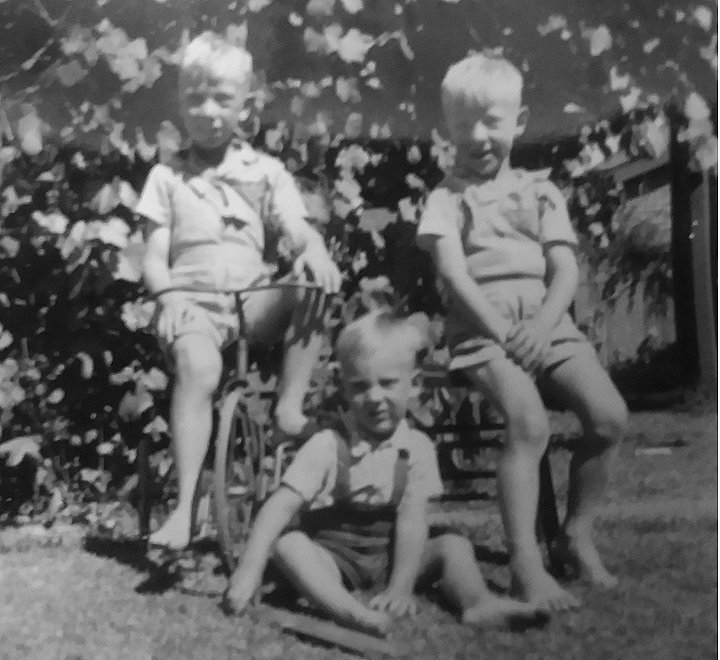
It has already been mentioned that Mum looked after Jim when he was a baby as Aunty Kath was unwell with post natal depression. Mum always felt a special bond with Jim as a result.
Aunty Kath was soon back mothering the 3 boys and living the farming life with Uncle Longy at their home in Kybunga.
The farm had sheep and wonderful land for growing cereal crops – mostly wheat.
As at Kelvin Grove there were large sheds for the draught horses and a shearing shed on the farm over the road which was also a Longmire farm.
There were no longer draught horses when I visited the family in the 50s and 60s.
Aunty Kath and all the family loved going to Victor Harbour for a summer holiday,
There is a yarn about a famous trip to Victor in which Mum and I were included. We were picked up from Clare so it must have been about 1945 before Jim was born ad before we shifted to Largs Bay.
Aunty Kath wrote of this story when she was wrote Memories of Mid for Mum’s 75th birthday party.
Here is her writing ….I am reminded that Mum often said “the Longies are always late so remember this and be prepared for it.”
In this story we had been expecting to be picked up early in the day ……..Read on …
Transcript –
Mid was our first bridesmaid. She helped us then and has been a wonderful help to Les and me over the years.
I don’t think she’ll ever forget our holiday at Victor Harbour –especially the trip down. We left Clare about 6pm instead of 6am.
Les had a Ford Tourer with a canvas hood which had a habit of getting speed wobbles and we had just started going over the Linwood Bridge when the wobbling came on and we had that all the way over the bridge!
Around Adelaide it started to rain and did it rain! There was so much water over the road as we came to Victor that we had to measure the water’s depth with a wooden coat-hanger.
However we arrived at about midnight.
Bagshaws were there but we were woken early in the morning by the milkman to say that our Ford was smoking.
Les had put a bag over the engine!!!
I remember this story being repeated whenever we went over that bridge!!
There are more lovely compliments to Mum which I will include.
When we lived at Mill St Clare, Mid was really good at polishing the candlesticks, door knobs and Dad’s boots ready for Church on Sunday. Consequently she still likes polishing her silver. (Meredith comment JOKE!! I don’t think we even had any silver!)
Schooldays at Watervale and I felt very proud and fortunate in having a sister teaching there. (Meredith comment -Junior Teaching) Mid used to ride Spotty our piebald pony in to school then tie his bridle up and send him home to “The Sheoaks” so I could ride him to school. Spotty would always come straight home – well almost always.
It was certainly a challenge for Mid at 18 to be posted to the little New Way school. As one of her first pupils Howard Simpson said recently “How times have changed since then. I still think it is rewarding to have been through those times.”
The days and years have passed by Mid, with skies sometimes blue and sometimes grey but all Les and I can say is – (to quote Helen Steiner Rice)
“It’s a wonderful world
and it’s people like you
Who make it that way
by the things that they do”
Happy Birthday and Congratulations Mid
The sweetness of Aunty Kath’s personality and the love which came from Aunty Kath are evident in these writings.
There were many holidays shared with the Baggies and assorted friends.
These photos are well after the birth of Jim so the holidays had been happening regularly for many years…(no doubt after reaping was over.)
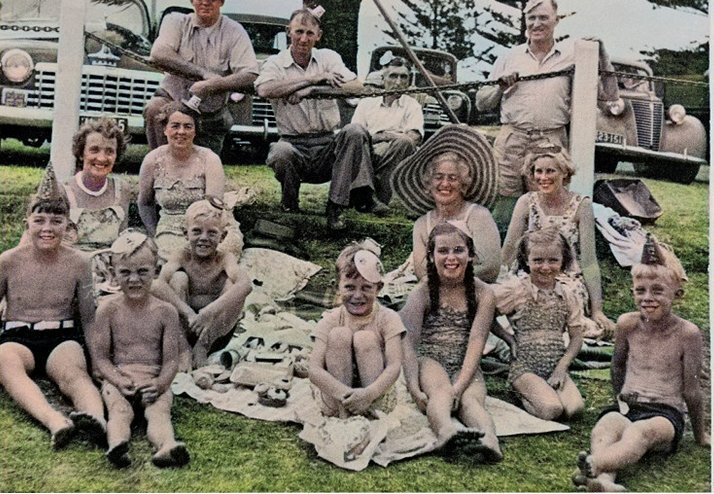
The Longies and the Baggies plus others I don’t recognise. Do you know them?
I notice how very happy Aunty Kath and Aunty Nell are.
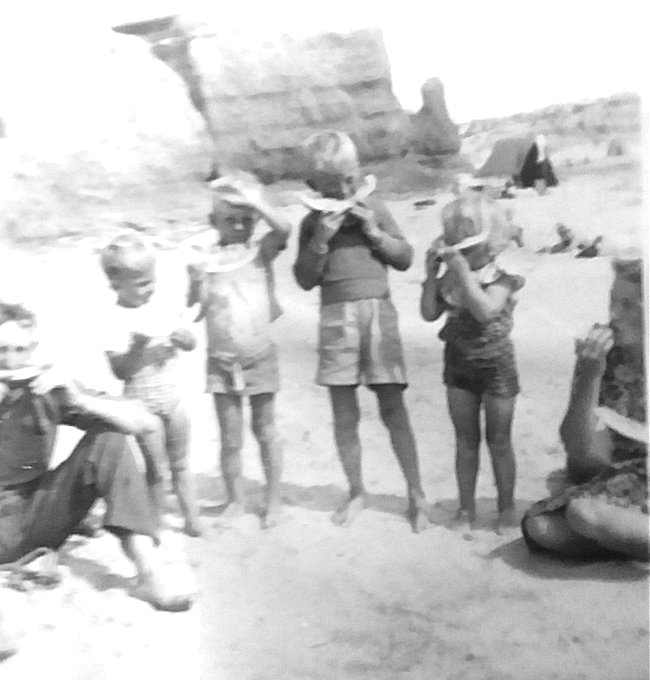
This beach looks memorable. Where is it?
There were many I didn’t know or remember in this next photo so I asked Jim if he knew anyone and he responded immediately. Thanks Jim.
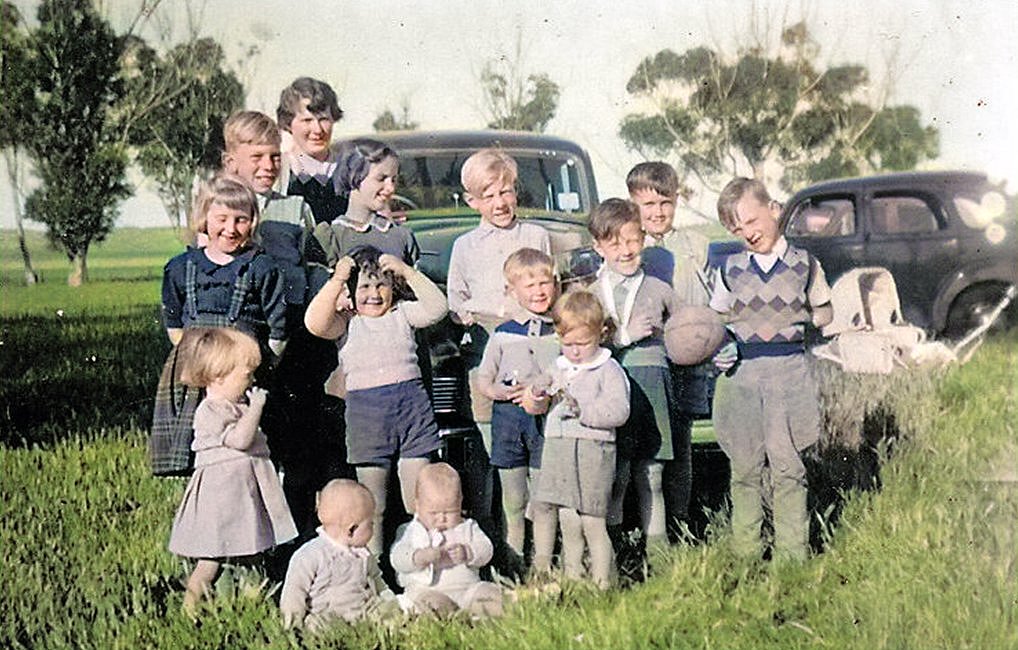
This is a picnic somewhere near Kybunga
At the back is Heather Evans who was a Kybunga neighbour
Then Ian and me (in the dress I wore to Mum and Ralph’s wedding so 1950ish is the year of the photo) then Bill and David Gardener.
Next row is Gay McSkimming, Peter Clark, Dennis McSkimming and Jim in jodpurs
Front –Denise Kernot, and the Woods twins Maybe.
The Kybunga days were always good fun. Often we’d get together when I was staying with Aunty Ada sometimes at Kelvin Grove and often at the footy matches on a Saturday.
I recall staying there when I was an adolescent and Aunty Kath gave me the big spare bedroom at the top of the house. It had their wedding photos on the wall and a couple of Blodwen Thomas photos of the boys.
This is the famous photo which we all had.
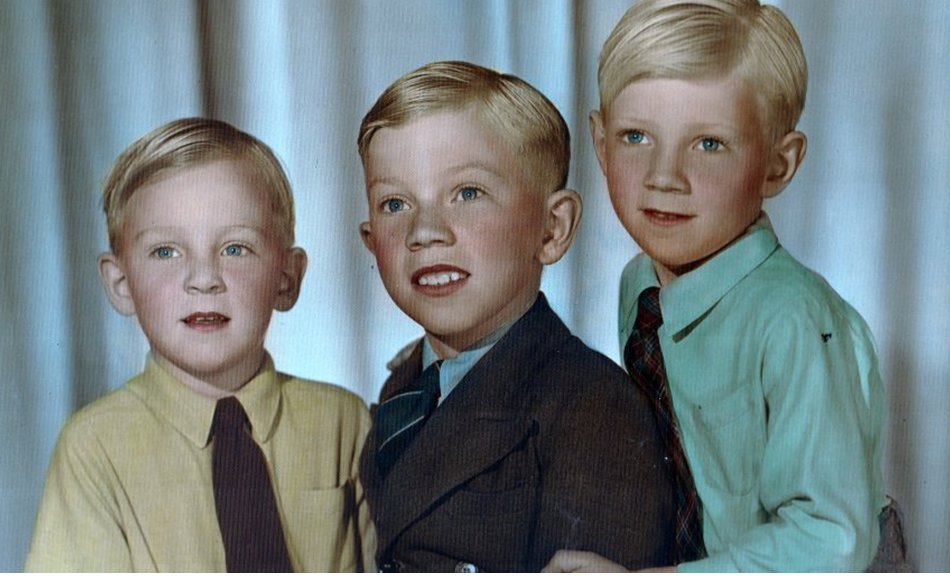
However this is how I remember them – ready to get in to Cricket or mischief…but clearly dressed ready to go out somewhere…Off to Blyth for some food shopping?
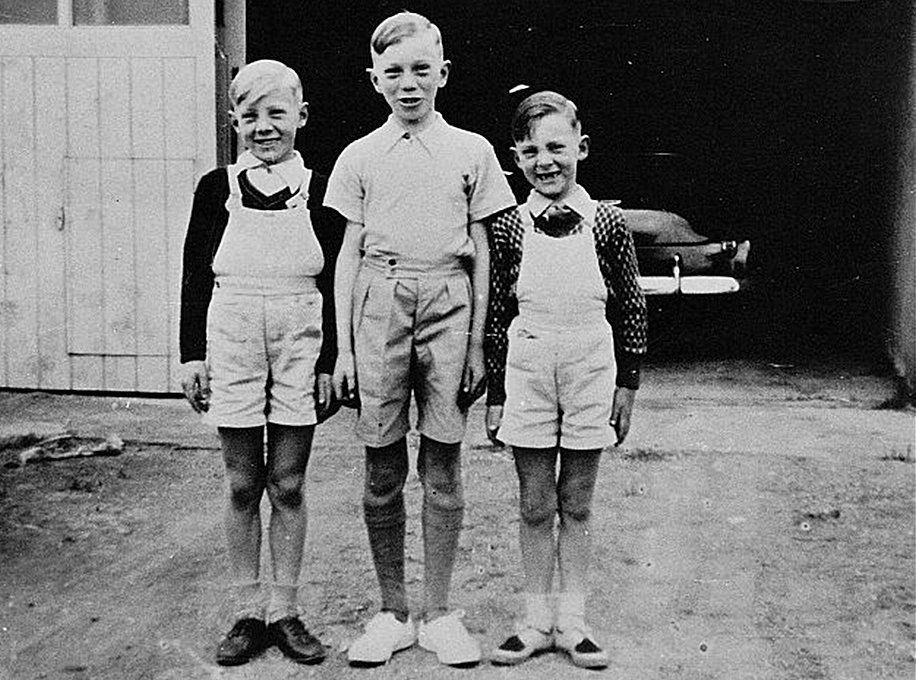
We were all terribly sad when Aunty Ada died. It left a huge hole in all our lives.
I remember staying with them much more often in the later 1950s and 60s.
Many a summertime we would be staying inside because it was over a 100 degrees outside with a hot dusty northerly blowing.
We would lie on the carpet by the radiogram. A wonderful new acquisition. Buddy Holly was playing over and over again. “That’ll be the Day” “Peggy Sue” “Maybe Baby” “Every Day” etc.
The Longies also had a pianola in the lounge. So we could play many difficult pieces with no effort at all. It was also the time of the musical “Okalhoma” and we loved singing “Oh What a Beautiful Morning” “The Surrey with the Fringe on the Top” etc.
Of course there was always test cricket on the radio and I tried to be interested in that But I felt it only came to life when someone got out and then boys would explode with delight or horror.
Ian is ready to start at Kings and they visited us at Largs Bay to before the new chapter.
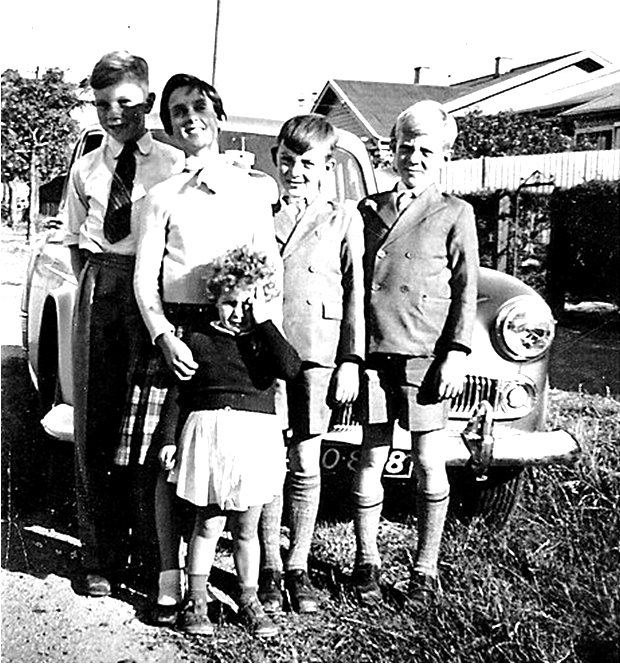
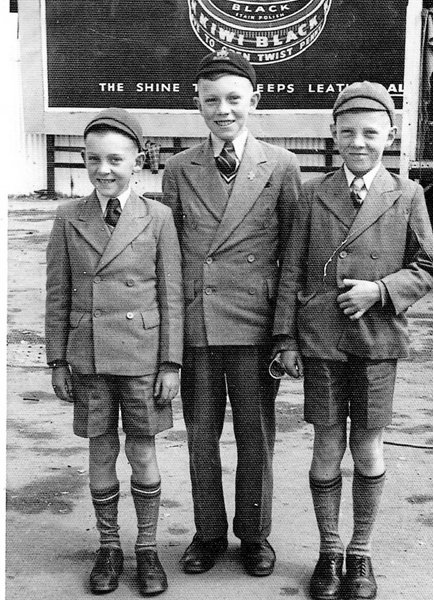
Sometimes one of their school mates would come and stay at Kybunga too. It was daisy air gun time and they were shooting pigeons in the old sheds. This was unusual but seemed to be fun. I only tried to use the daisy air gun once and never ever again!!!
Later Ian showed me how to drive in the paddocks and on the dirt roads in the family ute. I guess I was 16. It was good practice but I do remember taking the corners too fast and Ian doing a “Wahoo” which meant “be more careful” in English.
Once when I was staying at Kybunga, Aunty Kath took me to visit Aunty Rose in Clare. I hadn’t seen her since I was quite small and it was special to see her resettled in her Clare house and garden. I think it was 1961 and I was on Uni vacation.
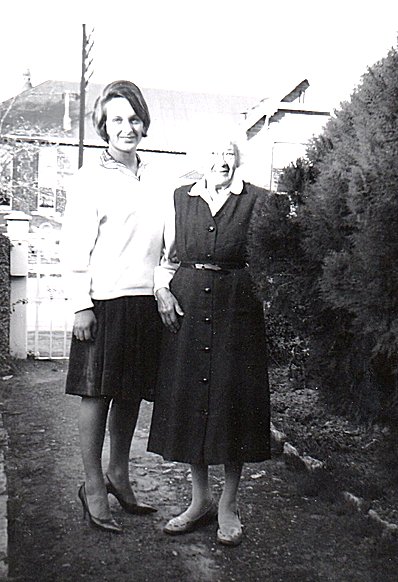
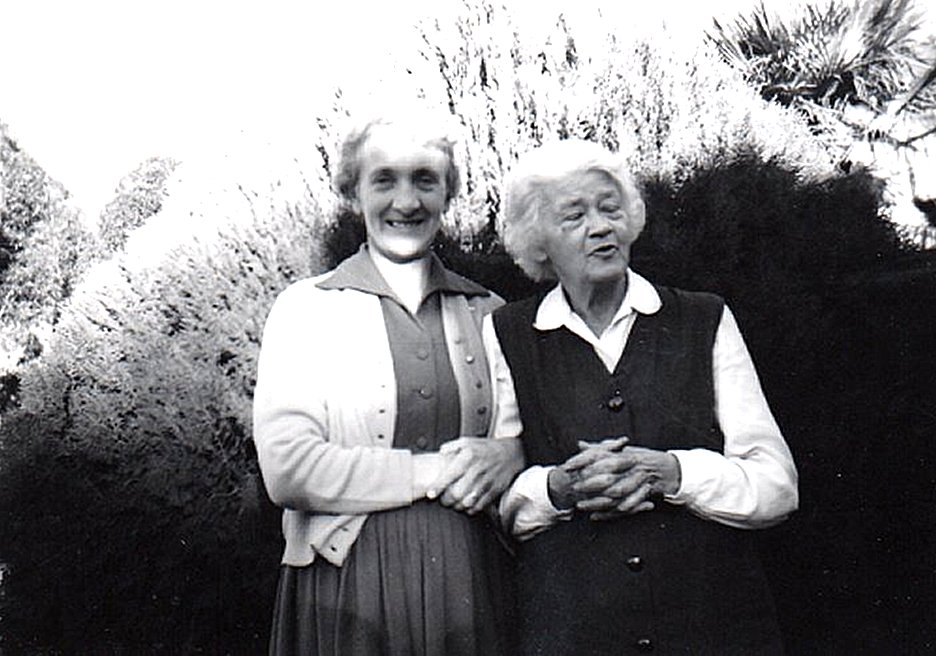
Aunty Rose died in the 1960s. Does any one know which year?
When visiting in the holiday times in the late 50s, I had to take some clothes in order to dress up for the local dance on a Saturday night. It was necessary to have a crisp cotton dress, stockings and moderately high heeled shoes.
The Military 2, and The Pride of Erin and the Canadian Barn dance were a delight. And supper time with the butterflied cream cakes was enjoyed by the girls. The boys often seemed to disappear for the supper break. I thin there were beers down behind the trees somewhere.
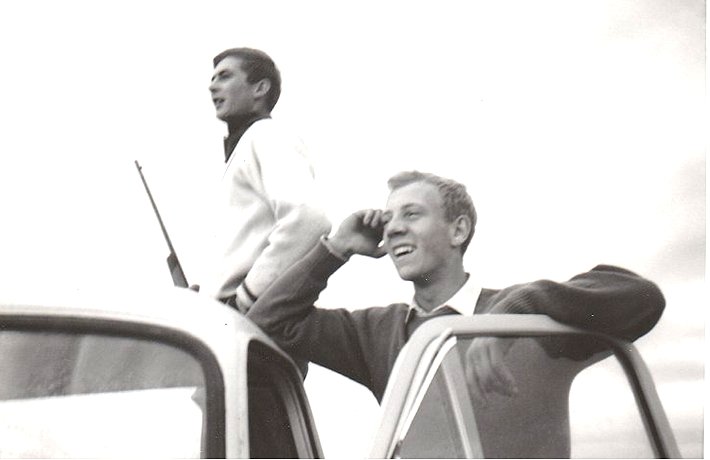
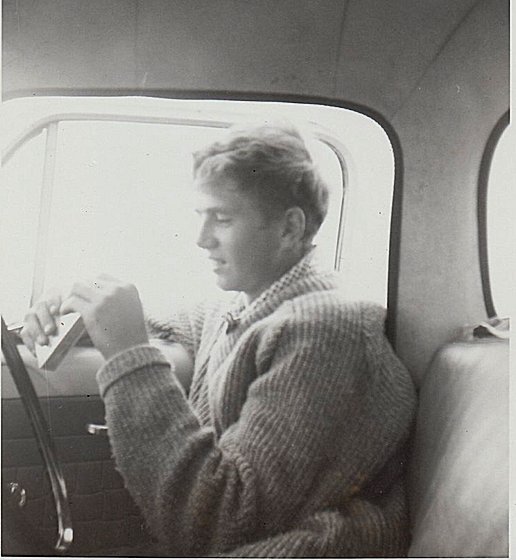
On one occasion in the 60s, I went rabbiting with Ian and Bill and their mates.
Bill and Roger rabbit hunting.
Peter Pratt became a good friend,
We played mixed doubles in the Blyth Easter Tennis Tournament and won.
Our prizes were 2 sets of plastic egg containers. I never won a tennis tournament again. Probably Peter didn’t either.
I still sometimes speak to him on the phone, so I will check this assumption.
Back in the 70s we had to ring the exchange in order to be put through to country friends or relatives. Later we could ring the exchange just to get the correct telephone number . On day I rang and asked for Peter Pratt of Stanley Flat’s number and the girl said “Oh Uncle Peter…Yes I love visiting him.” The conversation was brought to a halt but I was amused. Very South Australian to know each other all over the countryside. How different are the phone connections these days!!
A connection was made in the 60s with the lovely John Harvey.
I met him through these young men and they have all remained friends over the decades.
We also had a celebration at Peter and his wife’s house at Stanley Flat for Mum’s 80th birthday in 1991. More of that later.
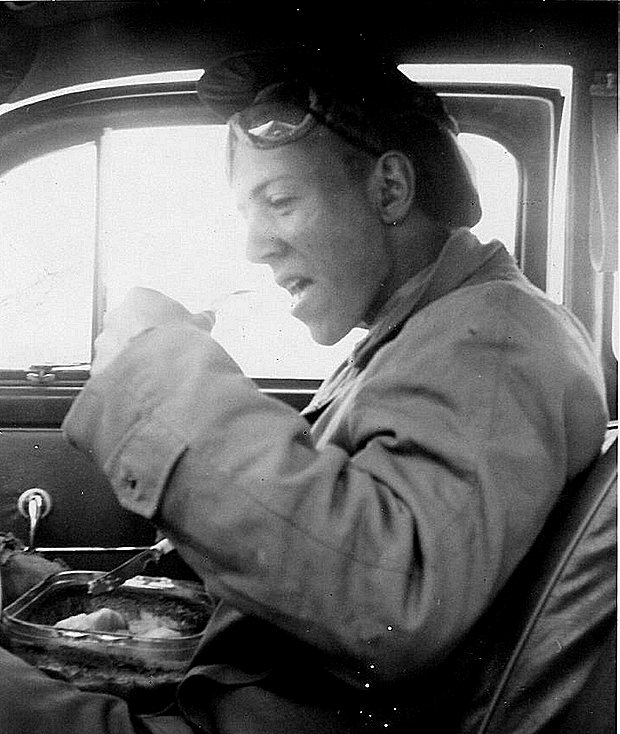
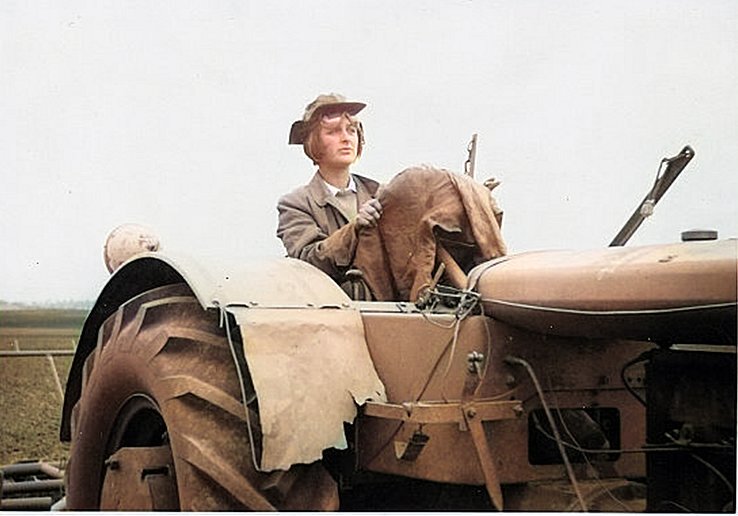
Bill often had to do some ploughing so it was good to drive out to him with his lunch and sustenance. It felt like belonging to the farm. Which I loved. Bill was another brother to me.
Aunty Kath and Uncle Longy eventually decided they needed more land. The boys had finished school and so they sold Kybunga and moved to Moree in NSW.
Ian was married and settled into his new life with Chris Banks.
Next Bill married Helen Best and they chose to start a farm in Keith SA. The children and I visited them on he farm on several occasions.
Jim married Tempe Hornibrook and proceeded to extend his Armidale studies by going to Uni of Newcastle in UK to complete his PhD. He is the only male PhD in our family. (Molly’s daughter Jenny has managed to gain a PhD as well. There are only 2 such high awards in the family at this stage. But many are famous for other reasons.)
When Mum died in 2001 all the Longy boys came to the funeral. They had to travel from WA and Queensland and NSW. But they felt Aunty Mid was like a second mother to them and of course they would want to be here at her funeral.
Jim at Norwood
.
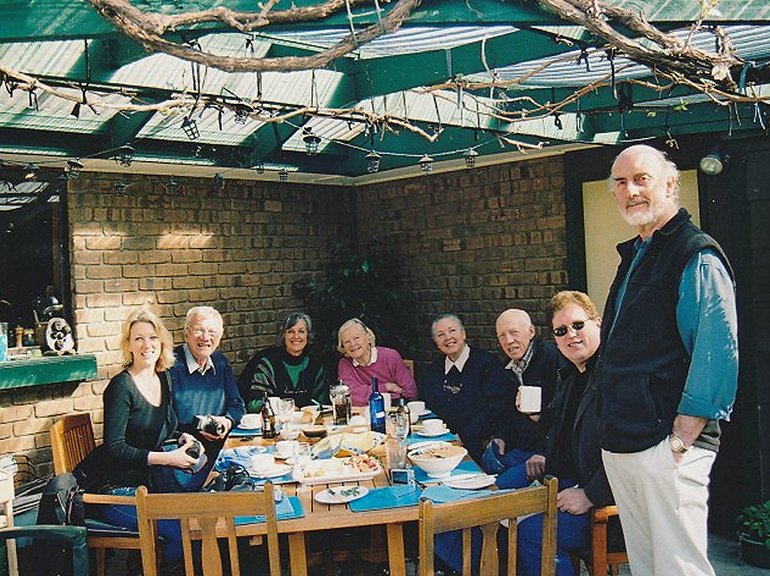
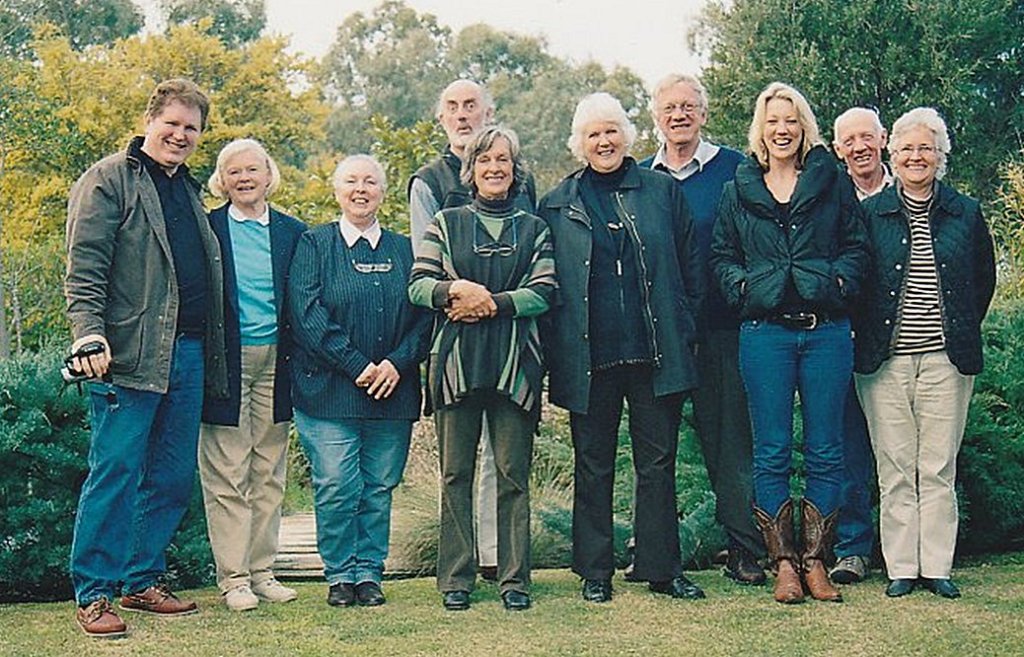
Ian and Chris and Bill visited us in our Willunga house in 2004 or so.
.
Wendy was able to join us and it was a lovely reunion.
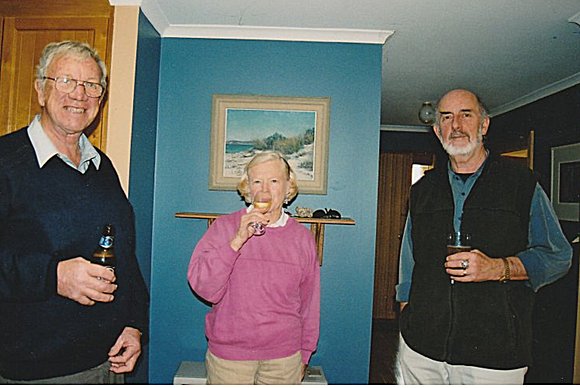
Ian and Chris had settled in WA in Esperance. He had discovered and researched many historical facts of our family. His daughter Sue is continuing with this family interest. Their records have helped me in writing the story of our early settlers.
Jim visited me in Norwood several times and again when I shifted to Willunga. He has been and is still like a young brother to me.
I think he was off to a Kings reunion here, but occasionally it was to speak at an academic Ag Science group.
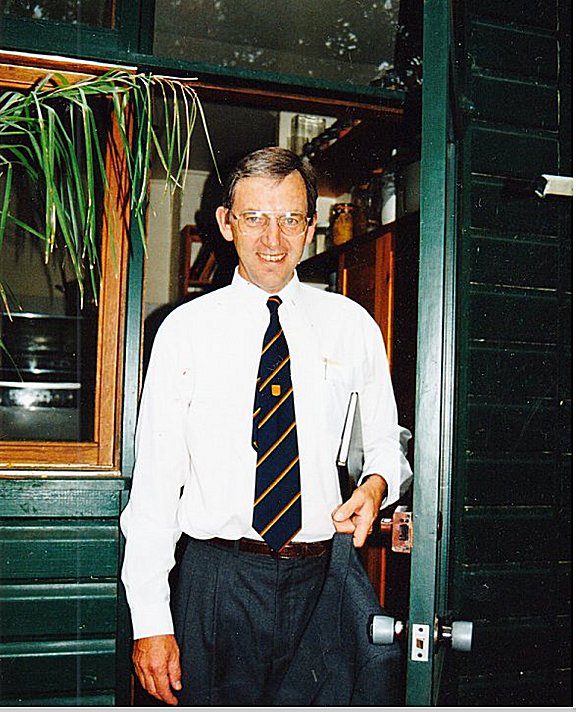
I was on study leave in 1994 and stayed for some weeks with Jim in Indooripilly. Uncle Les, now a widower, always stayed there for awhile. Jim took me to a huge concert starring Garth Brooks. I’d never been to a large pop concert. And I’d never heard of Garth Brooks. Nor had I ever been on the back of a motorbike until this event. It was a great night. Thanks Jim. Country music is ok.
Jim visited us often over the past few years and was a great help when we were preparing to leave our house in the golf course area of Willunga. He came for my 70th birthday in 2012 and stayed on to help. We shifted in 2014 and Jim has stayed here a couple of times since then. He helped me a lot with the research into the Early Settlers section of this writing.
Aunty Kath and Uncle Longy always lived close to Bill and Helen and their grandchildren. Over the decades they all shifted from Moree, to Keith and then to the Noosa area.
There are many stories of these 3 sisters together but one very funny story was when Aunty Nell and Mum stayed with Aunty Kath and Uncle Longy in their unit in the Noosa area. At this time the sisters were all in their late 70s and Mum was close to 80 years old.
It was a small unit without a bedroom for the two visitors. They were happy to sleep on the floor in the lounge. They had mattresses and were quite happy about it until 3 in the morning when one whispered to the other “I need to go to the loo and I don’t know if I can get up” . “Oh No Me too!!”
Giggles led to muffled hysterics as each tried unsuccessfully to stand up and control the bladder at the same time. (Makes me laugh just writing about it.)
Then there was dear Auntie Kath’s soft voice from her bedroom “Are you girls alright?” Well you can imagine that was the final straw. They screamed with laughter and sought help from all willing participants. And the story lives on.
Aunty Kath loved being a grandma and she and Uncle Longy had 12 grandchildren.
Of these grandchildren there are 6 boys and 6 girls.
Aunty Kath was proud of all her grandchildren.
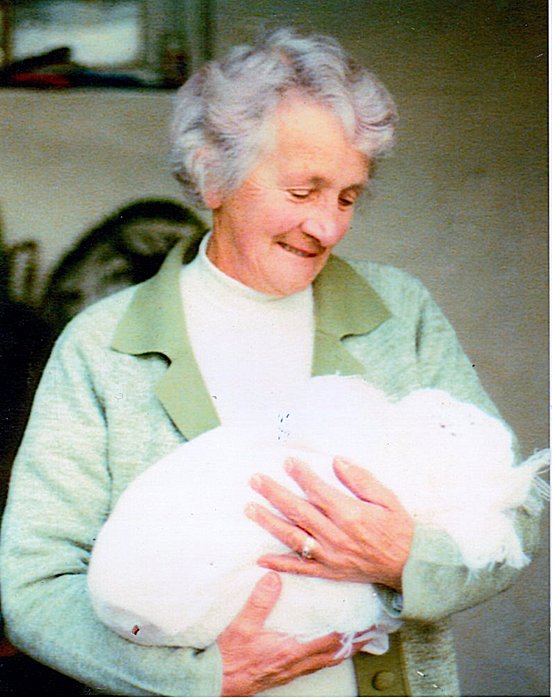
Between these 12 there have been many offspring and now there have been 26 great grand children born.
(A family chart of the Generations following the Famous Moyle 8 has been compiled of cousins, grandchildren, great grand children and great great children. It is in the Moyle Family file.) Wayne can we cross list it? And I need to complete it.
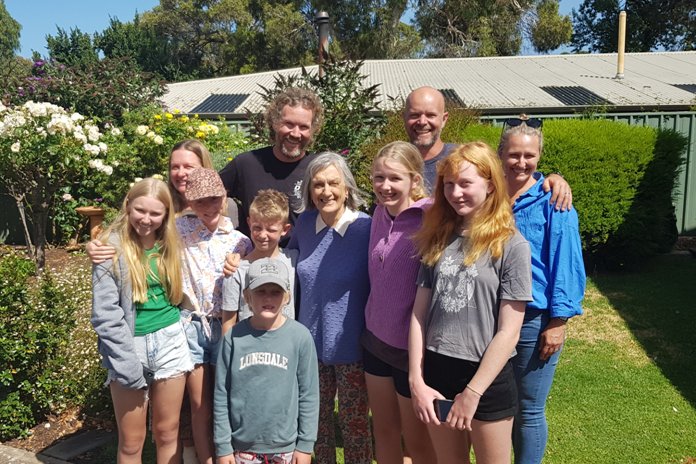
To my delight this year January 2023 Wayne and I were visited by 2 of Aunty Kath’s grandchildren with their wives and their children.(6 Great grandchildren) . They were all holidaying together and took time out to visit us. It was a joy to be with them..
I was reminded of all our cousins in the 1940s and 50s having family holidays together. Such fun. The grandchildren are Scott on the left and Neal to the right and their wives, Janelle and Ali.
They were so loving and happy. Thankyou all for visiting us octogenarians.
Aunty Kath died in 1993 and Uncle Longy in 2000.
They are buried in the Clare Cemetery.
The flowers were beautiful- mostly natives as I recall.
And there were magpies nearby at Aunty Kaths burial place.
Both had beautiful funerals in the Uniting Church in Clare.
Uncle Longy even had a rendition of the Blyth Footy Club’s song.
Valet Aunty Kath and Uncle Longy.
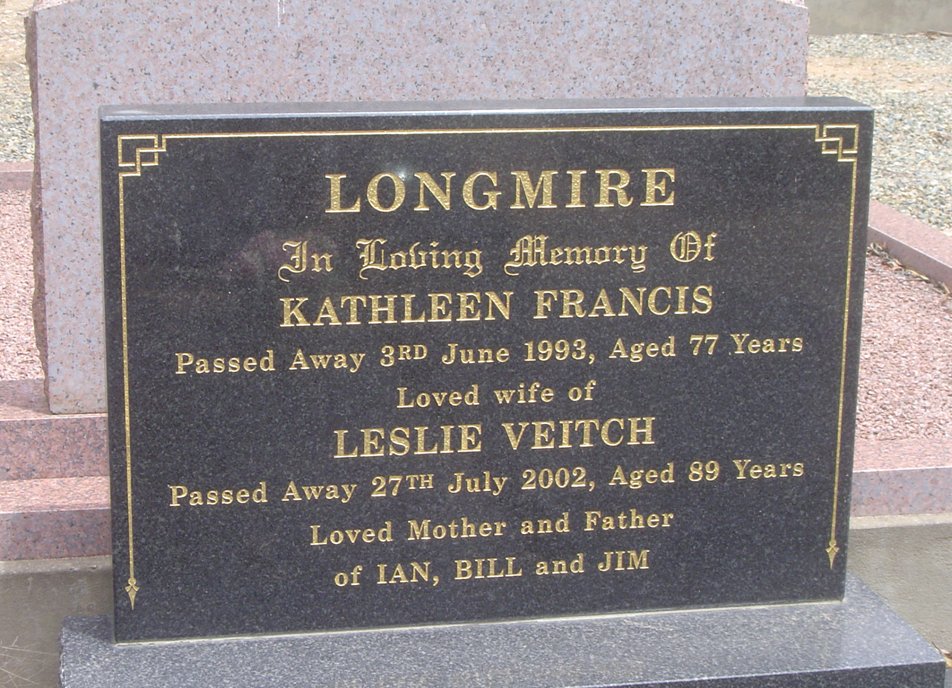
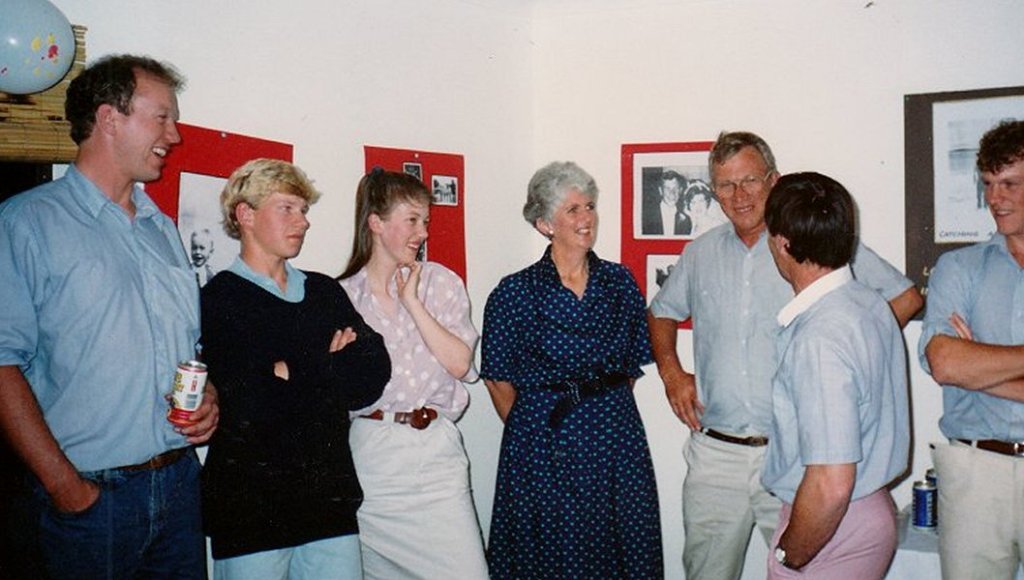
Ian was suffering from Prostate Cancer and he died in Esperance in 2008.
.

