This informative and fascinating little book was was written by William Roach Morton and published in 1997
CLARE, SOUTH AUSTRALIA
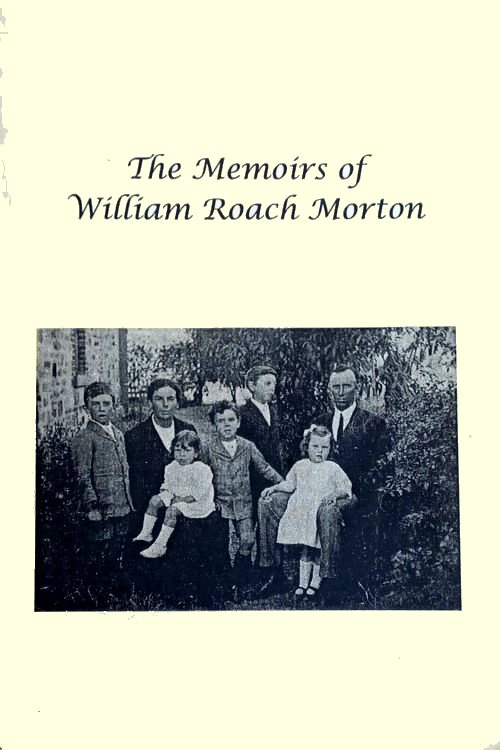
My Father’s name was Thomas William Morton and he was born at Condowie, South Australia. My Mother’s maiden name was Mabel Ellen Roach and at the time of marriage she lived at White Hut, Clare, South Australia. I am the third child in a family of six children. The names of the other children are, Mervyn (deceased), Gordon (deceased), Daphne (deceased), Elwyn and Bernice.
I was born at Clare, South Australia, in the year 1916. My mother told me that when I was born the doctor said, “Goliath of Gath! What a baby!”. I weighed 12 lbs. He tied the umbilical cord and then cut it on the wrong side of the knot. The midwife, Mrs Waller exclaimed, “Good God, Doctor, what have you done?” I nearly bled to death before things were remedied.
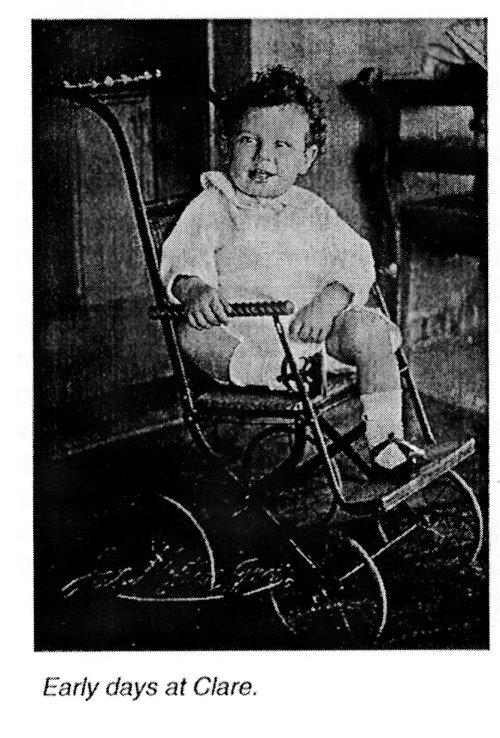
At that time my parents were living on a vine-yard a few miles north of Clare at Stanley Flat. It was while living there, a couple of years before I was born, that my Father bought his first car in 1914. It was a T model Ford. Henry Ford, the maker, used to say you could buy any coloured Ford car as long as it was black. The car was bought in Adelaide and the salesman taught Dad how to drive it by ac-companying him back to Clare, a distance of about 90 miles. Upon arrival there the salesman returned to Adelaide by train and Dad proceeded to drive home, but on the way the two straps which attached the roof of the car to the front mudguards jiggled undone. Dad looked behind to see what happened to the roof and veered into the embankment and broke a front axle. I never heard how he got the car home.
My Father sold the Stanley Flat property and moved into Clare, and, as far as I remember, we lived for a short while in a two storied house in Main Street, Clare, and then moved to Mill St Clare. Dad had an office in Main Street, Clare, and was involved in buying and selling property. Our grandparents, on my Mother’s side, lived at White Hut so we visited there quite often. When I was five we moved to Adelaide to live and Dad continued there buying and selling property. This meant that we had 5 moves in 5 years as he would buy a house, move in, and then set about selling it.
LIFE IN ADELAIDE
As far as I can remember the first Adelaide house we lived in was in Le Hunte Avenue, Prospect, and it was from there that I started school at the Braund Road Primary School. From there we moved one street to Beatrice Street where the house was on two blocks, half of the land being taken up by fruit trees. One night shortly after we arrived, maybe about a week, Gordon and I were just about asleep when the previous owner’s dog got through a hole in the wire door and came into our bedroom shaking itself most violently by the side of our bed. We both flew out of bed, and the dog took off like a bolt out of the blue, but burst into the dining room and yelled, “There’s a dog in our room!” No doubt we gave our parents a big scare, and Dad’s reaction was to march us outside to look for the dog. I wasn’t very impressed by this. In fact, I was scared stiff.
A point of entertainment when living there was to watch the man over the road as he backed his truck out of the driveway His wife would stand at the front gate and run from side to side yelling directions as to which way to turn the wheels.
One night Mervyn and I were sent up the street to post a letter. We had to go to Prospect Road and then along to the Tram Terminus for our nearest shops and post box will, Mervyn ran ahead while I chased him. When we got to the terminus he ran over the road to the post box and I followed without looking to see what was coming, with the result that I was hit by a car, which was driven by the local butcher, Mr Cain. People who saw it happen said they saw the wheel go over my head, but I doubt that as it was a heavy car. It also had a large flywheel which nearly touched the ground so it was amazing that I wasn’t crushed by that.
The bystanders dragged or carried me into a Chemist shop that was open and told Mervyn to go home and tell our parents what had happened, but not to frighten them. Mervyn went home and just sat down in the room, and when Mum asked where I was he said, “He got run down by a car and is in the Chemist shop.
I do not remember any of what happened but was told about it. I was taken home, I don’t know how, because I was unconscious. When I came round six hours later my first words were, “What hit me?” My face was so swollen that I couldn’t see out of my eyes for a couple of days. One of Mr Cain’s sons attended the same school as I and he told me that when I was hit his mother jumped out of the car and ran home screaming, “We killed him”. They were very good to me and brought around custards and jellies each day as I had a green stick fracture of the jaw and could not eat solids for awhile.
I think it was at Beatrice street that Elwyn (Topsy) jumped off the sofa and a needle pierced her shoe and foot. When the shoe was removed part of the needle broke off where it was embedded in the joint of a toe. The doctors spent two hours operating and this left a badly mutilated toe which gave her quite a lot of bother later in life. After the operation Elwyn contracted blood poisoning and we had a registered nurse in the home for about a fortnight attending to her.
There wasn’t much that was outstanding at School. I was only an average student. In grade seven we had to sit for a qualifying certificate. As I wasn’t doing too well, Mother saw the Headmaster and asked if I could repeat year seven, but when it came to the exam I obtained 550 marks out of a possible 700.
Across the road from the school was a place we always called the pug hole. It was a paddock of boxthorn bushes and holes where soil had been removed. When two boys wanted to settle their differences after school the word went around, “Pug Hole tonight.” We saw a few “fisty cuffs” there and they generally finished with a couple of blood noses.
We had to pass the local Catholic School on our way to school. There was much taunting of each other and sometimes stones were thrown, though I don’t remember anyone being hurt. One day at school a boy was hit in the eye with a piece of orange peel and lost the sight of one eye. The school buildings were built around a quadrangle in which we gathered each morning to salute the flag. In summer it got very hot in the square and it was quite common to see someone faint. One year there was a boy in my class who took fits. He would go stiff and keep saying, “Nebber, Nebber, Nebber”. When that happened someone had to give him a slap on the back. I think some of the boys liked doing it!
In grade seven we had the opportunity of singing in a 1000 voice choir. I was singing thirds and the teacher kept going up and down our row saying that someone was flat. She never found out who it was but I was worried it would be me and I would be tossed out, but I made it. It was important to me to be in the choir as both of my brothers had been in the choir when they reached grade 7. There was a contingent from many schools in the choir to make the 1000 and we sang in the Adelaide Exhibition Building.
The School Inspector when I was in grade 7 was Mr Gartrel and he used to sing in the Prospect North Methodist Choir, the church we attended. He always wore a flower in his button hole and to keep it fresh he had a tiny glass vase behind his lapel with a few drops of water in it. One day at school, when he came to inspect us, I was chosen to be a first aid patient with a broken leg that the other students had put in splints. We were taught that all knots had to be reef knots so the ends wouldn’t hang out and frighten the horses as they went by. After he had inspected the way the splints were done he said to me, “Next time you break a leg, see that you wash your knees beforehand”. I had been playing football in the lunch hour.
In 1928 the Duke and Duchess of York visited Australia for the opening of Parliament House in Canberra. They visited Adelaide and children from many schools put on a display with May Poles, gymnastics and so on. The Duke and Dutchess drove round the oval standing in an open top car. They were later to become King and Queen.
One holiday from that time that stands out in my memory was a trip we did as a family by car, a T model Ford, to stay with Uncle Bert and Auntie Hilda Mitchell at Millicent, South Australia. On the way I was sitting between Mum and Dad on the front seat and I fed a biscuit to Dad while he was driving and he quacked like a duck as I did it. It was rare for Dad to do things like that and I was surprised.
Uncle Bert’s house at Millicent was very large with many rooms. Having arrived late at night, we were put to bed after a meal. Gordon and I awoke early next morning and started to investigate the house and it took us quite a time to find the way out. Uncle Bert had a number of pigs and Gordon and I would get on their backs for a ride. Another day we went to Robe fishing. Uncle Bert baited up my hook and I put the line in the water. After some time Uncle asked me if I’d had a bite to which I replied, “No”. He came to check my bait and found that I already had a fish on the line. That was about the start and end of my fishing until we went to Bow Hill, but that is another story.
When we moved to Kintore Avenue we were delighted to find that the house backed on to the Prospect Football Ground. We had a gate in our back fence so we were able to get into the football games without paying. At that time there were evening trots on the oval on a Thursday night. Gordon and I would go and watch the trots and take notice where people were betting and the next morning we would rise about 5am and go to those spots and were able to keep ourselves in pocket money by picking up what people had dropped. Also we collected the empty bottles to sell. We were not at all popular with the groundsmen as we were taking what they expected to collect. Sometimes they got lads to wait on the embankment around the grounds and when they saw us coming through the gate they would pelt us with stones. Other people knew about this way of getting into the grounds without paying so quite often we would have people taking a short cut through our property.
Alongside the oval was the Prospect Bowling Club and Mr Thomas, who was the Curator and lived opposite our house, always went to work through our yard as a short cut to work. Gordon and I used to help him push the big roller over the grass and as a reward we scored a small bottle of soft drink. Some-times we squabbled as to who would help push and Mr Thomas would say, “Look out, if I get my Bolshevik blood up, you will cop it”.
Mr and Mrs Thomas were good friends of ours and on one occasion when they were taking a tombstone to a country town to erect on a relative’s grave, they had an accident. The tombstone fell forward from the back seat of the car and injured Mrs Thomas’ back and she was an invalid from that day on.
Two other things stand out about Kintore Avenue. One was that one evening we boys were playing cricket on the nature strip when Dad came home from business in the city. He took the ball and bowled a few balls. It is the only time I remember him playing with us. The second thing was that one night at tea when Mervyn wouldn’t eat what was put before him, he and Dad had a bamey and Mervyn ran out of the house. After Gordon and I were in bed Mervyn knocked at the window and we let him in. What he had refused to eat was put in the food safe and next morning he ate it and nothing more was said about the upset.
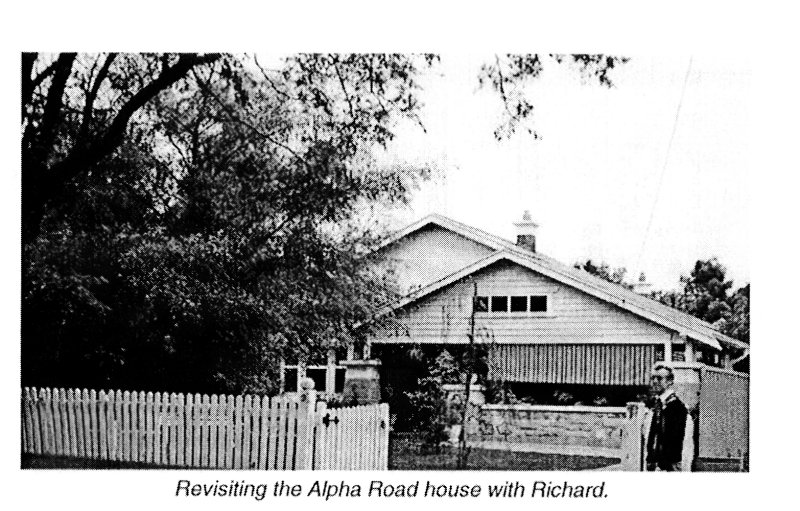
From Kintore Avenue we moved to 3 Alpha Road which was a new house, for which Dad paid two thousand, two hundred pounds. Some time after we moved in, we found that one wall of the house had been built over an old well which had been filled. Rain caused the filling to settle so we had to keep ramming more filling in as it sank. It was fortunate that there was no structural. damage as the house was of brick with a Mt Gambier stone frontage.
The house was built on an old stable site so we were able to grow a lot of vegetables! I had a vegetable round selling things we grew. On Saturday mornings I loaded the hand cart and went from door to door. I also cut up paper into about six inch squares and threaded a string through the corner so people could hang them behind the toilet door and use as toilet paper. Rolls of toilet paper were unknown then. I cannot remember how much I charged but I do remember that I wasn’t very impressed about doing it but it was one of Dad’s ideas.
I also worked for a butcher before and after school and when I was 12 or 13 I saved enough to take me on a holiday to Pura Pura, Victoria, to stay with Uncle Bert and Auntie Hilda who had sold their farm in South Australia and moved to Victoria. I was accompanied by Auntie Mary Perry, Mother’s sister. While we were there, several grass fires started so Uncle Bert loaded some 44 gallon drums of water onto his A model Ford truck. His son Jack drove the truck and when we got to some burning posts Uncle Bert, who was standing on the back with me and the drums, called out to his son to turn the truck around so we could put the fires out. Jack turned so quickly that Uncle and I and the drums were tipped off. How we didn’t get hit by the drums I will never know. Uncle was upset and gave his son a dressing down to which he replied “You can keep your farm……..!” In passing I might mention that when war broke out Jack was in the first contingent of RAAF engineers to go to England. He married an English lass and they came back and settled in Geelong after the war.)
On a later holiday there, when the gear box on the A model Ford was playing up, Jack decided to pull it down and fix it. After putting it together he started up the engine and put it in reverse gear, let the clutch out, and went straight forward and hit the front of the garage. Uncle Bert said, “Let’s get out of here quick.”
When we lived in Alpha Road I attended the Nailsworth Central School. Besides the usual subjects, we did drawing, sheetmetal work, woodwork and science. Our classes were in rooms built of asbestos which got very hot in summer and we were allowed to go home if it got much over 100 degrees. So one day while the teacher was out of the room we lit a match and put it under the thermometer. Unfortunately when the teacher entered the room the first thing he said was, “Who has been lighting matches?” He could smell it.
On another occasion we were at the Prospect Oval for sports and, unknown to us, some prisoners escaped from Yatala Prison and had a shoot out with the police in and around the school grounds. One boy, Frank Guppy, who didn’t go to the sports, was sitting in the class room when one of the escapees shot a blast from a gun through the asbestos just next to where he was sitting and put a number of pellet holes in the wall. When we returned to the school we heard the story and saw the evidence, including a smashed butcher’s shop window in Main North Road, Nailsworth, just opposite the school, where a shoot out occurred. What a story we had to tell when we got home. When Dad was told he said, “Your face is still white.” On the corner of Alpha Road and Prospect Road was a vacant allotment with olive trees around it. We boys could climb right round the block in the trees without touching the ground. In some places we had to put a piece of pipe between trees and use it to swing to the next tree. In one corner was a huge pine tree and we thought it good fun to climb to the top and throw pine cones at passing cars. Fortunately nobody got hurt. We cleared the grass from a large area and smoothed the ground and made a bike race track. As motor bike speed racing was all the rage at the time we tried to emulate their broadsides etc. We also played football on the same ground and sometimes the ball would go on to Prospect Road where the tram cars travelled. Occasionally the ball was scooped up by the cow-catcher on the front of the tram and we had to ride a bike to the terminus to retrieve our ball. One day a boy named Richards chased the ball onto the road and a car hit him and broke his legs when it jammed him against the kerb.
The tram tracks were an entertainment on Sundays when we were waiting for Sunday School to start. We would place all our pennies for the collection on the tram line to see how much they would be squashed by the tram. A couple of times, not on Sunday, we put 0.22″ bullets on the tram line and then went and hid and waited to see what happened. When the bullet ex-ploded, the tram stopped very quickly, and the driver and con-ductor got out and searched under the tram to see what had happened, while we shivered in the bushes. Another Sunday while waiting for classes to start we found that the glass in the fire hydrant was cracked, and a small piece had fallen out, so one of the boys got his finger in and just moved the handle a tiny bit. The next thing we knew was that the fire brigade was tearing down the road. We made a hasty retreat to the toilets behind the church. It is true that Satan will find work to do for idle hands. When waiting on other days we would stand on the footpath and see who could identify the approaching cars first. It was easy in those days as the radiators on cars were all of distinctive designs.
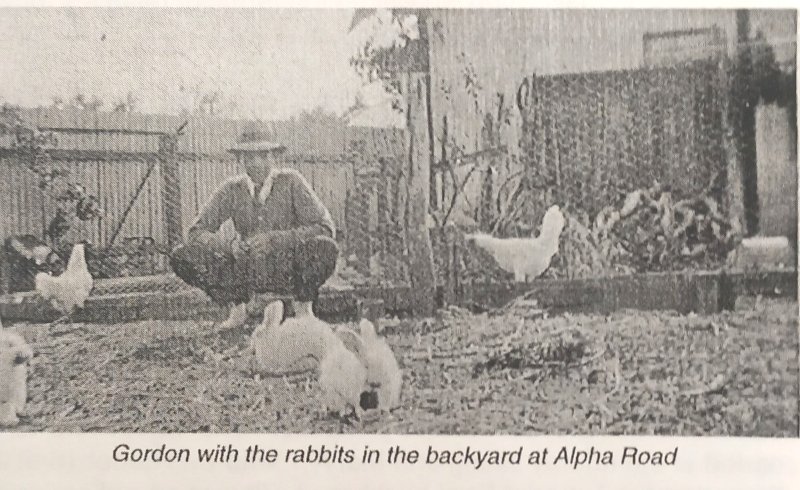
One of our hobbies at Alpha Road was keeping French rabbits. We fenced off the back of the yard where the clothes line was. It wasn’t a Hills Hoist as is used today but two wires stretched right across the back yard. Props were used to keep the wires high enough off the ground. These props always had a fork at the top to accommodate the wire. The rabbits had the run of this area and their shelter was an old carpenter’s bench. Dad had bought several of them at an auction so we put chicken wire around it for some security. Unfortunately dogs would get into the yard occasionally with the result that in the mornings we would find dead rabbits. The rabbits also had the run of a six foot deep pit from which we had taken limestone rubble to make garden paths. We had fixed planks around the walls so the rabbits could go up and down. One summer while I was away on holidays there was a sudden thunderstorm and the pit filled with water drowning some of the rabbits. At one time we had 36 so Dad suggested we get in touch with the Adelaide University to see if they would buy some. Two student doctors came out and after buying some, one said to the other, “I wonder if he has any in embryo”. I didn’t know what they were talking about so as soon as they had gone I went and asked Mum what embryo was. She told me to go and look in the dictionary. I think that was about all the sex education I got from my parents. The rest we learnt from animals when we visited the farms of relatives, or was gleaned from other dubious means.
While we were still living at Alpha Road, Dad bought a farm at Farrell’s Flat, between Clare and Burra. He wanted us all to move there to live but Mother was not at all well with goitre and was on an iodine treatment to reduce swelling of the thyroid gland so she refused to go. I cannot remember how often Dad went to the farm but he must have spent time there during seeding and harvest. We boys went there during the Christmas holidays to work. One job we had was to scape all the kalsomine off the walls of the house so they could be repainted. We used kitchen knives and wore out 2 or 3 of them. As it was summer time, harvest was in progress. The wheat had to be carted to the railway siding and Mervyn, who was about 16 at the time, drove a T model Ford buckboard. (It was an old car with a tray fitted where the back seat had been.) He carried 10 bags of wheat each load. Each bag would weigh between 180 and 190 pounds (90 to 95 kg) and we used to say that the buckboard bent in the middle on every bump. At the same time Dad would carry 22 bags on a 2 ton horse drawn trolley. Mervyn would do two trips at least to Dad’s one. At the railway station each bag was weighed and then a man known as a “lumper” would carry the bag on his back up on to the stack of bags which would reach 20 to 30 feet high.
On one occasion, whilst on the farm I told my brothers that as I was such a good kicker of the football I could kick it straight between 2 barb wires on the fence. I kicked it through OK but it scraped one wire and tore the football and my brothers gave me a hiding. When Dad came in from the paddock I told him and his reply was, “Well it wasn’t a very wise thing to do”, and that was the end of the matter. Another day I took something out to Dad in the paddock while he was ploughing and he pointed out to me how straight the plough furrows were and said, “Anything worth doing is worth doing well.” I had reason many years later to remind him of it when I thought he was doing the wrong thing.
Dad used to cook our breakfast of porridge and then he would put chops, onions, carrots and whatever into the porridge saucepan with any porridge which was left over, leave it on the one-fire stove and that was our lunch when we came in from the paddock. When he had the telephone connected to the house, we had to erect a telephone post half way between the house and the road. To do this without modern machinery we had to dig the hole and then dig a sloping trench on one side of the hole. Then we rolled the huge post over the trench and with four ropes attached to the top of the post we pulled it upright and held it steady while the ground was tamped firm around the post. I remember being scared I would not be strong enough to keep a steady rope. Dad sold the property after a couple of years.
The depression was hitting people hard in the late 1920s. Mervyn was working with a cabinet maker and Gordon was working for Uncle Jack Roach on the farm at White Hut. I had to leave school the day I was 14 and go to work at Nantawarra (which means black kangaroo) with a cousin’s husband, Bruce Underwood.
FARMING LIFE BEGINS
I had to travel to Nantawarra by train on my own, to live and work with cousins much older than I whom I had never met. As Dad was taking me to the train he told me to always see what needed to be done before I was asked. That was all the advice received as far as I can remember. The Underwoods had three children, the oldest a girl, was spastic and mentally retarded, the other two were boys about 3 and 6. I early learnt that it’s not wise to try and bring up other people’s kids. I spent a happy months there, although I didn’t see any of my family for 10 months, after which I went home for a week or 10 days, received no wages, just my keep.
There were two boys my own age on a neighbouring farm, Max and Ray Young. I often spent Saturday or Sunday in their company especially at Sunday School and church. Their father was an Englishman and always wore a stiff, stand-up white collar no matter what the weather or what he was doing.
One of my jobs was to milk the cow, a thing I had never done before. By the time I finished the milk was stone cold, I was so slow. I had to bring the cows in from the paddock for milking and Bruce said I was not to use a saddle on the pony but to ride bare back. One Sunday morning I got up early while they were in bed and saddled up the pony and was having a lovely time getting the pony to jump gutters on the way to get the cows. Just what Bruce was afraid would happen did. The pony put her foot in a gutter and fell. Fortunately my foot was thrown clear of the stirrup. I got up like a dog with his tail between his legs and led the pony home, put the saddle away and said nothing about it.
Another task I had was to prepare the nose bags of chaff for the horses, and, together with Bruce’s lunch, take them to wherever they were working. Bruce asked me one day to spend the morning spreading a heap of manure in a paddock and when the 11 o’clock train went past I was to go home and get his lunch and the horses’ nose bags. I used a horse and buggy to do this. When the train went past I dutifully went and did as I was asked. When Bruce came home at night past where I had been spread-ing the manure and saw that I hadn’t completed the task, he called me a lazy so-and-so and said that I had only waited for the train so I could get out of the job. I was deeply hurt by the accusation and brooded over it for many days. I suffered much from home sickness and once or twice went to the barn and had a good cry.
On one occasion when the shearing was being done their spastic daughter, Dorothy, came to see what was doing but couldn’t open the large sliding door of the shed. She was leaning on one of the door rails when Bruce slid the door open. A splinter from the rail entered her arm just above the wrist and surfaced near the elbow. I didn’t see how they removed it.
Bruce used to cut the wood for the fire on a saw bench which was driven from the flywheel on his Case tractor. I cannot remember what I was doing while he was starting the tractor but from a distance I thought I heard him call and when I went to investigate he was flat on the ground with a gash on his fore-head. The tractor had backfired and the large starting handle had hit him and gashed his forehead. His wife Ivy was away for the day so I had to help him to the house, bathe the wound and get him some Aspros.
Besides wheat farming, Bruce kept sheep, and as there wasn’t much feed in the paddocks I had occasionally to watch the sheep while they fed along the roadside. I left them there one day while I took Bruce’s lunch to him and when I returned to where I had left them they had disappeared. I travelled along the various roads in the area and followed their hoof marks and finally found them a mile or so away but heading in the direction of home again.
Before I went to Nantawarra I had learnt the piano for two years, but the Underwoods had a pianola, and I used to find it much easier to play the rolls so my piano playing lapsed. Underwood had a girl just a little older than me helping in the house and I used to play the pianola while she and a girl friend danced. They taught me a few steps and said I was very light on my feet. Ivy Underwood said to me one night, “Your mother would be upset to see you dancing”. Mother was very much against it, but at 14 I wanted to experiment but never went near public dancing.
Shortly after I arrived at Nantawarra Bruce took on a contract to reap a crop at South Hummocks. He had just bought a 12 ft Auto-header which was powered by a built-in engine. It took two people to operate, with one driving and the other standing on a platform filling bags with wheat which was fed by the machine into a bin. The platform held about 9 bags and the bin about 2. The machine then had to be stopped and the bags unloaded on to the ground. Remember I was only 14, and the bags weighed 180 lbs (90 kg). When we stopped Bruce would lift them down from the platform but I had to wriggle them to where he could get them. For the fortnight we were doing this the temperature was over 40 degrees and a record was set for the longest period of days over 40 degrees. I had my first experience of actually fighting a fire in a crop of wheat. It was a neighbour’s farm and the fire was coming straight at one of Bruce’s paddocks of crop. Fortunately there was a wide fire-break between the two but I had to stand there with a shovel to throw dirt on any tongues of fire that crept across the fire break. We saved our own crop.
Just before Christmas 1931 Dad got in touch with me and asked me to come home as he had a farm at Bow Hill and he wanted me to go there and work. When I arrived back in Adelaide Dad asked me if I had done any horse team work. I had not done any team work at Nantawarra because Bruce’s horses were very flighty and hard to control. When Dad found this out he got in touch with Gordon and asked him also come home and go to Bow Hill. This caused some friction between Dad and Uncle Jack Roach whom Gordon worked for. He had expected Gordon to remain with him and take over the farm at a later date. Dad had a very good trotting pony which was kept on Moyle’s farm at Watervale a few miles from Clare. Gordon collected the pony and rode all night from Watervalo to 6 Cain St, Prospect where the family was living at the time. It was a rented house. Dad had money invested as mortgages on two farms, one at Bow Hill and the other at Sandalwood. Mr Neimitz who was farming the Bow Hill property left the arm as he was bankrupt so Dad occupied the farm as mortgagee-in-possession so as not to be responsible for debts accrued by Mr Neimitz. Dad bought four horses and a two ton trolley and we brought the horses to Cain St on the Sunday and tied them to trees in the back garden ready to leave for Bow Hill on the Monday morning. I collected one of the horses from Walkerville (I think it was a dairy) and a lady who let me in to collect the horse gave me a dressing down for working on a Sunday. She said anyone wanting to work on Sunday should be deported to Russia. Dad said I should have replied to the effect that I was only collecting the horse so it could be fed properly ready for the trip ahead. I doubt if she would have been impressed.
BOW HILL HERE WE COME
When we left Adelaide on the Monday morning we had a crate of fowls on board, some pieces of furniture, feed for the horses and odds and ends. The horses were yoked in tandem with two horses as pole horses and two leaders up front. Re-member these horses had never worked together before and didn’t know each other. We had the pony tied at the back of the trolley. It was a three day journey to Bow Hill and the first night we got as far as the area of Birdwood and the second day we made Mannum.
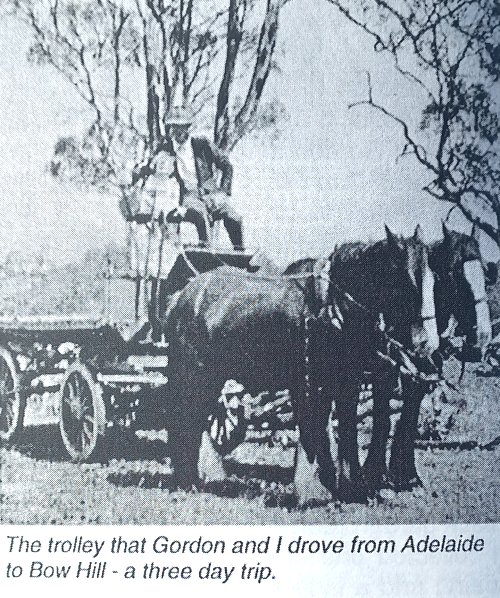
We tied the horses to trees or posts at night and we slept under the trolley. On the third day just out of Mannum we had to go up a steep climb awayfrom the River Murray up to the higher ground. Half way up the hill the horses weren’t pulling too well so Gordon used the whip and they jumped into their chains and broke one of them. We stopped and put a stone behind the wheel and then mended the chain. When w e tried to get the horses going again they wouldn’t pull together, so Gordon took the pony and went to the nearest farm and asked the farmer if he would bring a couple of horses and pull us up the hill. When he arrived we took off our two leaders and hooked on his two beautiful Clydesdales. He just said, “Right boys”, and away they went. It was great to see how easily hey did it. Our horses in comparison to them were only ponies. (It was on this same hill that the local carrier had trouble when transporting a combine from Adelaide to Bow Hill. The truck was small in comparison to today’s machines so there was quite a bit of the combine protruding beyond the tray of the truck. Percy Briggs, the carrier, had extended the tray temporally with some timber, but going up this hill the weight at the rear of the truck lifted the front wheels off the ground and he lost steerage. He had to get someone to sit on the bonnet of the truck as a counterbalance.)
When we got to the River Murray at Cournamont we had to make the same descent to river level. Dad had driven to the spot in the car and looked out the best place on the side of the road to travel for safety. By the time we got to the bottom of the hill the two polers were skidding their hind legs trying to hold back the pace and we had the brake flat on and still we were travelling at the pace of a trot. We breathed a sigh of relief when we were on level ground. The next thing was to get on board the punt to take us over the river. The horses, having been used to Adelaide traffic and noises, didn’t make any trouble.
After crossing the river at Purnong Landing we had to climb the hill again as we did at Mannum but by this time the horses were getting used to each other and we didn’t have any further trouble. When we left Adelaide Gordon and I didn’t know what sort of a place we were heading to but soon found out it was nothing like Clare or Nantawarra. Eventually we named the Bow Hill country SAND, SORROW AND SORE EYES. The average rainfall there is about 10 inches a year, and half of that seemed to come in the summer when it wasn’t wanted during harvest. But we were cheerful about it as now we were on a farm of our own. Little did we know about the droughts, low prices, the stock that would die, the sand drifts, and the rabbit plagues we would have to endure. Dad had work in Adelaide but mother and the three girls came to live at Bow Hill and cared for Gordon and myself.
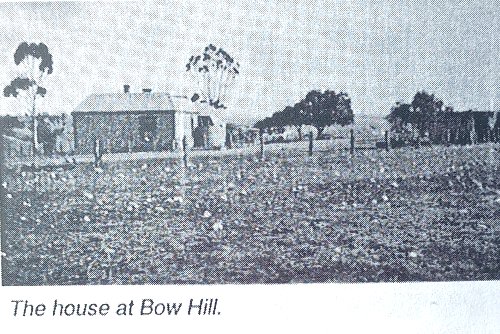
To get finance to run the property Dad applied to the Farmers Assistance Act which meant that they continually sent inspectors to visit the farm and to check on what was being done. We also had to fill in forms as to what stock we had. One of the local farmers sent in a form one year stating that he had 5 porkers. The next time he sent a form, he didn’t put in 5 porkers but listed 5 sows instead. The bank wrote back and asked where the 5 porkers were and where he got the 5 sows from. He replied to the effect that on the first form they weren’t of breeding age but now their sex was proven. There were many funny episodes like that dealing with what we termed “Rundle Street farmers”. Another farmer wrote in for finance for 5 tons of supper instead of 5 tons of super, short for superphosphate.
The banks advanced as wages, to Gordon and myself, 10 shillings ($1) a week each for 6 weeks during harvest and for 6 weeks during sowing time. The rest of the year we had to trap rabbits and cut wood for pocket money. When trapping rabbits we used to set 20 or more traps, but as the foxes were bad and would kill and eat the rabbits in the traps, we had to go round the traps at night before we went to bed. To find where they were we had to drag an iron hook and make a small furrow in the ground as we set them and follow that with the aid of a kerosene lamp. At the beginning we sold the skins but later on the “rabbio” came round in a truck and collected the carcasses which would hang in pairs on a rail between two trees on the roadside near the house. They were enclosed in a bag hopefully to keep the flies off. When the rabbio arrived he would toot his horn and one of the family would run out and collect the money. I remember one occasion when selling skins, which we had to forward to Adelaide by carrier, the price was so low that they didn’t bring enough money to pay the carrier and I was left with a bill to pay.
Our mail had to be collected from the local store and only came three times a week. The store was a couple of miles away. One day Gordon was riding his bike to the store down a hill past Obst’s property when the front fork broke resulting in a broken collar bone and hospitalisation. I was in Adelaide having a holiday at the time and was called home to do the farm work. I called to see Gordon in the Mannum hospital on the way home. and he said that the doctor had put his knee between Gordon’s shoulder blades, pulled on his shoulders and snapped the bone back into place then strapped it to keep it in place.
We always kept a few cows which provided our milk. The milk was separated from the cream by a machine turned by hand. The skim milk was fed to any calves we were rearing and the rest to the pigs. When we took the calves away from their mothers we had to teach them to drink from a bucket and to do this we had to put the calf’s head in the bucket of milk and our finger in the calf’s mouth so they sucked on the finger and at the same time sucked in the milk. They soon leamed to drink from the bucket. The cream was sent to Mannum by carrier. Mr Shepherd ran a service from Karoondah to Adelaide 3 times a week. He had a large sedan with extra seating for passengers. and he towed a trailer for carrying cream cans. Wo left the can of cream on the road side and he would collect it and his carrying charges were deducted from the cream cheque. One day when he had his car full of passengers an Aboriginal man stopped him and asked for a ride and he told him the only place was on the roof rack and the Aboriginal accepted that. They hadn’t gone very far before he banged on the roof of the car and asked to get off because he was frozen stiff.
There was a carrying service to Murray Bridge once a week to the stock market there. This was run by Mr Obst, the local blacksmith. I cannot remember the make of truck but it had a wooden cabin. On one occasion in Murray Bridge he was crossing the railway line near the sale yards and he was hit by a train and the impact shot him straight through the roof of the truck and he landed on the cow-catcher of the train and was carried along until the train stopped. The driver of the train jumped down and asked him if he was OK to which he replied, “Yes, I’m OK”, and promptly fainted. His only damage was a split in the top of his head. The truck didn’t get off so lightly. Mr Obst carried all sorts of livestock to the market on the back of the truck but also had a section behind the cabin with a seat for passen-gers. There was no covering and it got very cold. Locals would travel to the market that way to see their stock sold, spend the day at the pub and go home the worse for wear. One day the locals, nearly all hard drinking Germans, took a young fellow to the pub and filled him with mixed drinks so that he was very drunk. On the way home, when we got to this chap’s farm they helped him off the truck and laid him at the gate on the roadside and just left him there. On one particular trip the locals decided they would force me to drink beer on the way home and tried to hold me down and pour it down my throat. I got hold of the bottle and threatened to throw it overboard and managed to extricate myself from that situation.
The country at Bow Hill was either sand drifts or limestone, One paddock in a sand drift area had three fences, one on top of the other. Bushes called roly polies, would break loose like tumbleweed, roll in the wind and be blown up against the fence, the sand drifting over them until the fence was covered. After strong wind in the summer the dust would cover the pattern the linoleum floors in the house. I remember one day picking stumps on the property of local farmer and visibility was down to a few yards. Another paddock had pine tree stumps sticking high out of the ground as the wind had blown all the sand away down to the clay, a depth of up to 5 feet. When ploughing in those situations sometimes the team of horses was some feet lower than the plough with the result the pull on the horses collars was cutting into their throat causing them to choke and collapse on the ground.
The horses were always scared of rabbit warrens as the ground would give way under them. To overcome this we would try to go round and round the warren gradually working towards the centre. Even so, the horses would plunge and rear, and on one occasion a coupling between the horses broke and half the team went one way and the other went the opposite way. One horse was pinned against the machine wheel and started to squeal. Gordon went for one lot and I for the other. It took a while to get all in order. Another day when, having circled the warren as described, we faced the team to go straight over it. One lazy horse named Darky fell through the ground and col-lapsed, pulling the other horses on top of her. One year we bought a couple of horses from the Kapunda horse sale and one of them turned out to be a kicker. At first, as the team were being driven around the paddock, she would choose two places to start kicking. We always knew when she was doing it by her fidgeting and actions of excitement. Following that as soon as we got those two places she would start kicking. We tried every trick in the book to stop her but all to no avail. We put a spreader between the chains to keep the chain from rubbing on her sides but it made no difference. What she did on that occasion was to kick and break the spreader and it shot like a bullet straight at me. My reflexes were good enough for me to duck and it went over my head. We tried tying her hind legs to the bit in her mouth but of course we couldn’t do that all the time. When it was attached she didn’t kick but plunged and jumped about to show her anger.
When ploughing in the winter I always had a fire bucket on the plough to keep a little warmer. The trap was that if you weren’t careful the reins would get burnt. As there were so many loose stumps in a paddock there was no shortage of wood. When my hands got too cold to bear I would stop the team and put my hands up between the horses flank and hind leg and keep them there until they were warm.
When reaping the crop one year I had a horse break its leg. I was watching the crop and the machine and felt the horses slowing up. When I looked up, one horse’s hind leg was swaying and the horse was limping trying to keep up with the others. The only cause we could find was that it may have trodden on a loose stump and twisted sufficiently to break it. After shooting the horse we opened up the break and found it broke half way into the bone and then along the bone for some inches and then out the other side.
When working the horses we had to rise about 5am to feed them and groom them with a curry comb and brush, after which we would go and have breakfast. Following this we would prepare their nosebags and hang them from their collars. We took our own lunch with us with bottles of black tea to drink. We had about an hour for lunch so the horses could get enough energy for the rest of the day. In the summer when we got the horses home we would wash them down to remove the caked sweat from them. We then fed them, had tea and then fed them again before going to bed. We cut hay and stacked it at the end of the stable next to the chaff cutter so the feed was right where the horses were.
One very hot Sunday, after we were married, we heard people running outside the house and when we went to see what was going on we found they were trying to put out a fire in the dry manure of the stable floor. It was a hot north wind and burning ashes were being blown towards the haystack. We had a young lad from Adelaide staying with us at the time and he had been smoking in the stable and had buried the butt in the manure so we wouldn’t find it, hence the fire.
During the war when petrol rationing was in force, a lot of people were using gas producers on their cars, and as there was a market for charcoal to burn in these units, we decided to burn charcoal for sale. It meant digging a pit about 8 feet long and about 5 feet deep and filling it with burning stumps. When it was well alight and glowing, we would cover the pit and smother the fire. When it was cool, several days later, we would bag the charcoal for sale. Incidentally we dug the pit in the summer when the temperature was touching 100 degrees (40°C). When we got home from doing the bagging we looked more like black men than white.
We had an old Willys Knight car that a neighbour gave to us to repay a 10 pound debt. We had a gas producer fitted to it and used it as a car for a while. Later we put it back on petrol and used it as an engine to drive various machines by jacking up the back wheel and driving machines via a belt from the jacked up wheel. We had taken the back off it so we only had a front seat. We did quite a bit of spotlight shooting with it and one night when travelling flat out across a paddock without lights we ran over a stump which got caught in the tail shaft and stopped us dead. It was usual when we spotted the eyes of a fox in the spotlight to turn off the headlights and drive straight at the spot and when there we would turn the spot light on again and invariably the fox was close at hand. Somehow the fox seemed to get bamboozled and waited to see what was going on. I always used the spotlight and could tell by the glowing eyes what animal it was. One night I was fooled and when we got to the spot where the eyes were, it was a spider!
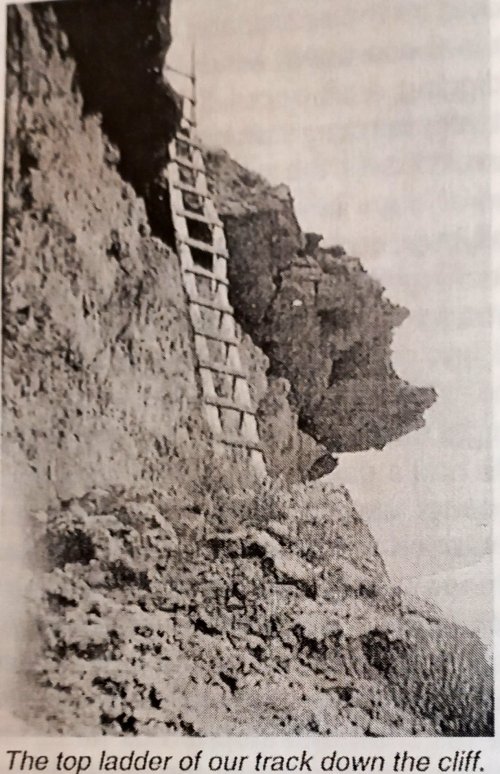
The property at Bow Hill was on the cliff side of the River Murray and the water for stock and garden use was pumped by a windmill from the river. To get to the windmill we had to walk down a 45 degree slope to the cliff edge and then down a series of ladders and walk along ledges on the cliff. There were 4 ladders and the top one was about 15 to 16 feet long. It was tied at the top with wire to a peg, but it actually leaned to one side. One evening after being down at the river fishing, Gordon and I were making our way home and were teasing each other that we might step on a snake. It was getting dark at the time. I went up the ladders first and when I got to the top of the last one and put my face over the edge a snake was lying there and in its fright it struck out at me. I swung the edge of the ladder and the snake overbalanced and fell on Gordon who was standing at the bottom of the ladder. He threw it off but as his arm was hurting we struck matches to see if he had any fang marks. That’s the closest shave I ever had with a snake they were likely to show up at any time. One went between Mum’s legs one day near the house. We always kept a length of wire in strategic places so as to be able to deal with them. I once saw one try to attack my dog. The snake reared up on its tail and its head or neck swelled up like a cobra. All I had at the time was a pick handle which was a bit too short for my liking, but I was able to dispose of the offender.
We used to carry all our superphosphate bags down to the river, or rather, roll them over the cliff, to wash them. We tied 30 them in bundles and left them in the water for several days and then we hung them over the water pipe to dry, but then we had to carry them up the ladders while we hung on by one hand. Something more difficult was to carry a round pie melon up those ladders. The melons grew down by the river. As a matter of fact we had 5 acres of swamp land but it was no use to us because we couldn’t get the machines to it. Dad had big ideas of cutting a tunnel down to the swamp but it was too big a task. Over recent years Doug Emmins has blasted two tracks down to his swamp land and is able to take vehicles up and down. During calm spells we had to take an engine down to the windmill and attach it to the pump to keep up a water supply for the stock. To do this we had to take the engine to Bow Hill wharf and load the engine into a rowing boat and take it up the river to where we needed it.
We always had dogs as pets but, more importantly, to help with moving either cattle or sheep. We kept a whippet dog and on one occasion we had a cream stag hound that had the habit, when the other dogs were chasing rabbits, of going to the rabbit warren and hiding behind a post. When the other dogs chased a rabbit to its warren, this dog would jump out and grab it as it came near. He also never slowed up as a rabbit got near its warren, he had learned that a rabbit always slows up to enter its burrow but he never did and was adept at 1 catching his prey at that point with the result that he would go head over heels, but mostly with the rabbit in his mouth. We always wondered how he escaped breaking his neck. When we first got him, I had him on the chain down at the foot of the cliff when a fox sprang out of a bush. The dog wrenched the chain out of my hand and took chase, but the chain catch jammed in a rock and stopped the dog dead in its tracks and even then it didn’t break its neck.
We also had a pet kookaburra. We found it where it had fallen out of its nest. It had no feathers, only down, and was covered with ants. We cleaned it up, kept it warm, and carefully ted it. It prospered and turned out to be the best watchdog we had! Nobody came near the place without it warning us, and it even attacked a child one day. We kept one wing cut so it couldn’t fly, but we must have got careless and the feathers grow and apparently it tried to land on the 12 inch wide wall of the stock water tank and fell into the water and drowned. That was a sad day because it was a good pet.
FARMING AT SANDALWOOD
After a year or so at Bow Hill, the farm at Sandalwood also came into our hands as the owner went bankrupt, so Gordon and I had to farm that as well. It was 40 miles from Bow Hill and it took us one and a half days to travel there with the machines. We would spend the night at one of the Government bores, tie the horses to the trees and sleep under the trolley or whatever machine we had. One day when we passed a farmer’s property on our way he came out to talk to us and posed the question, “Are you coming or going?” What he meant was are you being starved out or are you just starting out to try your luck?
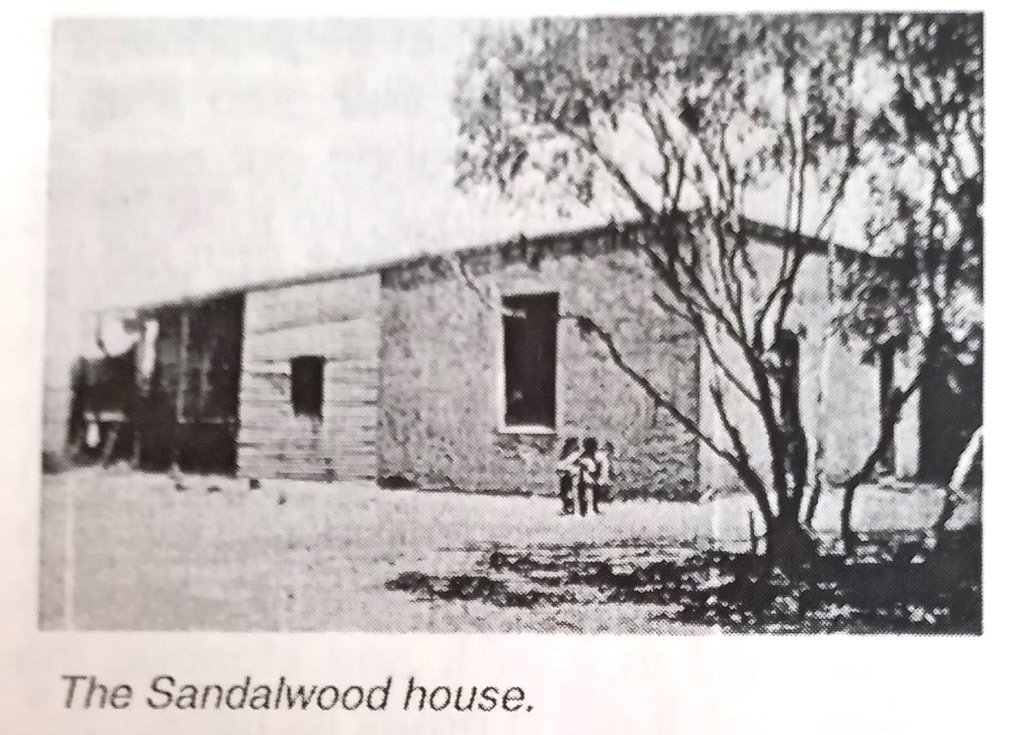
When we arrived at the farm we found a four roomed house completely empty. We had no table or chairs so we took a door off its hinges and put a couple of boxes under it and used two boxes for chairs. We had taken two beds with us. There was a one-fire wood stove to cook on and our bath tub The Sandalwood house. was a 4 gallon kerosene tin which was on a concrete floor. There was no running water, but a rain water tank stood outside. The farm was about 5 miles from the local store and railway siding. I used to go once a week on horse back to buy our supplies which I put in a 3 bushel bag and carried across the front of the saddle. We had no facilities to keep the bread and other things fresh so by the end of the week the bread would break in crumbs rather than slice, it was so hard. We used condensed milk. Meat had to be cooked straight away to preserve it.
The previous owner of the property, when he knew he was going bankrupt, had placed all his assets in his wife’s name and took up farming in her name on a neighbouring property. We were quite friendly with them and one Sunday after attending church they invited us to have dinner with them. During the main course of roast mutton and vegetables one of the family found a maggot on his plate and complained to his mother. She turned to her husband and said, “I told you not to cut too deeply.” It was by the grace of God and the help of a toothbrush that we got the rest down. When Mr Joyce, the husband, thought it was time for Gordon and I to go home at night he would stand up and say to his son, “Well, Reg, it’s time to feed the horses.”
Occasionally we attended social events like strawberry and ice cream evenings and such like things. This would mean riding the horses about 5 miles, Gordon on a draught horse and myself on the pony. I remember coming home one night, at about midnight, and entering our property through the nearest corner of the property rather than going further to follow the drive. The paddock we entered was 250 acres and had two or three dips and rises. At midnight in the pitch black the horizon looked the same everywhere we looked with the result we both got lost even though we separated to go our own ways. Eventually we had the brain wave of letting the reins go loose and allowing the horses to decide the way, which they did without fail.
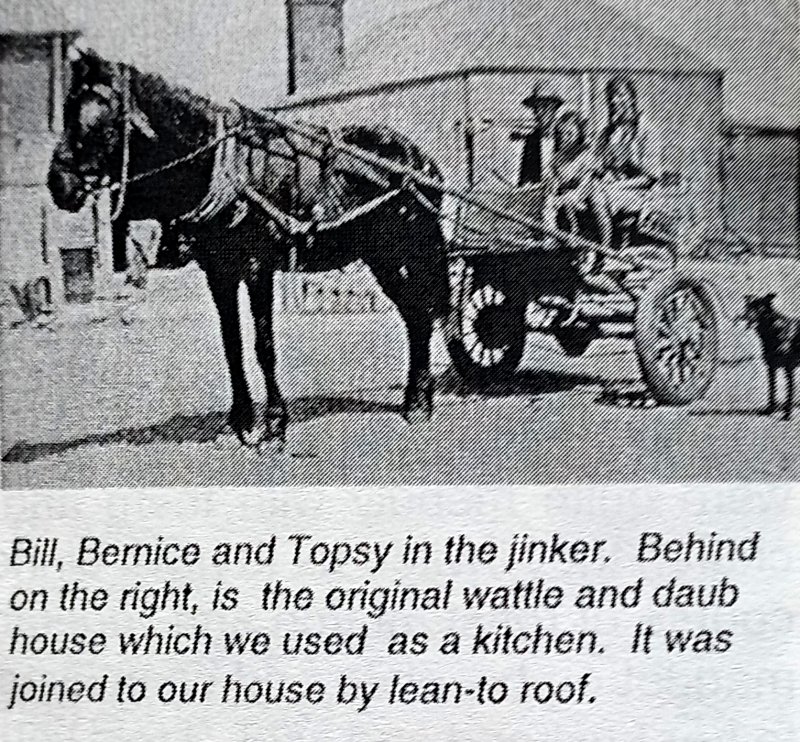
We also had a jinker, an old sulky with motor wheels and tyres in place of the wooden wheels. Our pony was an excellent trotter so after one of the aforesaid evenings we decided to have a race home with another chap who had an old race- We became so intent on the race, at midnight, with no lights of any sort, that we didn’t realise the other chap had taken us a long way past our tum off. It took quite a long while to become re- orientated.
The water supply for the stock on the Sandalwood farm was from a bare 120 feet deep and the pump was operated by a windmill. When the pump at the bottom of the bore needed a new leather washer all the pipes had to be pulled up to get at the pump. This was done with a windlass and the wire rope passed through a series of pulleys attached to the top of the windmill with a chain. On one occasion when going through this process, we had about two lengths of pipe removed, each length was about 9 foot, when the chain at the top broke and the pipes plummeted down. The clamp around the pipe by which we attached the wire rope hit the top of the bore casing and smashed apart with the result that the pipes went to the bottom of the bore. In the mallee country at that time there were men who specialised in fishing for pipes in these circumstances, but we needed the job done quickly so we let down the pipes length by length, all the pipe we had. When the pipes touched the fallen pipes we had just 4 inches of pipe left above the bore casing, and, wonder of wonders, it screwed straight into the pipe below. We had strengthened the pulley fixing at the top and it took all our might to release the pipes from the mud below as the force of the drop had driven the pipes deeply into the mud. Incidentally many of the farmers of those days had pieces of fingers missing through pipes slipping while pulling up their bores. Gordon and I were very fortunate that neither of us were standing at the bore casing when the chain broke. The pulleys and attachments would have either killed or seriously maimed us.
We batched on this farm for a few weeks at seeding time and at harvest. After a few years this property was rented to a neighbouring farmer, and I was pleased not to continue with such Spartan living.
BOW HILL AGAIN
In 1939 Mr Don Kidd, of Adelaide, contacted me and asked if I could accompany him and four others to Victoria to attend a church camp. It so happened that we had a very light harvest that year and we were finished by Christmas, the time of the camp. It was so arranged that I went to Adelaide and joined Ron Hogget and Len Higgins to travel to Melbourne by train, where Don Kidd met us and took us to Shoreham by car. Another lad, Wilf Rye, travelled motor bike. He arrived at the camp site just as we were serving the Communion. Don was so excited to hear the motor bike arrive safely that he gave thanks for the wine while the bread was still being dispensed. This camp gave me the opportunity to meet people of my own age, or thereabouts, with similar spiritual interests. The people of Bow Hill were mostly hard drinkers and worldly in their outlook. After arriving home from the camp I had reason to write to Jessie Blythe, whose address I had collected, and ask if she could locate some property I had let behind. Some people said it was all a ruse but I confess it was no such thing. I had left a blazer behind and I wanted it back. Nevertheless it started a correspondence which led, eventually, to me making a trip to Melbourne, one of several such trips.
In the train I slept on the seat, when there was room, and on the floor, when there wasn’t. On one occasion when travelling home, I was sitting next to a girl about my own age, and I fell asleep against her, as passengers seem to do sometimes. When I got out at Murray Bridge I said goodbye, to which she replied, “Must it be so?” I got out quick!
Our courting was done by letter, so it was important to me to get the mail each mail day. After one of Jessie’s trips to Bow Hill to visit me she was expected back at work in Melbourne on a Monday morning. I could have taken her the 35 miles to Murray Bridge to catch the Sunday train, but I would have had to return to Murray Bridge again on the Monday to answer a call up by the army, so Jessie asked me to ring her boss and tell him she would be 2 days late. He let me know that he considered it a ruse to keep her a little longer and he wasn’t at all impressed.
We eventually married on 28 March, 1942 at Conference Hall, Camberwell, in Victoria. Gordon was my best man, and he said he couldn’t afford a new suit so I had to pay for it. Gordon, Elwyn and Bernice went with me to Melbourne a week before the wedding. Jessie met us at the train and then we all boarded the Camberwell train. As we were waiting for the train to start, Jessie heard what was to us an unintelligible announcement, and she said, “Get out quick! This train is going express to Box Hill.” We made a mad scramble to get out with our 4 cases and hand luggage. Melbourne was mad after the quiet of the farm. Neither my father or mother came to the wedding. Mother stayed on the farm to care for the stock and I often wonder if I didn’t press the issue far enough as regards my father’s attendance.
He was working in Adelaide at the time. Uncle Bert and Auntie Hilda Mitchell repre- sented my parents. The officiating celebrant was Rev. Crawshaw, a Baptist minister who was attending the Brethren meetings. The wedding was held in the Camberwell Conference Hall, which is now an antique market, and the reception was upstairs where the guests sat on backless forms
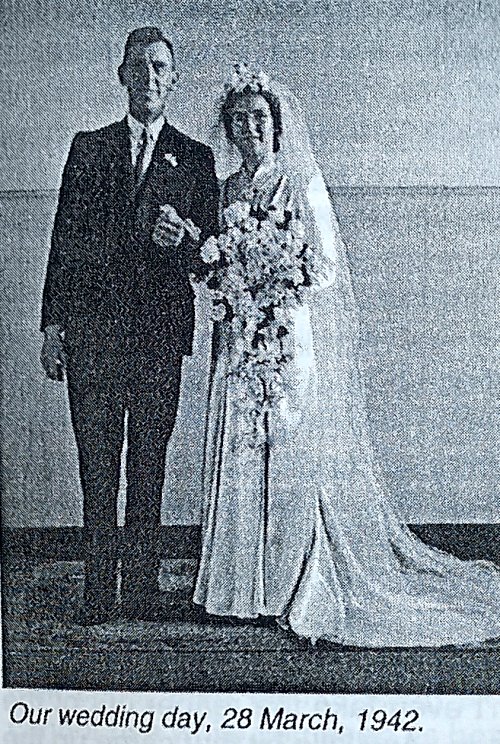
After the wedding we went by hire car to Morris and Ruth’s home in Surrey Hills for the night and when I went to pay the hire car driver he couldn’t change the notes I had so we had to tell him we would fix it later. (They knew Jessie’s father as their business was near his.) The next day we went by public transport to Mount Dandenong and spent a week in a house we rented from one of Mr Blythe’s customers. The second week we spent at Pura Pura with Bert and Hilda Mitchell. All our wedding gifts we packed into cases between layers of clothes and we got the lot home to Bow Hill without any break-ages.
As I look back now it was pretty tough for Jessie to go from busy Melbourne to isolated Bow Hill and to take on milking cows and so on. She was very fortunate one day when she went to put the cow into the bail and it tossed its head and broke her glasses. Another time she let the cow out of the bail without untying the leg rope. Rosemary was sitting on a stool along side the cow and the animal got past her without knocking her over.
Rosemary was born in the Murray Bridge Hospital when the temperature was about 42 degrees. We had arranged for Jessie to stay in Murray Bridge for the fortnight prior to the baby’s expected arrival. She went there early as planned and we do not know if it was the rough ride of 35 miles to Murray Bridge, or if it was the chocolates she ate, but next morning I got a phone call back at Bow Hill to say I was a father, a proud one at that, so I had to travel back to Murray Bridge. When my father had found out Jessie was expecting he arranged for us to have the phone on. If I remember rightly, ours was number two in the district.
At the time of our wedding the Mallee was experiencing a very bad drought and my share of the crop (I was share farming with my father) was 70 bags of wheat. The second year I had 350 acres under crop and didn’t even take the reaper out of the shed as there was nothing to reap. Any little bit that came up the rabbits ate. Jessie and decided that we ought to find a job somewhere else so I applied for a position on a property at Birdwood, South Australia, with Mr Fleet, an Adelaide builder who had bought the farm to avoid the military call up during the second world war. He was developing a Stud Jersey herd and wanted a new manager. When he called me for an interview we travelled to the farm in Dad’s old Rugby 6 car. We had the interview and then left the car there and travelled by public transport to Adelaide for the weekend. He said he would give me an answer when we returned for the car on the Monday.
When we met him on the Monday we were standing alongside the car and just as he said he had decided to give me the job a drop of water shorted the horn wires on the car and the hom started to blare and I had to remove the battery wires to stop it. It was a dramatic entrance to the job. Birdwood was quite a contrast to Bow Hill There were big gum trees and plenty of green grass. We spent two good years there. We had one weekend in four off work and this enabled us to go to Adelaide for the weekend and attend the assembly at Goodwood and stay with Mr and Mrs Jim Young. Russell was born, in the Gumeracha Hospital while we were living at Birdwood. Many years later when Russell was teaching in Hobart he met a teacher from South Australia. When Russell asked him where he lived, the man said it was a little place Russell would never have heard of, and when pressed he said it was Gumeracha, to which Russell replied that he had been born there!
My main job was milking and clearing the countryside of furze bushes and old tree stumps. The milk had to be taken to the roadside in a horse-drawn cart and the only speed the horse knew was ‘flat out. One morning he tripped crossing the railway line which ran through the property. As he fell I trod on top of the milk cans, then on his rump and then on his head. A horse cannot rise while you keep its head pinned to the ground so I sat on it and called for help. Mr Fleet’s son heard me and came and undid all the harness and shifted the cart before we let the horse up. We didn’t spill one drop of milk. By the way, a horse rises head and shoulders first whereas a cow rises rump first. A cow kicks sideways but a horse kicks straight back. If you know that you know where to stand to miss the kicks.
The name of the horse was Jackie and I rode it in a couple of gymkhanas in such things as the thread-and-needle race and the melon race. I won my heat of the thread-and-needle race, because Jessie was adept at threading a needle but when it came to the final Jackie wouldn’t behave and backed all over the course before I could get him settled and both of us were not in a racing mood by then so we were too slow.
I recall that on one occasion when I had to do work on a bore and windmill on the farm, the job took longer than expected and when I didn’t get home for lunch in time, Jessie was sure I had fallen down the bore. She didn’t know that a bore was only about six inches diameter. I think it was the same day that somehow I lost a jumper she had laboriously knitted for me. While working at Birdwood we had to provide meals for an Italian prisoner of war who worked with me. He slept in a small hut near prisoner of war our house. There were many prisoners of war in the district and they were allowed to travel up to two miles to visit one another and Mr Fleet’s property was a common gathering ground for them. Our man’s name was Vincent and he taught me how to espalier tomatoes and also he used to cut my hair when necessary, but he was cunning enough when there was something he didn’t want to do to say, “Me no compre.” I cannot remember how much they were paid each week. Our wages were three pounds ten shillings (about $7) a week with house and milk provided. A manager’s wage at that time was five pounds a week.
The first car we bought at Birdwood was a single seater Morris and one day Jessie and Rosemary and I were crossing the railway line, where the horse fell, just on a bend on the drive when the car door flew open and Jessie fell out on the ground. Rosemary very belligerently said, “You’ve tipped Mum out!” By the time. I got out and around to pick Jessie up she was back in the car with only her pride hurt and no damage to the un- born Russell.
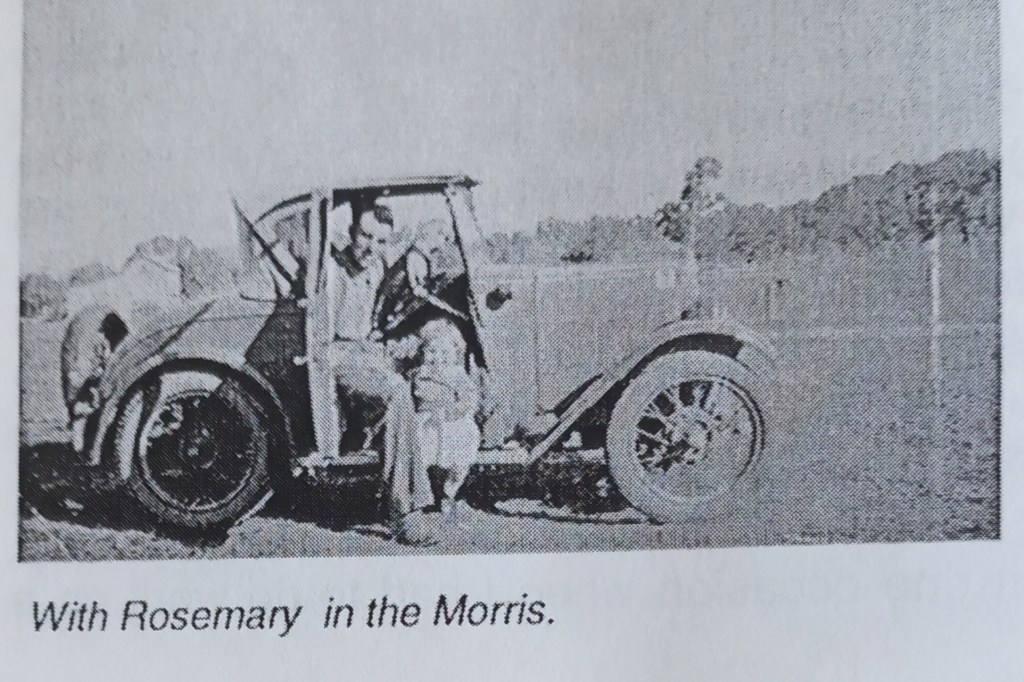
On one of our weekends off when travelling home from Adelaide after the evening gospel meeting, on a very hot night in summer, we were driving up a steep hill when I looked behind and was horrified to see a line of red hot cinders. Evidently the carbon in the exhaust pipe was burning and dropping on the road. I kept driving with a guilty conscience hoping I wouldn’t start a bushfire. We sold that car and bought a Whippet from the local butcher. It served us well but when we decided to go to Melbourne we couldn’t get enough petrol rationing tickets to do the trip, so it had to be sold.
One of Jessie’s uncles in Melbourne got in touch with us and said there was a job available with a grocer in Heidelberg, which I decided to take. If I wanted the job in Melbourne I had to start straight away, so I gave a fortnight’s notice and told the boss I was leaving straight away and that Jessie would remain behind and look after the milking and packing up the furniture and arrange for a carrier to shift it to Melbourne. When I told mother we were going to Melbourne she said, “Distant fields are always greener.” I travelled to Melbourne by train and took Rosemary with me and left Russell with Jessie. This would have been in 1946. I arrived in Melbourne about 9 am and took a train to Camberwell and left Rosemary with her grandparents and then travelled by public transport to Heidelberg to do the afternoon delivery of groceries. I knew nothing about the area so I took a book and wrote the names of the streets so I would have some idea of where to go the next time. The previous employee accompanied me each day for a week and then I was on my own.
LIFE IN THE BIG SMOKE
When the furniture arrived we stored it in a shed at the back of Jessie’s parents’ home and boarded with them for two years before we found a house. For work I travelled by bus to East Ivanhoe where I left a bicycle overnight in a garage and then by bike to Heidelberg. We eventually were able to rent a house in Heidelberg from Mr E.W. Torr who attended the Camberwell assembly and after 2 years we bought it for 1900 pounds. We had to move into the house on the day before school started so as to get Rosemary into the West Heidelberg School. The house wasn’t quite finished and we asked the builder to have the floors clean so we could move in. The workmen forgot to take a broom do the job so they used a shovel. We had to put all the furniture into one room while we cleaned a room fit to live in. The builder did have the grace not to charge rent for the first two weeks. The toilet was not connected so we had to use the builder’s toilet in the back yard. Jessie had the experience of getting locked in it when the lock jammed so she kicked a hole in the asbestos wall and climbed out so from then on it was air conditioned.
I told the boss I would be late for work as I had to get Rosemary enrolled at school on her first day. The school was just in the street at the back of the house so I took Rosemary around and left her with the teacher, but when I had gone Rosemary decided home was a better place and walked home. Jessie had to take her back.
I worked for Mr Walker as a grocer boy and had to prepare the grocery orders each morning and deliver them in the afternoons. Mr Walker was a very jealous man and didn’t like me taking orders over the phone from customers, nor would he allow me to cut cheese or bacon and such things. I could see I would only be a grocer boy there, so after a few years I took on selling Watkins products and was allotted an area in Preston. I did every house in the area in three weeks so I contacted the company and asked for a bigger territory, but they said they wouldn’t give me one but I was to go back over the same area. I found that people were selling Watkins goods as a way to introduce many other lines such as clothing, and that they did stay in their own area but transgressed into other areas. I told the Watkins company to keep their job and I returned to being a grocer boy with Mr. Walker at Heidelberg as he wanted me back.
Richard was born on 26 April 1951 and we well remember him contracting whooping cough and having to be with him continuously for three weeks. He was a very placid child and was a great help to me when he was old enough to help with the mowing, as was Russell. Alyson was a February baby and made the second of the babies born in the 1950s. It was on her tenth birthday that she was diagnosed as a total diabetic. The way she accepted her condition was an answer to prayer. She even wrote to her Uncle Mervyn while still in hospital telling him she would have to inject herself with insulin for the rest of her life. I had just as well continue to the arrival of Heather in November 1960. This was a shock to the family system, because, as is said of the apostle Paul, she was “born out of due time” and we had thought our family was complete. Irrespective of the doom and gloom of those 9 months she turned out, of course, to be a pleasure and joy.
After a year or so one of the Girgaree Cheese Company travellers, Jack Mitchell, who called on the grocery shop, asked me to get in touch with him, which I did, and he offered me a position as first hand in a delicatessen he had bought in Ivanhoe. He offered me a better wage than I was getting so I accepted the job. Besides Mr and Mrs Mitchell, there were two other ladies employed and we worked as a happy team. The business. prospered and we built it up to be quite successful but Jack. Mitchell couldn’t handle the prosperity and took to drinking and by late afternoon he was quite sozzled. I couldn’t get the till to balance because he would take money out and not record the amount so finally I accosted him one day when he was complain- ing about the staff, and I told him he was drinking too much and most of the problems lay in his court. It cleared the air for awhile but still there were problems.
Somehow I heard of a Mr Provan who wanted to rent out a lawn mowing contracting business and after some discussion gave notice and took on that job. I had reservations about whether my back would stand lifting heavy machines. After 2 years we bought the business and I continued for 12 years. One job I contracted to do was cut the lawn of the Macleod High School oval where Rosemary attended. All the girls in Rose- mary’s class knew her father was doing the mowing, which took me one and a half days, so every now and then they would look out the window to see how I was going. The teacher became exasperated with them and said to them that if they didn’t pay attention to their work they would finish up in dead end jobs like that bloke mowing the lawns. The whole class jumped on him and told him that I was Rosemary’s father. He apologised to Rosemary. If he only knew I was making money than he was
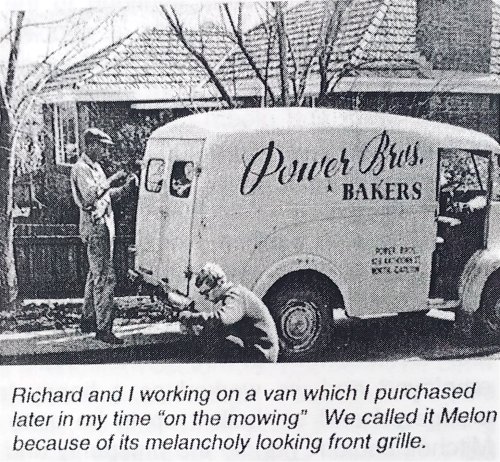
After 12 years of mowing I was finding the going tough at 52 years of age working in all weathers, rain or shine, so I decided to try and find a job as a sales representative or such like. A position as a storeman at Melbourne University Union catering was advertised so I applied. We didn’t hear anything for several weeks and then one day I got a letter asking me to come for an interview. I was told that they considered me too old for the job, but seeing I had experience in the grocery I informed them that I had a trade they would employ me. I informed them that I had a business to dispose of and they said they would wait two weeks while I sold it. After two weeks I contacted them and told them that I hadn’t been able to sell the business, nobody being interested. Their reply was that they were prepared to wait and that they had decided that they hadn’t offered me enough wages and were increasing it by one pound a week. To take on this job it meant my income dropped by about half from what I had been getting from the mowing, but Jessie and I decided that we could manage. The very next day, I was put in contact with a man who bought the business. The income from the sale enabled me to pay off the mortgage on our house.
After a few years in the store I was approached and asked to take on the position of Purchasing Officer for not only the catering but also for all purchases for the Union building. Except. for the catering which was my main task I really only was a signature to the purchases requested by the managers of each department. In 1979 I was due for long service leave so we spent 4 weeks in Philadelphia visiting Jessie’s Auntie Dora who had been a missionary in China and Thailand for 40 years and from there we spent 4 weeks in the UK. Most of this is recorded in Jessie’s diary of the trip. I continued at the University for 12 years but towards the later part I found that each new catering manager wanted me to buy supplies from their mates. We had a few differences of opinion and one particular manager complained to the Administrator who told me that the catering managers were paid a lot more money than I was and it was their responsibility if they overrode me in buying. Finally a Catering Manager asked me to take over the purchases of all liquor used on the premises. I know why I was asked. It was because of all the stealing going on. I told him I was morally opposed to doing so and that I was too near retirement to make a study of what was needed. After some time, six months or so, he showed me a letter from the University Accountants saying that all liquor sales had to go through Mr Morton’s office. I let him know that I was still opposed but I would give him an answer on Monday morning. Jessie and I talked it over and decided I should take early retirement rather than cause an upset. They appointed a young lad of about 18 to take my job. I think they wanted someone they could push about.
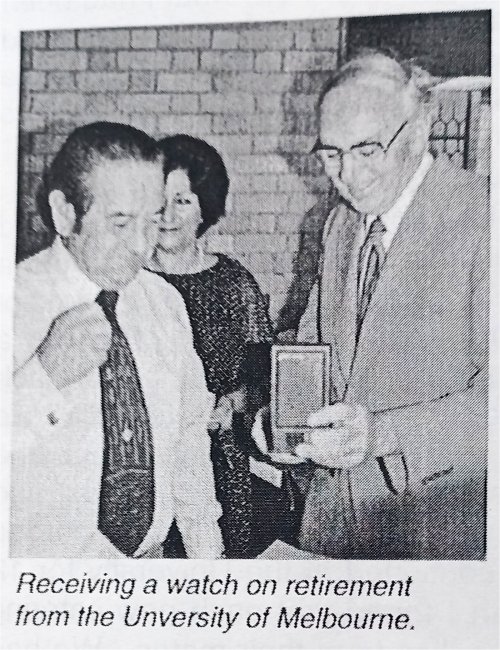
I wondered what they would do about a farewell for me as the normal thing was to have a booze-up. I had generally refused to attend such farewells in spite of their urging me to come along, so one day I said I would come if they supplied orange juice, which they did, and I was interested to see the number who availed themselves of the alternative. At the farewell they gave me there was no liquor, only tea, coffee and orange juice. In making my speech I thanked them for their consideration.
As I had a small superannuation I was able to take one third in a lump sum and the rest is paid on a monthly basis. This enabled us to manage financially until we could get the pension. At the time of writing this record I have been retired for 15 years.
RETIREMENT
People ask what you do in retirement? I had quite an interest in the magazine ‘Assembly Links’ having been on the committee for some years, and as Ray Wilson, the editor, was having a lot of health problems, I took over that task which I did for 9 years, after which I was assistant editor until I retired from the Links committee on 6 October 1996. During those 9 years two weeks of each month were taken up with finding material and preparing it for the printer and then looking after the dispatch.
During these last 15 years we have been able to make some lovely trips such as those to Fiji, New Zealand and the Sunshine Coast in Queensland, travelling with Harry and Bertha McKeon. The holiday in Fiji was taken in between two coups in that country when the Fijians attempted to take back control of the country from the Indian population who owned and controlled much of the business of the country and had a strong representation in the government of Fiji. Because of the unrest and the drop in their tourist trade, prices were quite low for accommodation and travel. In all of our travels we always took with us a list of assemblies and were able to enjoy Christian fellowship wherever we went. Retirement has given me the opportunity to do a little wood-turning as a hobby, and also to do more tapestry work.
MY SPIRITUAL JOURNEY
Because of our many escapades as children Mother used to say that the Lord must have some special work for us to do or we would have been dead years ago.
My grandparents on my mother’s side were Wesleyan Methodists but my grandmother on my father’s side belonged to the Exclusive Brethren, who in those days, whilst being exclu-sive, were sound in their teachings, though mystical in their application of Scripture. My father met my mother at a church prayer meeting but never seemed to have much interest in spiritual things I only remember him attending church for an occasional special event. He did take me to hear Gypsy Smith in the Adelaide Exhibition Building, but I do not remember any follow-up references about it.
At Stanley Flat there were neighbours who had bought their property from Dad. They belonged to the Open Brethren and had a small Sunday School in their home and Mervyn and Apparently Gordon were their first pupils. I was too young. sometime while we lived at Clare Dad had an interest in the Cooneyites, but I never heard to what extent. Mother refused to have anything to do with it and many years later when dad seemed to be far from spiritual things a relative told mum that it was her fault because she wouldn’t go with him when he was interested.
When we moved to Adelaide we attended the Prospect North Methodist Church, Sunday School, Endeavour Society, Band of Hope and Good Temperance Lodge. At one stage I sat the Scripture Examination and still have the certificates. During our 10 or so years in Adelaide mother kept in touch with Mr and Mrs Kerr and their daughter Celia, who had run the Sunday School at Stanley Flat and had moved to Adelaide and attended the Open Brethren in Carrington Street, Adelaide. Mother took me there on a couple of Sunday afternoons when Mr Kerr was using a model and speaking about the tabernacle. I think it must have been over my head as I do not remember anything but a little of the model.
When we moved to Bow Hill Mr Kerr got in touch with Mr Bill Black at Purnong, who was a full time worker in the gospel, in fellowship with the small assembly of Open Brethren there. He used to come to our house in Bow Hill each Saturday night for a couple of years taking a Bible study with us. Dad used to refer to him as a Bible basher. We attended the local Methodist Church service in Bow Hill which was held in the local school building which was on the corner of our property. It also was used as the local dance hall and for other things.
As a result of the Bible teaching we were getting, especially about the Lord’s return, I came under deep conviction of sin and battled with this for two years. Gordon and I didn’t discuss spiritual things to any extent so I didn’t know if he was born again or not, so that if we were working together, and he went to do something else without telling me, I would be sure the Lord had retumed, taken him and left me behind. This caused, what I now recognise as ludicrous situations, but were then matters of deep concern. It was at Easter in 1935 that Mr Don Kidd came to Purnong to speak at Easter meetings at the local assembly. These meetings were held in the Mechanics Institute and on the Sunday night as we were going out of the hall he said to us, “Are you saved?” to which both Gordon and I replied, “No, but we want to be.” He took us over the road to Mr Bill Black’s little tin werk house and there read to us from John 3 and pointed out the way of salvation. We both, together with Don Kidd and Bill Black, knelt on the floor and accepted the Lord Jesus Christ as Saviour and Lord. We said to both Don Kidd and Bill Black, “You will be able to hear us singing all the way home, five miles away!” Actually we never spoke to each other all the way, Gordon on horse back and myself on a bike. We were too full for words. There is a report of those Easter meetings and our conversion in the June 1935 issue of Australian Missionary Tidings magazine, a copy of which is in Tidings office Sydney. I was eighteen years of age.
My father was up from Adelaide for the weekend and on the Easter Monday he wanted us to do something like get some mallee roots ready for him to take back to Adelaide but we told him how we had been saved the night before and wanted to go to Pumong for the day for a picnic arranged by the Christian visitors from Adelaide before they returned home. After Dad returned to Adelaide he wrote us a letter saying he was very disappointed at the state of the farm but very pleased about the stand his sons had taken. It was some time later that Bill Black asked us about baptism so it was arranged for it to take place in a run off from the River Murray at Purnong. (A Mrs Jack Johns was baptised on the same day, but unfortunately she later on had a mental break down and had to be put in a home. Her husband divorced her and remarried and many years later when she was released she couldn’t understand why she couldn’t go back to her husband. It was all very sad.)
When we decided to be baptised we wrote to our Father and told him of our decision, and explained in the letter what baptism was and its symbolism of death and burial and being raised to walk a new life. He replied to the effect that if baptism was what we described then he was not against it but he was opposed to infant sprinkling.
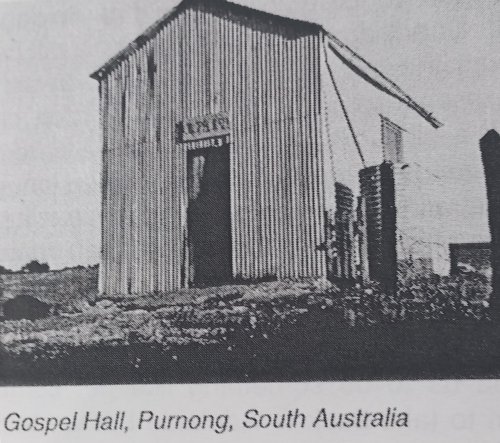
On Sunday mornings Gordon and I would get up and do the chores and then change and take a few sandwiches with us and go to Purnong to the Breaking of Bread service. There were never more than half a dozen of us and sometimes there were only three and the third person was a lady in her 70’s who would row her boat about a mile along the river to be present. She brought with her a little scone she baked for the occasion for the communion bread. Gordon and I would eat our sandwiches down by the river and then conduct a Sunday School in the afternoon, then ride home for the evening jobs on the farm and then return for an evening service.
Sometimes we used a jinker and took the girls with us and then later on mother bought from her brother Fred, a motor mechanic, a four cylinder Buick car for £25 ($50) and that made life easier. Our tools for preaching were meagre. I had a Schofield Bible and Nicholson’s Bible dictio-nary. It was by the Lord’s grace that we de-veloped our teaching and preaching skills On one of my trips to Adelaide, when visiting Mr Kerr, he gave me a book on learning New Testament Greek on the condition that I learned the Greek alphabet. It was many years later, in Melbourne, that I completed the task when I attended evening classes on Greek at Melbourne Bible Institute. Gordon, Len Higgins and Bill beside the Buick When we lived in Birdwood we attended the local Union Church three Sundays a month and the fourth we went to Adelaide to the Goodwood assembly. This Union Church was a misnomer as the two elders who dispensed the bread and wine wouldn’t talk to each other during the week. It was at Birdwood that I introduced Jessie to the Band of Hope Society and the ditties they sang about the horrors of alcohol.
When we moved to Melbourne we lived with Jessie’s parents in Camberwell for two years and we attended the Cam-berwell assembly. Whilst there six young men, myself included, went on the first Sunday of the month to help the struggling assembly at Geelong. We got there in time for the morning service and then did visitation in the apartments and houses near the hall in the afternoon and then conducted the evening gospel meeting. We used to have meals with a Mr Jones who was a water diviner and was trying to use the same method to locate oil in the district. We used to say that one day the papers would come out with a headline “Brethren strike the good oil”. We were a happy team working together and I was generally referred to as the Archbishop, but others of the group were ahead of me in spiritual understanding. When I first spoke at Camberwell at a prayer meeting Mr Clayton introduced me as a visiting speaker from Adelaide so that also stuck as a title.
When we moved to West Heidelberg we attended the Preston Assembly and travelled there by bus which meant walking to Bell Street which the children found trying especially at night. About the time we commenced there, Mr Meggs also started to attend and he had an old tourer car and we travelled sometimes with him but we found his driving was a bit scary. Mr Meggs became a ‘grandfather to the family and his experience and knowledge was a great help. When we acquired our own car we used to take him with us, and as he was deaf, we always took him in for supper and I would go through the meeting with him and try and fill him in with what he had missed. This was a great help to me personally.
I mentioned earlier about studying Greek and I found this a tremendous help with memory training. At that time Sunday School was held in the afternoon as it was considered correct to have worship before service, but later on we had morning Sunday School. We became involved in the Sunday School work and at its peak we had three Sunday Schools running at Preston, West Heidelberg and Kingsbury and each of them had up to 100 scholars. The Preston assembly was responsible for the commencement of the East Coburg and Warrandyte assem-blies, and some of us went to these assemblies once a month to assist. I was able to move around quite a number of assemblies preaching the gospel.
While at Preston assembly I used to attend the Combined Meeting of Elders once a month and from there I was asked to join the Christian Brethren Trust, which holds the title deeds to many of the Brethren church and camp properties. I was secretary of the Trust for quite a number of years and had a special interest in the maintenance of the Hillsview and Grace-court Retirement Homes. Also from the Combined meeting I was asked to accept a Marriage Celebrant’s licence. I retired from the trust when I was 73 and about the same time handed in the celebrant’s licence.
After about 29 years we moved to live at 8 Smythe Avenue, Mont Albert and started attending the Deepdene assembly. We have been happy there for about twenty years and at the time of writing I am still an elder there though I think it’s nearly time to give up although I have not a clear conviction to do so. I do not do much preaching around the assemblies these days but do have three devotions a month with the elderly folk at Hillsview, Gracecourt and the Baptist Home Karana, as well as teaching in the local assembly as required.
Jessie and I moved to 4/5 Cherry Road, Balwyn in August 1997.

