Farming with Clydesdale horses at Kybunga, South Australia
by Jim Longmire
This article appeared in the August 2017 edition of TULLE, the Journal of the Australian Guild of the Lacemakers of Calais.
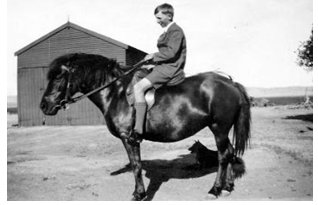
Selected Stories of Les Longmire (1913-2002)
[Jim Notes: In keeping with our theme the stories which follow paraphrase some yarns of my father Les. I am the current Editor of Tulle. These were told to me over the years and I noted most here in 1996.]
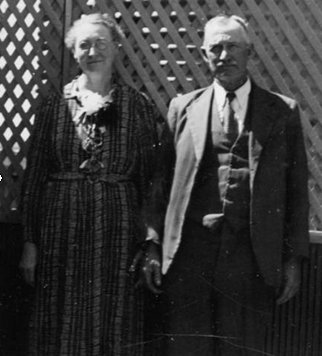
On our farm in the old days my father William (Will) LONGMIRE the proprietor insisted that no person should sit down to eat before all the animals, working ones and pets, were fed and watered (at daybreak and evening.)
Dad (Will) slaughtered a ‘killer’ sheep most Mondays. He kept a quarter of the carcass and Uncle Walter (Wop) and Auntie Myrtle LONGMIRE over the road received a quarter. Peg was their daughter. The rest was divided between Eric HOWARD’s family (a WWI returned soldier living a mile to the south at Howard’s Corner and the family of Ted BEST working on the farm.
Tulle 136 (August 2017) 21
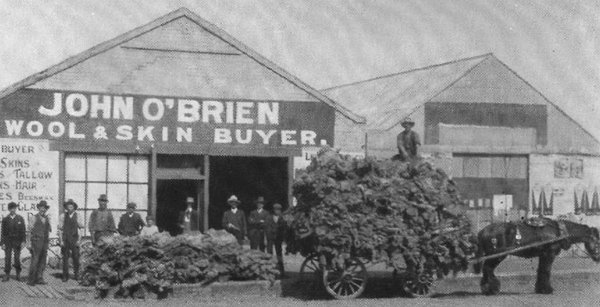
The dogs got the scraps and some offal, although lambs fry, onions and mashed potatoes inevitably was served at home the next day – one of my favourite dishes. The sheep’s carcass was hung and covered in a meat bag and cut up when set a day or two later. The longer it hung the more tender the meat and the busier the blowflies around the meat bag! After being cut up the meat was kept in the safe cooled by water splashed on hessian bags covering it (another job for the girls and women.) The meat safe was on the back veranda and the dogs used to sniff around a bit. Meanwhile the sheepskin was hung over the rails in the shearing shed where it dried and meat was picked from it by crows. Later the sheepskins were sold to the wool and skin merchant who came around occasionally.
My Mother Edith L (née VEITCH) always did the washing on Monday. She used a copper heated by wood chips to boil water for the linen and the dusty or very-muddy work clothes. The clothes line was a strand of light cable and was secured by posts set well in the ground. Later these were to be replaced by rotary Hills Hoists possibly the most-recognised invention of South Australia. Wooden laundry pegs were strong then. We had a chip heater for a bath after work. I started shaving with a razor and strop. The Gillette safety razors came later.
Tulle 136 (August 2017) 22
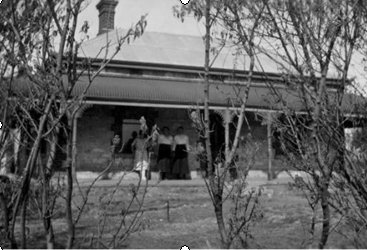
We had big canvas waterbags on the veranda and carried the smaller portable ones out to work. Always a dog or two slept on my bed in
the back room of our home known as Alva House. It was named after the town in Scotland where our maternal ancestors the DAWSONs lived. They emigrated from there to South Australia in 1856 (IRELAND, 1972, Appendix B.) The women and girls were always very busy and worked hard doing various jobs, milking, gardening, weeding, sewing, making things, cooking great tucker and so on.
Most weeks my Dad Will LONGMIRE went to the neighbouring town of Blyth on a Friday and he would bring home fritz and sausages from the local butchers of German descent. We loved the fritz in cold salads and sandwiches. Friday was a great day out for the cockies (farmers) who would meet in Blyth. All of them would bethere. Anyone with a new car, their first, didn’t let the women drive it. Old Mr JERICHO had been to Adelaide and driven home rather wildly along some rough tracks north of Mallala. He said to Dad: ‘Mr LONGMIRE, I’ve just bought a new chiseller with a duck-oh finish!’ having just purchased a Chrysler with a duco finish.
When I was about 12, my twin sister Dulcie and I managed to borrow a few quid from our older brother Stan at the Blyth Agricultural Show. This paid for a joyride over the showground in a tiger moth-like biplane which I arranged. Imagine us two young farm twins lapping around the show scene in a biplane piloted by some Biggles-like character. Much later I acquired the nickname Ginty.
Tulle 136 (August 2017) 23
[Jim notes: Recently I searched for the origin of that nickname so decided to google it. The most notable Ginty of those times in Australia was a WWI ace pilot with that nickname and the name P.J. MCGINNESS. He was a co-founder of QANTAS and a strong promoter of rural air services in Australia. I suspect that the nickname Ginty came after Les and twin sister Dulce went on that joyride.] When my father Will heard about the biplane saga at the show he said ‘You cranky young beggars!’
The railway line ran along the eastside of our property and a steam train would pass by both ways daily – northwards in the morning and back to Adelaide in the afternoon. Our horses were attuned to the train choof choofing along and to its whistle. So they had learnt about the big iron machine and were not spooked by it.
However, horse teams coming in from further west with waggon loads of wheat were spooked by it. Many times after being stirred up by the train these horse teams bolted down the road westwards past the Kybunga primary school towards the seven cross roads junction, at Bowillia. They were heading home while the reinsman was trying to pull up the team before the bags of wheat were strewn everywhere. Often it took a mile or two to stop the teams, if at all. And a fair few hessian bags (weighing 180 lbs or 80 kg) had to be picked up, rebagged and sewn again later on. There were some really bad trolley accidents because of the train. Too many great horses died.
Tulle 136 (August 2017) 24
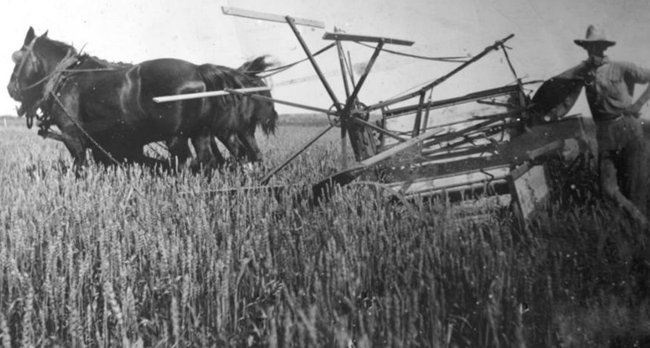
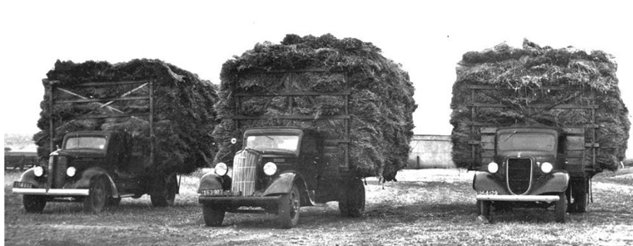
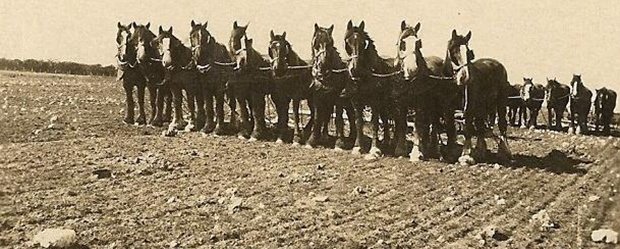
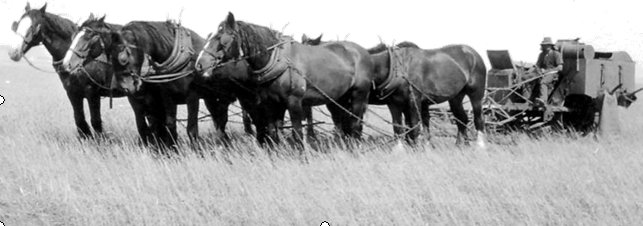
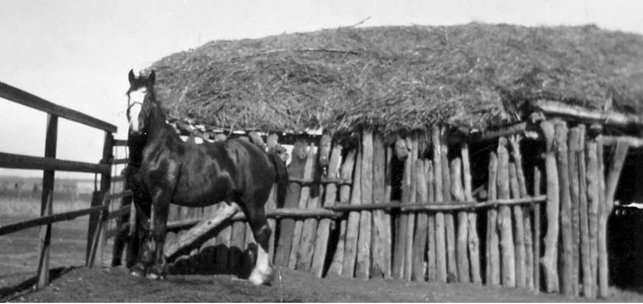
Embers from the train started a few fires on our place but we always ploughed firebreaks around crops and pasture. The mouldboard plough cut the best firebreaks and we could back burn off the last furrow cut. We never lost too much crop or grass to fires. Once the small block over the railway was burnt out. I don’t recall big fires on the rest of our land. We made lots of sheaved hay with binders and the haystacks were always neatly built to shed moisture. The draught horses ate a lot of feed which we grew at home. We fed them in a huge trough and they used to line up in the same order each feed.
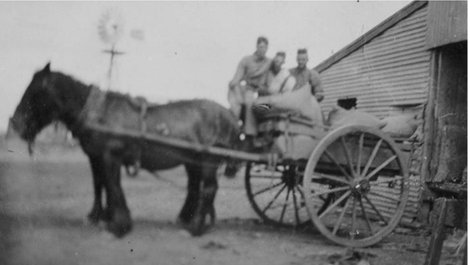
LONGMIRE horse team & tip dray [with Les LONGMIRE & Stan (Smokey) & Rex MCSKIMMING, good mates] with a few bags aboard.
Tulle 136 (August 2017) 25
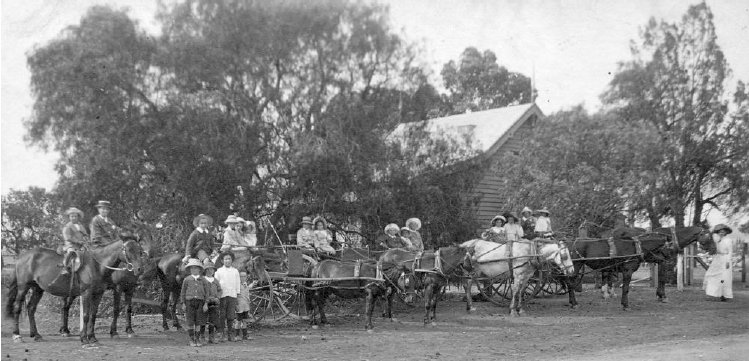
We used to go two miles to primary school at Kybunga in a horse and cart in the early 1920s. One day we had a minor incident on the way home from school with neighbours the MCSKIMMING children in another cart. My sisters, Dulce and Jean and I were in our cart which was drawn by Bob. With nobody hard on the reins as usual he decided to run between the telephone pole and the fence. This was down by ROBERTS’ farm not far from Kybunga. Woops! Out the Longys went – all of us! We hit the dirt on our backsides. No seatbelts then! Bob just wanted to catch up with the neighbour’s cart horse Lanky. In their cart were Jim, Dulce, Joan and Lex and they all laughed their heads off. The MCSKIMMINGs had the wildest laugh around. Dulce my twin sister, Jean and I were dumped. But we hit good red earth and tussock grass so apart from a few dirty marks on our clothes and a sore backside there were no dramas fortunately. Mum and my oldest two sisters Edith and Ann did the washing then but we all had some explaining to do..
Bob HUNT began work for Uncle Stan TILLER and was sent out with five harrows and a five-horse team one day. He was told to harrow up and down the paddock. Uncle Stan TILLER said ‘He didn’t get over the paddock very quick. What is he blarn well up to?’ Guess what? Bob harrowed up and down all day over the same
| Tulle 136 (August 2017) | 26 |
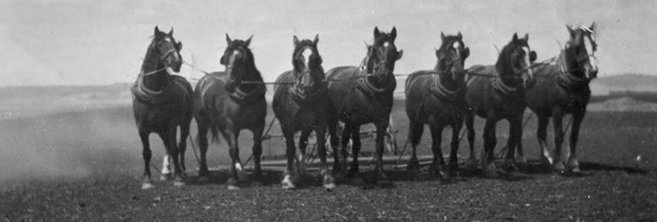
ground! He was a newcomer and did not know he was meant to move over a 5-harrow width having done one row. The Clydesdales must have been rather confused but had a light day’s work harrowing very fine fallow all day.
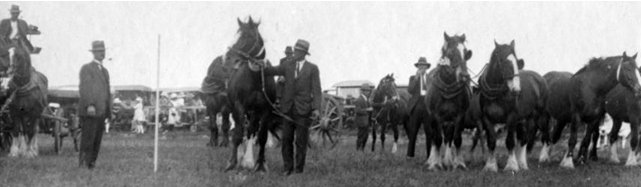
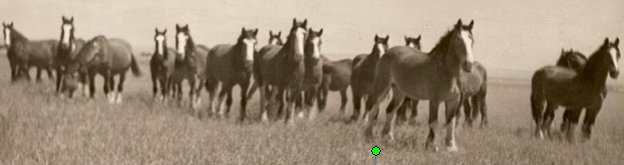
I loved working with the horses. They were big. They probably ranged in height from 17 to 19 hands (1.7-1.9 metres tall at the withers or shoulder.) Most probably weighed 800-900kg but some maybe a ton. I was just over 6 foot tall so had to stand on tiptoes to look over one. We had some wonderful draught horses who knew when to turn and when to stop. They’d work long hours all day too. All were different in character. They loved their work and the daily routine. The horses and we farmers worked very long hours and they knew by call or whistle what to do. But often that was not needed.
Tulle 136 (August 2017) 27
Kate was my favourite lead horse, but we had Donald, Micky, Tommy, Rosie and numerous others with simple names. Kate would turn always when she should without even a twitch of the reins, whistle or call when working the field and all the team of horses would follow her.
We used to take some to the local shows but they never took out many prizes. There were ploughing competitions in the early days. This was with a single-furrow plough and one horse only. Our horses worked in teams mainly with wheeled farm implements made of cast iron. Grandma won more prizes with the apricot and fig jams in the local shows. We loved the various jams with fresh cream on homemade bread. They were our staple diet.
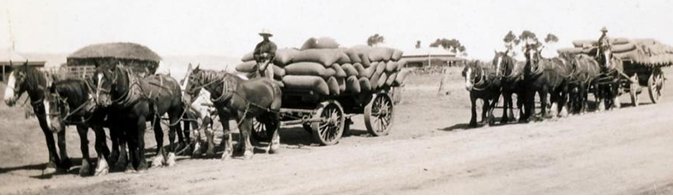
In the depression, wheat prices dropped back to one shilling and sixpence a bushel, or five bob a bag (i.e.25 cents per 80 kg). Our wheat was sold then to the same agents. My Dad Will LONGMIRE sold his wheat through Louis Dreyfus, an international grain trading company. He always seemed to get a better price with them. They were in a pretty big way with wheat exporting from South Australia. Dreyfus always used to be able to offer a loan from Adelaide ifGrandpa needed some money. The banks were pretty tight in those days.
Tulle 136 (August 2017) 28
Uncle Kite took up land at Lock on the West Coast (the local name for Eyre Peninsula, South Australia). He went ‘arse up’ during those early days and Dad bought him out. It was a good farm but it put my Father under a lot of pressure financially. My older brother Stan took it over. I went over there to work for about six months on the farm when I was about 18 or 19. During that time Stan got crook. It was good country, about 3000 acres of mallee land. The crops were taken off with strippers, the swathe (mainly grain and cocky chaff) was winnowed by horse-powered machines and the grain was carted toLock, an important receival point for bagged grain then. All bags were of hessian and when filled they had to be sewn with twine, another hot job after harvest for farmers until bulk-handling of grain came in the 1950s. Sadly Kybunga missed out on a big wheat silo and dwindled quickly as a grain siding to nothing by the 1960s.
A very important job for one Clydesdale horse hitched to a machine was bag lifting. The bags then weighed 180lbs (80 kg), considerably more than the 20kg standard bag for fertilizer or garden soil today.
The bag lifter was a simple machine fixed to the ground. It was worked by a single draught horse hitched by collar, chains and swivel to a frame that would lift a bag from ground level to the height at which it could be lumped on to the shoulder of the wheat lumpers standing on the floor of the waggon. The floor was about 5feet above ground. The horse had to be accurate and steady with this job as the bags were lifted about 10 feet above ground level. Some could do it without a person leading them. But of course a bloke would be putting the bags to be hoisted on the lifter at ground level.
The PRATT family of Blyth bought a place at Lock on Eyre Peninsula too. To help farm the West Coast properties the LONGMIREs just south of Kybunga and the PRATTs about 5 miles west of Blyth walked Clydesdale horses the 50 odd miles to Wallaroo with a mob of 40 to 50 working horses all together. They were shod by local smithies but walked without even a halter. At Wallaroo they were taken out on to the jetty one by one and walked via a wide loading plank on to the main deck of a coaster and
Tulle 136 (August 2017) 29
shipped across Spencer Gulf to Cowell. Old Mr PRATT was seasick almost before he left.
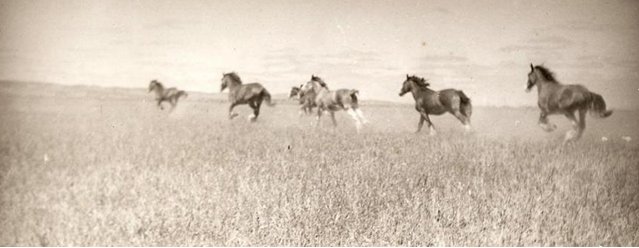
One of the PRATT horses jumped overboard while out to sea. I saw them get the horse back by winching it out of the deep blue water. One of the sailors slung rope under the horse while it was swimming out in the briny sea. Neither horse nor sailor worried about the great white sharks who never appeared fortunately! What a great job the seaman did. He made a sling with thick coir rope which then was tied to the chain of the ship’s crane to hoist the horse aboard. And that Clydesdale weighing not much short of a ton was brought back unharmed. We all got home to Blyth and Kybunga OK. The horses came home in great condition. Horses were valuable those days. We needed them to make a quid and we looked after them accordingly.
[Jim notes: I heard a story recently of a thoroughbred horse who was being exercised by swimming along a beach facing the Pacific Ocean near Sydney. For some reason he started swimming out to sea and the handler could not stop him, eventually letting him go. They went out in a boat to try to retrieve it but the weather and seas got rough and they could not find the horse. They did the same for the next two days. On the third day the horse returned ashore, rather tired but none the worse for wear. As told to me recently by highly-respected trainer Danny WILLIAMS of Goulburn NSW]
Tulle 136 (August 2017) 30
The Clydesdales did their job in the mallee country on the West Coast but were happy to return to the red soil plains of Kybunga and Blyth. One thing about farming then which you do not see now is this. It was full of life with many workers and horses about and hard work for all including the women who kept the home going, the smaller enterprises and so on. Today farming is still hard work but is all about much bigger machines and modern thing-a-me-jigs. Farming is different now. I preferred the old days of the draught horse, mouldboard ploughs and waggons.
Reference Marananga via Greenock, South Australia. [Available upon request from jimlongy@gmail.com ]
Tulle 136 (August 2017) 31
Reference
IRELAND, Kingsley. 1972. The DAWSON Family. Appendix B in The Family History of Hiram LONGMIRE 1814-1880. Self-published: Marananga via Greenock, South Australia. [Available upon request from jimlongy@gmail.com ] Kingsley advised me on 28/7/2017 that the year of arrival of the DAWSONs at Port Adelaide is 1856, not 1846 as published in 1972. See: http://www.theshipslist.com/ships/australia/amazon1856.shtml .
| Tulle 136 (August 2017) | 32 |

