Index
Lucy Moyle diagnosed with breast cancer
The Sheoaks in the 20’s and 30’s
Early Days
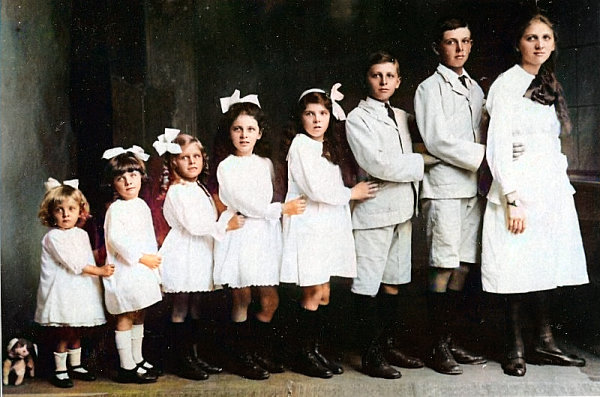
Every second year another baby was born to Lucy and Walter.
From right to left –
Aileen, 1902, April 16th.
Les, 1904, April 21st.
Bob in 1906, March 28th.
Win in 1908, April 0th.
Ada in 1910, January 9th
Mary in 1911, December 19th.
Nell in 1914, February 8th.
Kath in 1915, August 22nd.
All except Aileen and Les had been born in Helensville.
She, our grandmother Lucy Moyle had been missing her sisters. They were thousands of miles away in South Australia.
There is only one correspondence I have from Lucy to one of her sisters.
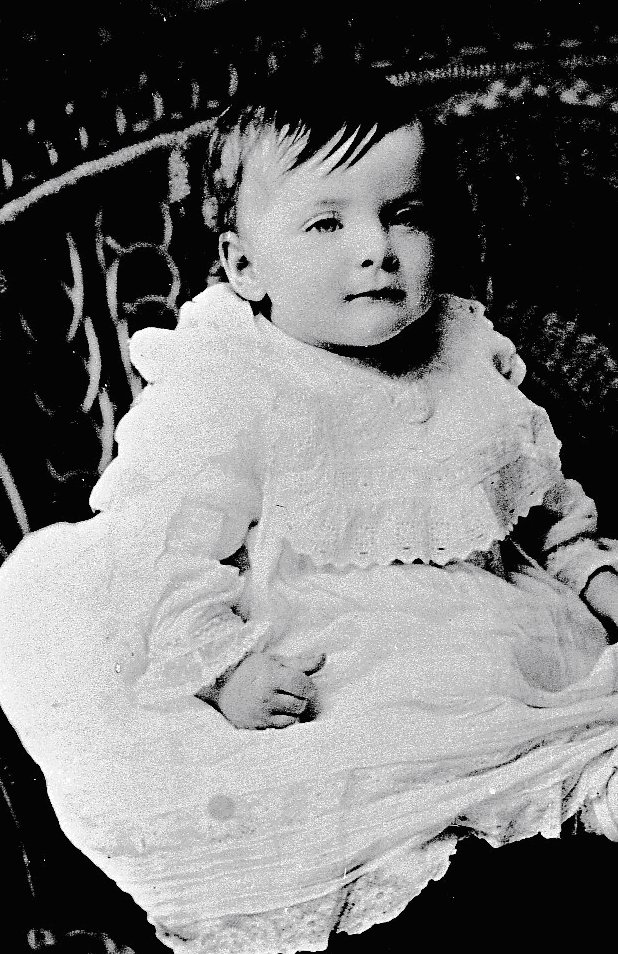
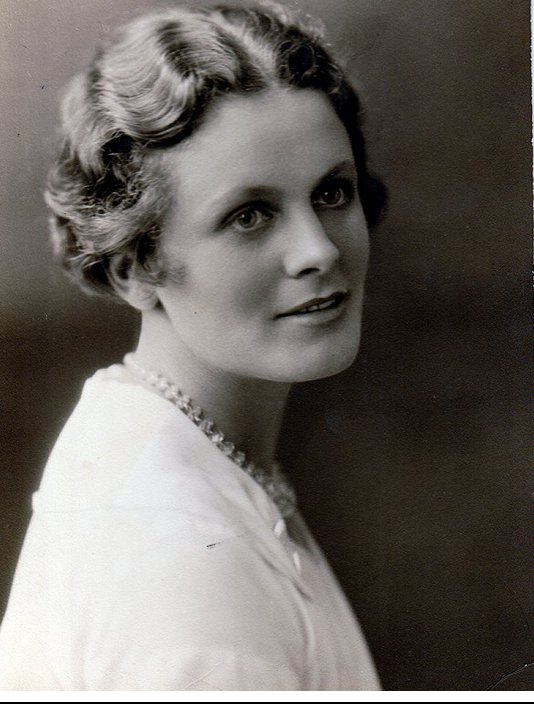
This beautiful photo of Ada was sent by Lucy from Helensville to her sister Mary Lindo (recently married and now Mary McPheat) in South Australia
The back of the photo card has a letter from Lucy to Mary in small writing which covers every possible writing space. It explains many aspects of their lives at the time. It was written in 1911. Ada was by now 2 and Mary had just been born.
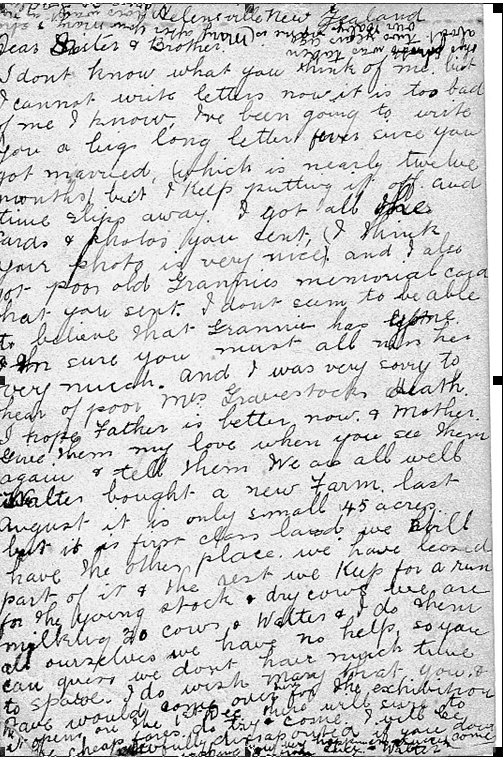
TRANSCRIPT of Letter/card
“Dear Sister and Brother
I don’t know what you must think of me. But I cannot write letters now. It is too bad of me I know. I’ve been going to write since you got married (which is nearly 12 months) but I keep putting it off and time slips away.
I got all the cards and photos you sent (I think your photo is very nice) and I also got poor Grannies memorial card that you sent. I can’t seem to be able to believe that Grannie has gone. I am sure you must all miss her very much. (see the following note)
And I was very sorry to hear of Mrs Gravestock’s death. I hope Father is better now and Mother. Give them my love when you see them. We are all well.
Walter bought a new farm last August. It is only small 45 acres but it is first class land. We still have the other place. We have leased part of it and the rest we keep for a run for the young stock and dry cows. We are milking 30 cows and Walter and I do them all ourselves. We have no help so you can guess we don’t have much time to spare.
I do wish Mary that you and Dave would come over here for the exhibition. It opens on 1st December. We will ?? the cheap fares. Do try and come. I will be dreadfully disappointed if you don’t come.
Wishing you every happiness.
Lucy and Walter
This photo was taken about two years ago. Our baby is Mary (after you Mary) and she does want a new dress so badly.”
To her Morton sister Mary and Mary’s new husband, Dave McPheat
Posted from Helensville NZ
The card is 9.0 x 13.5 cms
This is an amazing insight into their life in Helensville with so many young children and family responsibilities.
It is clear from this small letter that Lucy was missing her sisters and it is asking Mary to please visit her in New Zealand.
Mary was born at the Helensville Hospital on December 19th 1911
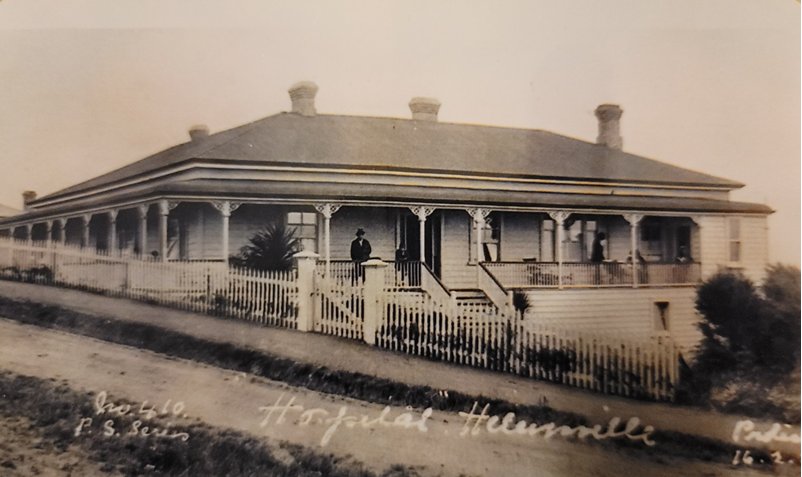
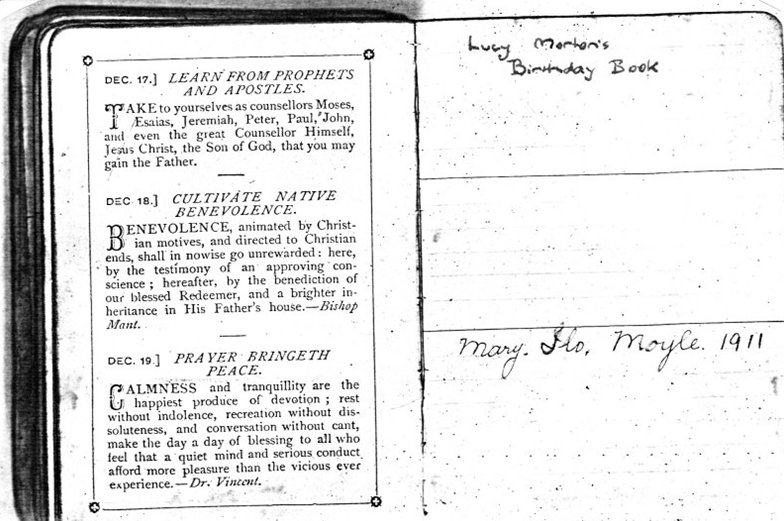
Notice the religious references. The Morton family were strong Protestants and mostly Methodists at this stage.
Aunty Aileen reflected on Mary’s birth for a special book honouring our Mum’s birthday. It was actually Mary Parker’s 75th birthday.
Aunty Aileen, her oldest sister was always very close to her.
“When Win and I were over there(IN NZ) in 1977 we saw the hospital and I pointed out the room where Mid and Mother were.
At the time we were living at Ohirangi on “the Run” which was the name given to the property and it was 4 or 5 miles from Helensville.
Mother was waiting in Hospital for some weeks before the birth and I don’t know if it was because of the distance to the hospital or a false alarm. – but I was attending the Helensville School and used to spend my dinner hour with Mother and she used to share her meal with me . I loved it when she had prunes and rice! Auntie Alice was looking after the family at home.
Then when Mid was nearly 2 years old Mother noticed that she was dragging one leg while crawling, so she was taken to Dr Mienhold who found she had Infantile Paralysis and advised she be taken to Auckland to see a specialist from Australia who was specialising in treatment of such cases because of an epidemic of same. She showed Mother how to massage and exercise the leg and I remember Mother saying she was a real Australian because she had so much hair growing on her neck! She was regarded as being very clever – and well -THERE (pointing to Mum) is a result of her treatment! It enabled Mid to live a very busy helpful life and she is still going strong in her help to those in need.
Mother could remember her mother massaging her leg. She held very affectionate memories of this time with her mother.
Nell was born in 1914 and Kath in 1915.
After the birth of Kath, Lucy Moyle became very ill .
Lucy Moyle was diagnosed with breast cancer.
She was homesick and missing her Morton family. She had left her family in order to be with Walter who had felt the move to NZ was the correct thing to do. It was a very successful new farming and family life in New Zealand.
But now there was a problem.
Lucy was very ill with terminal cancer and she was needing to be close to her Morton family.
They would probably have been content with their farm and family in Helensville had the situation not changed.
Aunty Charlie and Ben McLaren were completely settled and also had 8 children.
The following are photos of their New Zealand family.
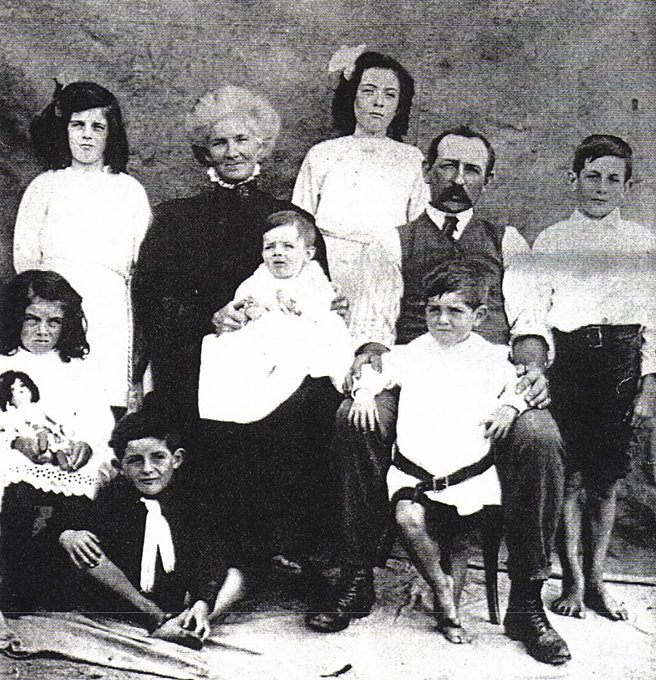
The children of Walter and Lucy and Ben and Aunty Charlie, all cousins, are of very similar ages.
| Moyles | McLarens | ||
| Aileen | 1902 | Eileen | 1901 |
| Les | 1904 | Les | 1902 |
| Bob | 1906 | Dorry | 1903 |
| Win | 1908 | Beryl | 1906 |
| Ada | 1910 | Alan | 1907 |
| Mary | 1911 | Ken | 1910 |
| Nell | 1914 | Don | 1912 |
| Kath | 1915 | Robert | 1905 -1918 |
Although the children had grown up together and were very close, Walter’s responsibility was primarily to his ailing wife. He decided to sell the Helensville properties and return to the Clare district in South Australia in order for Lucy to be with her family. The financial and emotional costs of the shift must have been considerable.
Walter sold both properties in Helensville and brought Lucy, all eight children and his half-sister Rose Day back to Clare. Alice and Edgar remained in New Zealand.
They left New Zealand in 1917 and returned to the mid-north, where the Morton and Lindo families lived.
Mary’s Childhood and Youth
| Significant dates | ||
| 1911 Dec 19 | Mary Ilo Moyle born in Helensville | Mid |
| 1914 Feb 8 1914 | Ellen Grace Moyle born in Helensville | Nell |
| 1915 Aug 22 | Kathleen Frances Moyle born in Helensville | Kath |
| 1917 | Family shifted to Clare | |
| 1917 | Mary attended Clare infant School | |
| 1918 | Mother Lucy Moyle died in Clare aged 37 | |
| 1923 | The Sheoaks bought in Watervale | Family farm and home |
| 1923 | Schooling at Watervale Primary | |
| 1924 to 26 | Clare High School | |
| 1927 | ……..Aileen married Eric Giles | |
| 1927 | Jun Teacher-Apprentice at Watervale Primary | age 15 I think |
| 1928 & 29 | Teacher Training Kintore Ave | Age 16 -17 |
Nell was born in 1914 and Kath in 1915.
After the birth of Kath, Lucy Moyle became very ill .
Lucy Moyle diagnosed with breast cancer
She was homesick and missing her Morton family. She had left her family in order to be with Walter who had felt the move to NZ was the correct thing to do. It was a very successful new farming and family life in New Zealand.
But now there was a problem.
Lucy was very ill with terminal cancer and she was needing to be close to her Morton family.
They would probably have been content with their farm and family in Helensville had the situation not changed.
Walter could see that A Charley and Ben were completely settled and had produced 8 children.
Walter’s responsibility was primarily to his ailing wife and their children..
Walter decided to sell the NZ Helensville property and return to the Clare district in order for Lucy to be with her family.
The financial and emotional cost of the shift must have been considerable.
They left NZ in 1917 and returned to the midnorth where there were Mortons and Lindos.
Walter brought all the 8 children and his half sister Rose Day back to Clare. (Alice and Edgar remained in NZ)
Walter and Lucy had a farm and another piece of land in Helensville. They sold both. They bought sea tickets for the whole family to return to South Australia and the mid north. There was enough money left for a farm in Clare.
Lucy died in Clare 1918 aged 38.
The children all visited her on her sick bed …..one by one.
A Nell and our mother Mary had vivid memories of this. Nell was only 4 years old .
Aunty Nell also remembered her father walking with her in the paddock after her mother had died, and explaining to her that she was a big girl and “you need to be able to put on your own bonnet now”.
This could be a motto for the family.
Their attitude was always…No sulking. No feeling sorry for yourself. No moodiness.
It’s chin up. Get on with it. Be kind and helpful. Do unto others. Pull your weight.
Remember your manners. Stand up straight.
“Put on your own bonnet now.”
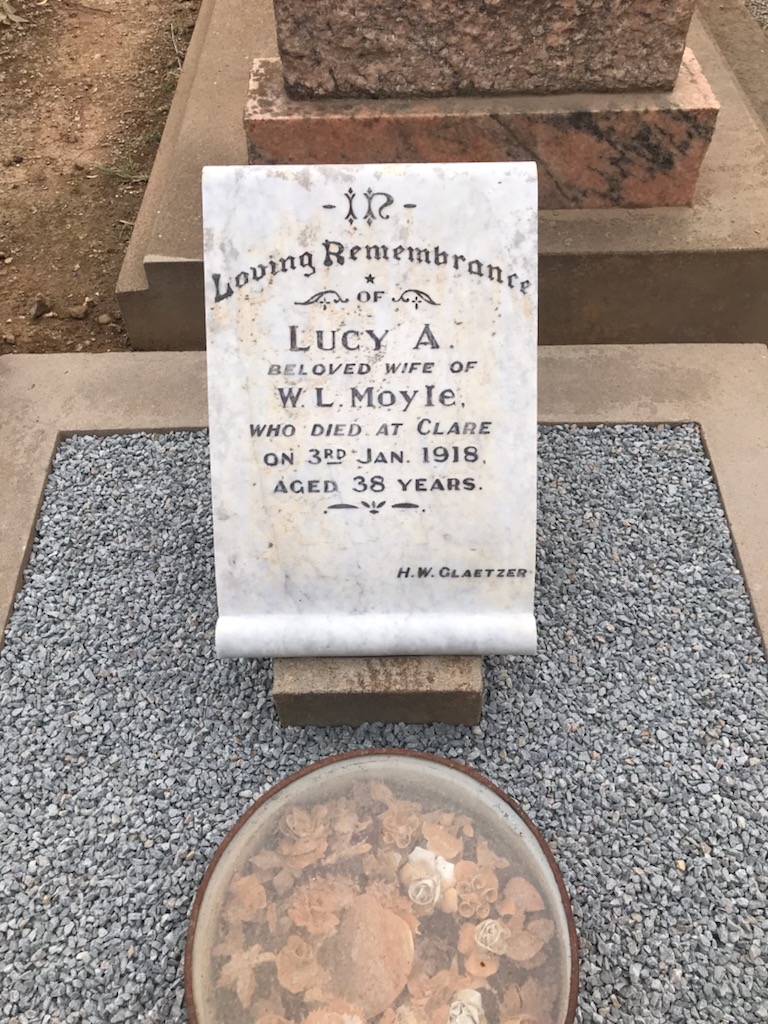
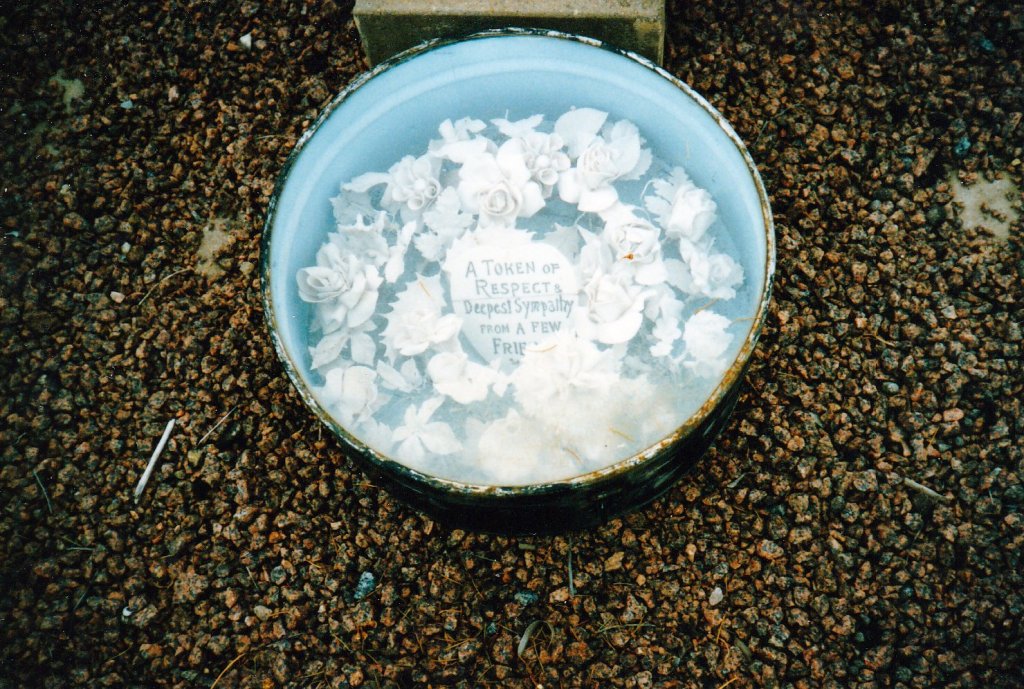
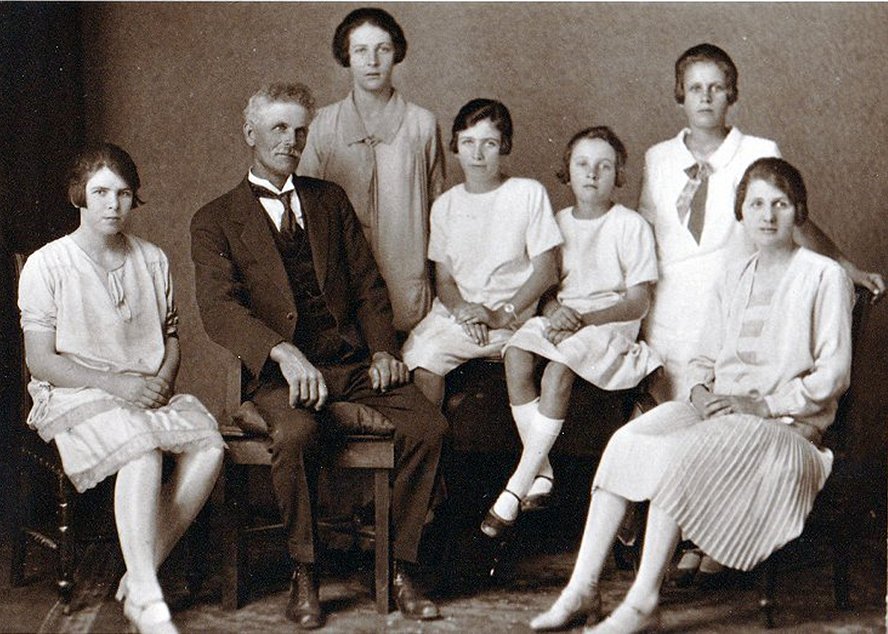
Now here goes the family photo
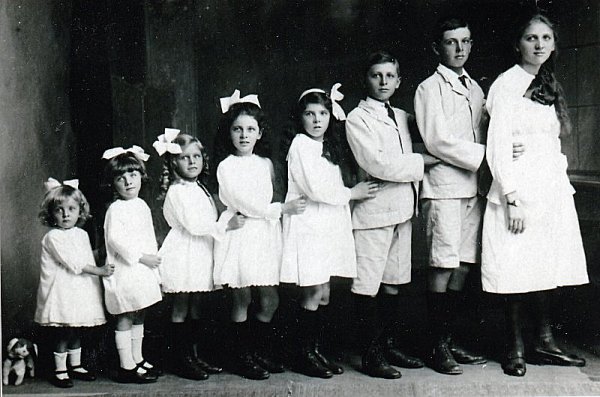
I understand that the famous photograph was taken in Clare by a professional photographer. It was probably soon after the death of their mother in 1918.
Aunty Kath was only 3 and insisted on have her toy dog beside her
They are in their very best clothes . Their hair and ribbons are beautifully arranged. They are handsome and beautiful .
It is also apparent that some people have been very concerned that they are dressed in their “Sunday Best”. Some women have hand sewn all their new clothes for this photograph. It looks as though even the boy’s suits were hand made. I suspect it was Aileen and Win. And maybe other Morton aunts and maybe A Rose. The boots are impressive and especially polished.
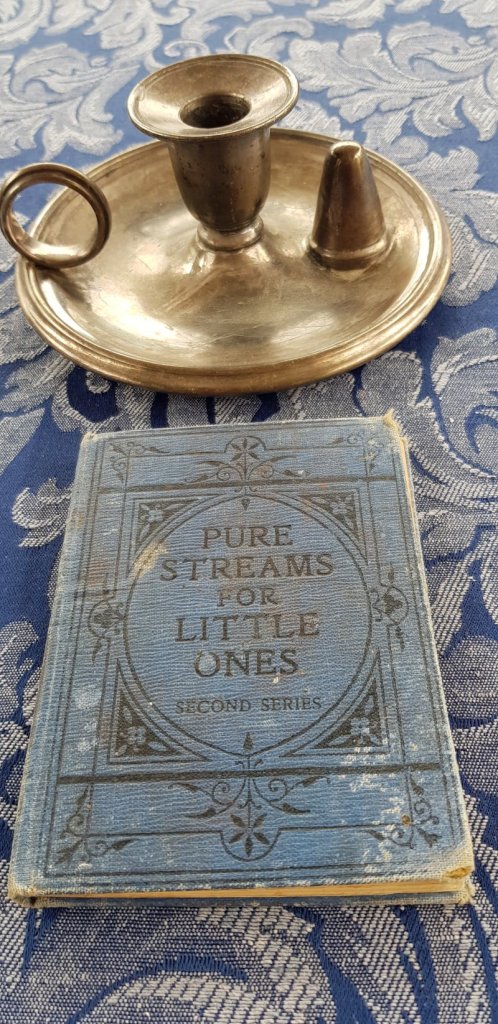
Pure Streams for Little Ones Aunty Janet Morton gave this little book to Mary in 2018, after her sister Lucy and Mary’s mother had died. It was a very special gift at a very sad time. Mary was 6 years old.
Janet may have felt particularly aware of Mary’s withered leg and wanted to offer a beautiful book of guidance and stories.
The book had been well read when I found it amongst the special letters in Mum’s box of momentoes. There was also a second book given 5 years later in 1923.
Both books have beautiful stories of children and families with a strong Christian message in them all.
Owning books was a luxury. There were no others to my knowledge. These little books were treasures.
Further details of the little books may be found by clicking here.
Clare Primary School
After their mother had died some of the younger children attended the Clare Primary School. It was not too far from their Mill St house. Bob was a “big boy” and responsible for walking the younger girls to school.
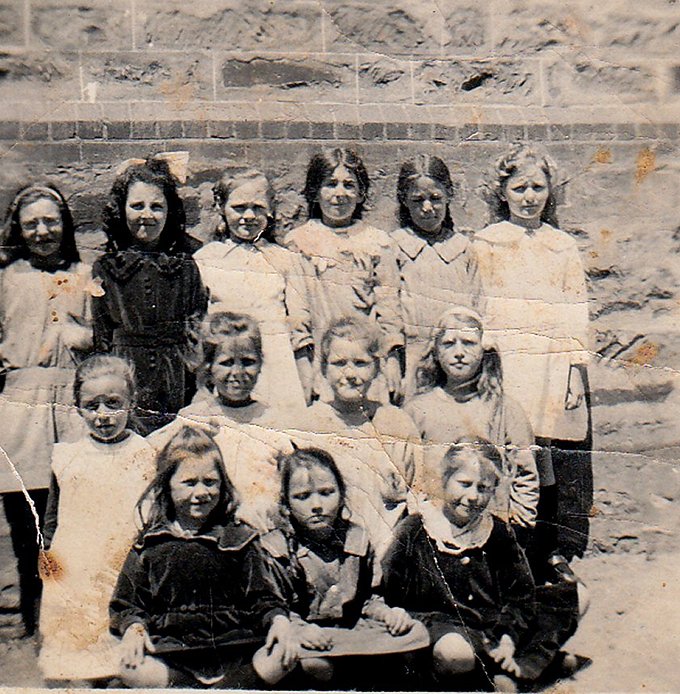
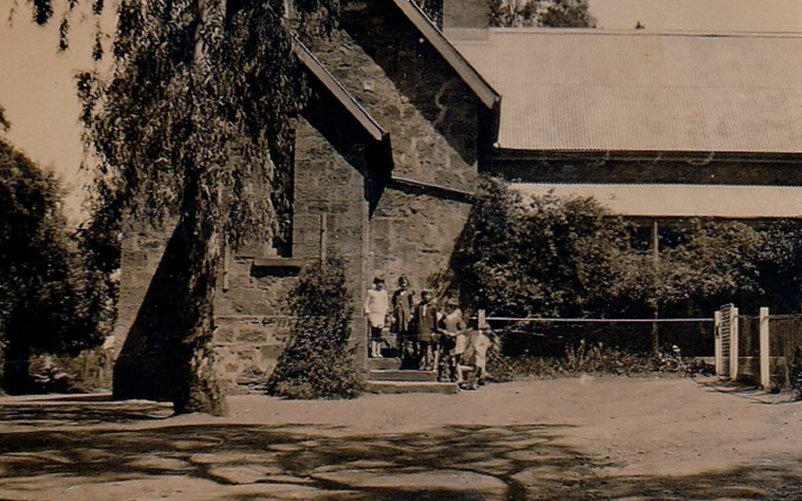
There was a famous night which always stuck in her memory. It was at the time when the family was living in Mill St. It was a concert night for the community and she performed on her own. She was very young. The Clare community were well aware that the children’s mother, Lucy Moyle had died.
The song she sang was “Please give me a Penny sir.”
The first verse is
“Please Give Me a Penny Sir, My mother she is dead.
Ohhhh I am so hungry sir, A Penny please for bread”
One verse would have been enough.
It was a heart stopper
(I wonder if she was wearing her caliper! It could have added to the Victorian style melo-drama.)
The crowd went wild. They loved it and clapped and cried and started throwing pennies onto the stage.
Mid gave it great energy and was quite pleased with her performance. I’m not sure if she collected the pennies.!!!
As an old lady, Mid could still sing it and smile with the memory of her immense success.
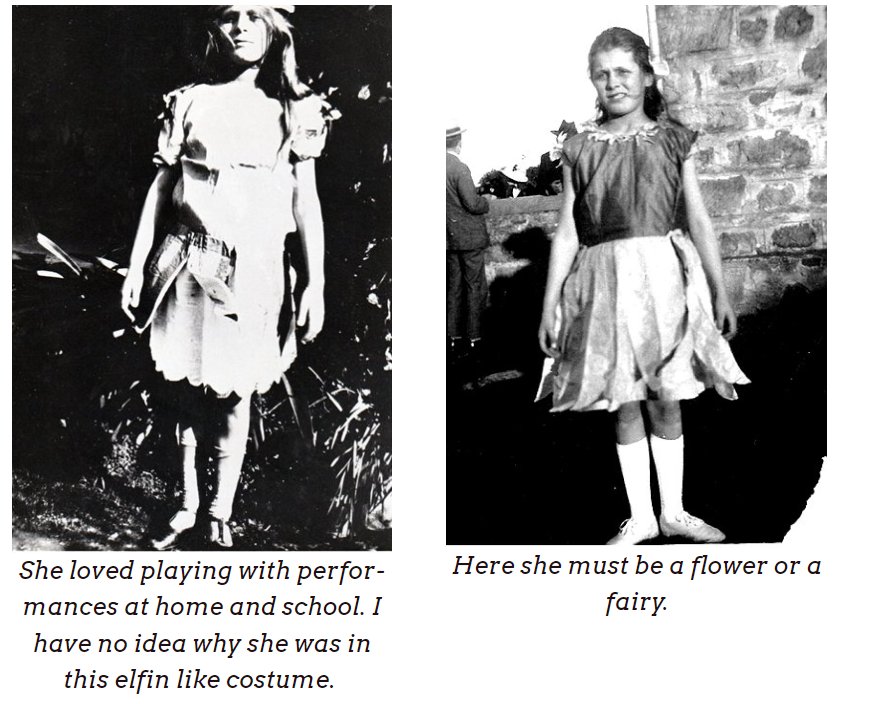
In early photographs, the photographer would always position the person looking into the sun. Blue eyed Moyle children looking into bright sunlight always led to the photo of a squinting face.
I note there is no caliper in the school age photos.
When the children were very young Aunty Rose helped Grandad Walter and the older sisters Aileen and Win with some of the caring and the domestic chores. This would have included sewing all clothes and dress ups for special events.
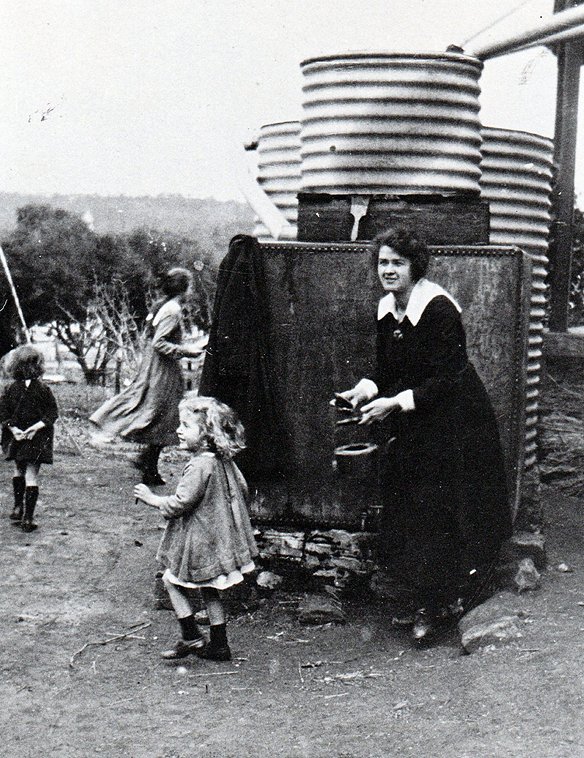
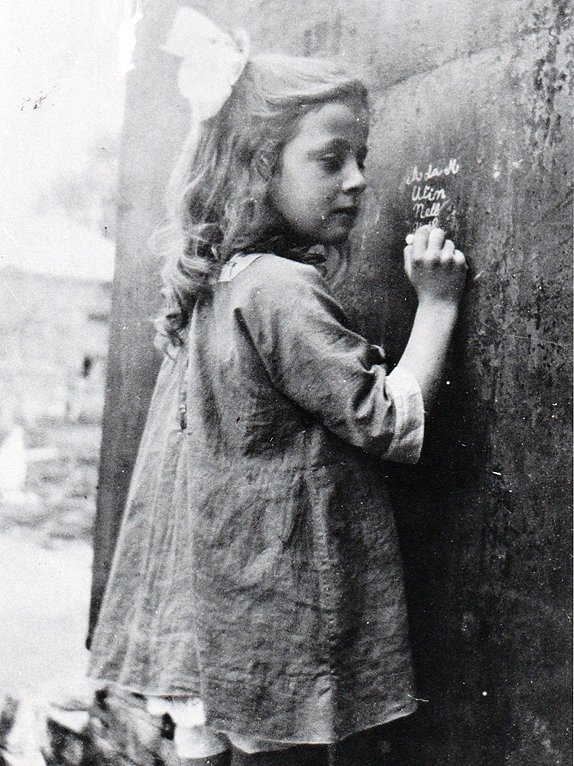
This beautiful picture is very unusual for these times. No posing. A natural everyday shot. I understand it was taken by Uncle Bob. Bob was always interested in taking photographs and he certainly took some beauties when the children were in their teen years. Bob would have been about 13 to take this photo . Les would have been about 15. Maybe their father took it?? Can anyone solve that mystery? It is so rare to fine such natural photographs in these early times. No squinting here!
Aunty Rose helped in the initial stages of the family resettling in the Clare district but she eventually established her own life and married Les Ness. Uncle Les Ness was a well respected Clare gardener. They lived in a small cottage on the block adjoining the northern edge of the Clare Show Grounds. She was still a regular visitor to the Sheoaks and loved by all the aunts.
I remember staying with them in their wee cottage. Maybe it was 1947. The cottage was literally abutting the Clare railway line and the train coming past was a dramatic event. It happened only once or twice a week as I recall.
They had no electricity in those days, so at night time 2 oil lamps were lit. The lamps had a very warm romantic glow. Aunty Rose was a smoker and I loved the smell and the ambience of their back dining table/living area. In the 50s they shifted to a house on the Main Rd at the southern entrance to Clare. Of course it had a beautiful garden.
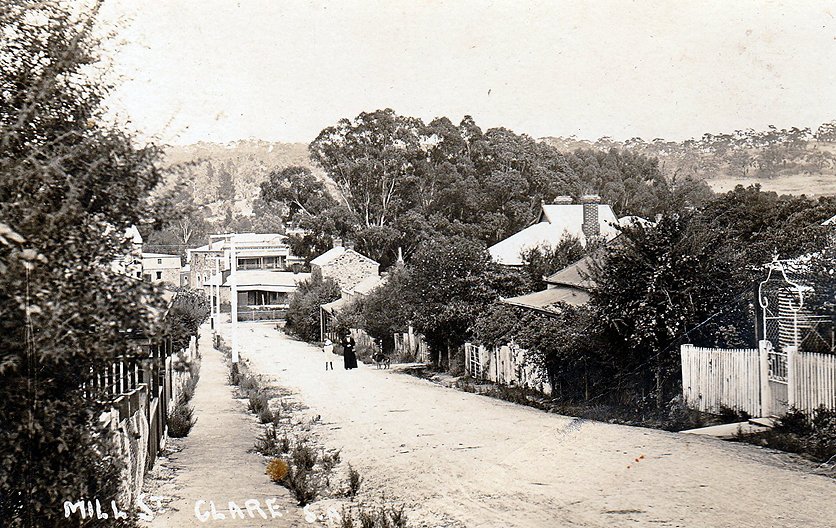
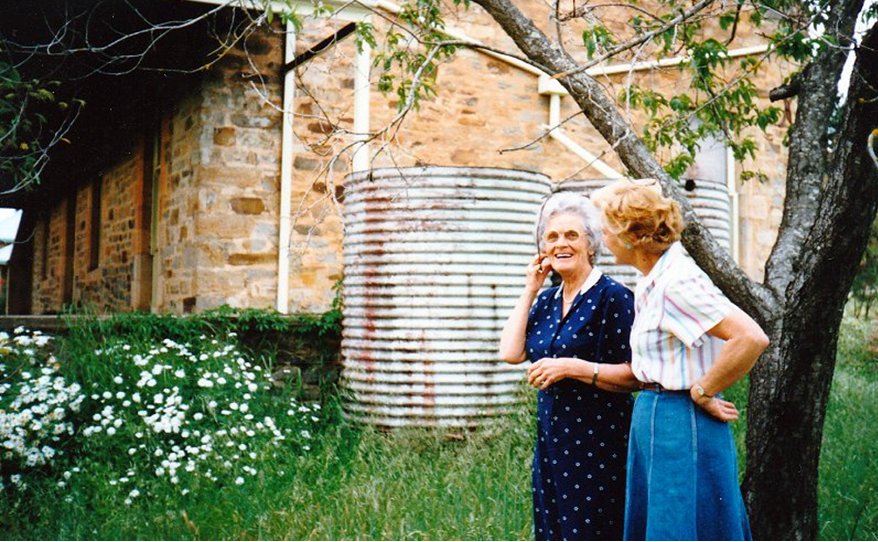
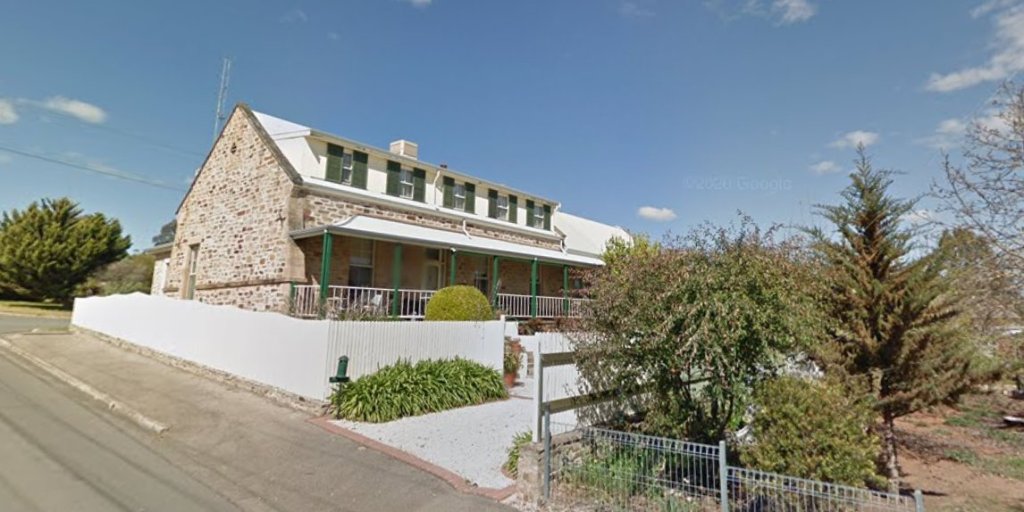
The Sheoaks
In a letter to his brother Edgar in New Zealand, Walter mentioned that the girls were hoping to stay in the township of Clare, but he and Les were keen to get some land and start farming. This is exactly what they did.
In 1923 Walter bought their farm at Watervale . The property was called The Sheoaks . It was a smallish farm. A good land holding with a solid stone cottage.
Their western boundary was next to the train line which ran north/south on it’s way to Watervale. There were many stories of the family watching the train as it choofed past on a hot summer’s day. They were carefully watching for sparks from the train’s chimney. On at least one occasion the sparks started a grass fine which they were able to put out.
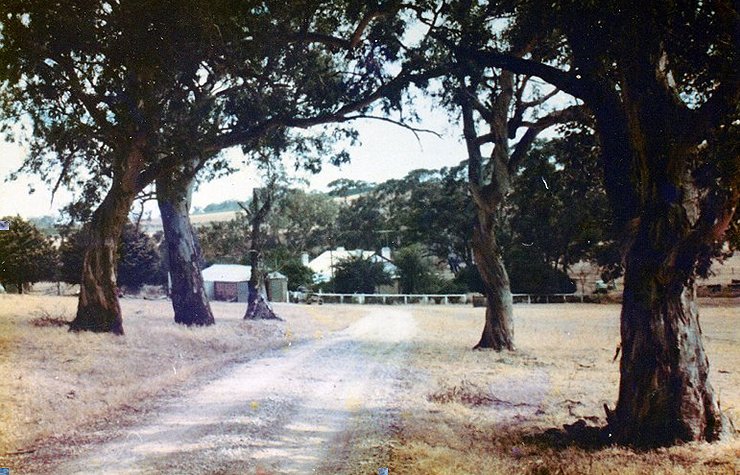
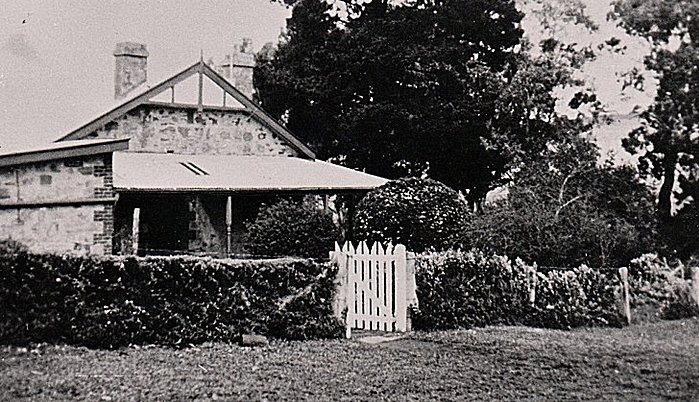
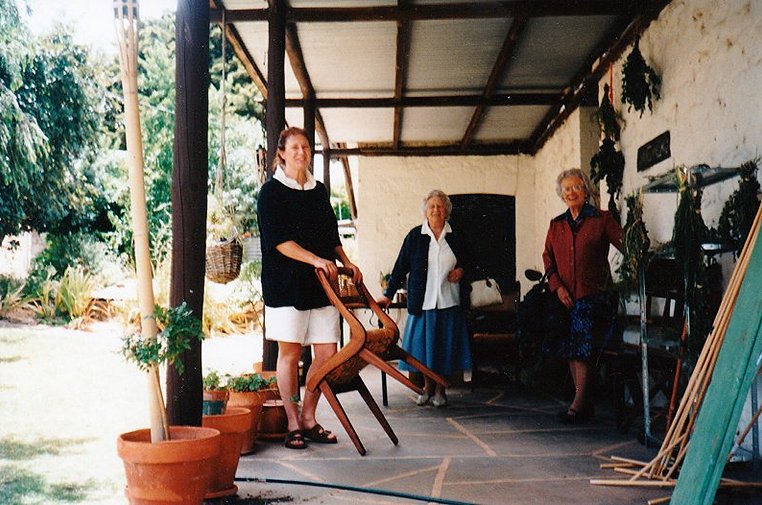
The Sheoaks quite quickly had sheds, a milking yard, chook yards, a vegetable garden, many fruit trees and even a piece of leveled ground on which they played tennis. They called it the “Tennis Court” but it wasn’t sealed or grassed to my knowledge.
The times were leading them towards The Great Depression.
It was possible to have a subsistence lifestyle at The Sheoaks. It was hard work, but possible. Aunty Win wrote some of her Sheoaks memories describing the lifestyle in more detail. Click here to read them. Do read it. It is special.
It was such an important time for the family. There are many happy memories of this growing up time at The Sheoaks. The values of the family were stressed and reinforced by their father, Walter Moyle. He was an amazing man. He brought up the 8 children to be proud, respectful, honest, reliable and deeply caring of each other. And all with much good humour. Music was always important. They owned a piano. Aunty Win played it and so did our mother. There were no lessons. But singalongs and concerts, cards and table tennis were essential entertainment.
Father Walter, never shirked from this demanding path of being a father and a mainstay to his 8 children. He lived without a spouse for the rest of his life. He spent all his energy and affection on the 8 children . He was strict but loving. He loved his 6 daughters. Les was his right hand man. They planned and developed the farm. Bob enjoyed many activities with his father including hunting rabbits.
Grandad was quite religious in a private way. Aunty Nell used to tell me how he often went to his room after tea, with his Bible and stayed quietly there for the evening.
Molly reinforced this by saying that Sunday was a day when Grandad went to his room and wasn’t to be disturbed unless it was very urgent. (As for example when Molly and Colin were staying and reading by candle at night. Their candle was by the window and the curtains caught alight. Molly recalls that Grandad put out the fire. No great harm was done.)
I recall what Walter said to Aunty Nell after her mother had died. “You need to put on your own bonnet now”. It is part of the family’s ethos. Be resilient and personally responsible. I recall Aunty Nell when she was older, saying to us as young cousins “There is to be no sulking , no moodiness in this family”.
The girls were responsible for their own and each other’s well being. They were always very close. They needed to help each other in all ways. The affection they shared became stronger with every chapter in their lives and it never faltered. We of the next generation have been included in this family warmth and have been welcomed into their ring of affection.
They also each learned to be self sufficient. There was no mother to advise, or to explain about women’s issues. Our mother Mary was very uncomfortable talking about women’s issues and in fact was surprisingly unaware of anatomy and the like. I think it was the same for all of them. Nobody ever complained of course. Menstruation was called “rags” and handled as unobtrusively as possible. Aunty Win records that she was very scared when she had her first period. She had no idea what was happening. This is recorded in her memoirs. The girls were so private that even in their older years, some would have preferred her not to mention this in her memoirs!
Every body had jobs to help with the running of the house. Cousin Molly told me that our Mother Mary didn’t do any of the heavy lifting jobs because of her “gammy leg”. Taking the full milk cans to the gate must have been a very tough job. She certainly didn’t do that! Mother was in charge of cleaning the silver, the clothes, the kitchen and similar household jobs. Molly recalled this but Mother never mentioned it. There was a lot of sewing to do as all the clothes (under and over garments ) blankets, curtains, pillows etc were hand sewn.
Cousin Molly also remembered the house had a blue room and a pink room where the girl’s slept. Bob and Les had a small room by the kitchen. Grandad a bedroom near the front door.
Schooling
Walter was insistent that the children get an education. However Aunty Aileen had missed out on secondary school education. She was caught between grade 4 Primary School in Helensville NZ and coming to Australia and then helping to care for her very sick Mother and seven siblings . She also had a bad attack of pneumonia (I think when they got back to the mid north) and this affected her breathing for years. I have no recollection of Aunty Aileen having asthmatic problems but there was a cough I can associate with her. It was considered that she had weak lungs. Despite this, Aunty Aileen lived a strong and active life until the age of 91.
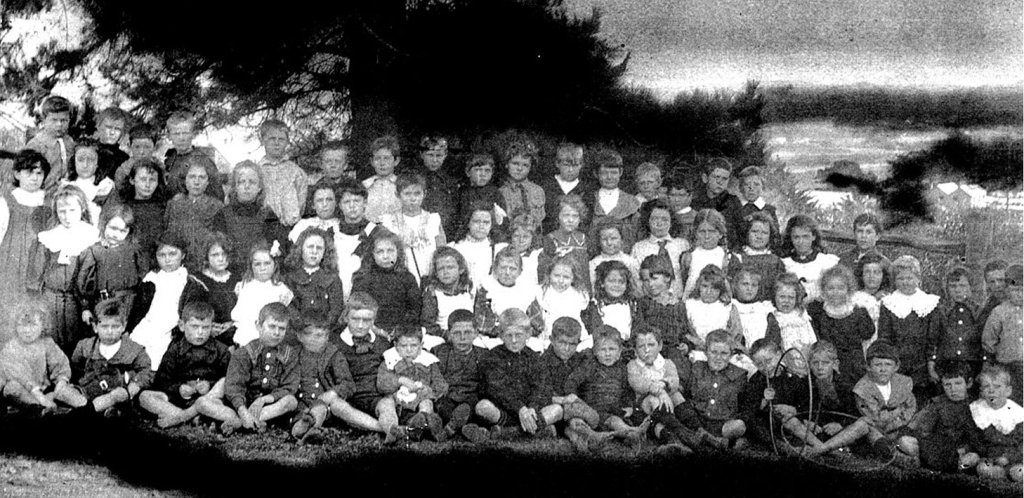
Uncle Les attended the school in Helensville but I am unsure what grade he got to in his schooling. He was needed to help with the farming and the farm management when they arrived back in the mid-north.
Once they had returned to South Australia, the younger children went to Clare Primary School.
After 1923, they were living at The Sheoaks and they went to Watervale Primary School . Mother Mary recalls how they would ride “Spotty” the horse into school. He would take one or two children on his back. The children would hop off, give him a slap on the rump and he would head home to bring the next kid(s) to school.
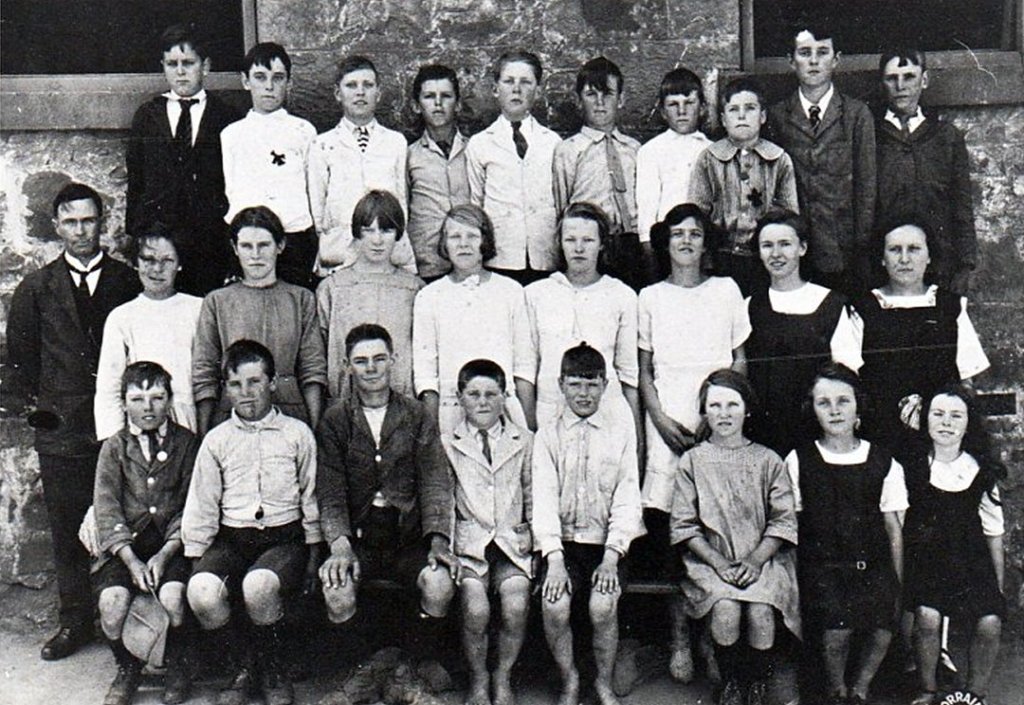
I’m not sure how the horse transport worked after school – when they had to come home. Maybe they walked. It was only a mile or two to the school.
Mum’s School Records
At Watervale Primary, Mary enjoyed school and possibly excelled in many areas but the only one for which we have evidence is the Watervale Show’s Second Prize for Best Addressed Envelope which I now proudly present to the readers.
And the winning envelope has also made the records!
The dirty note wasn’t there 1n 1923!!
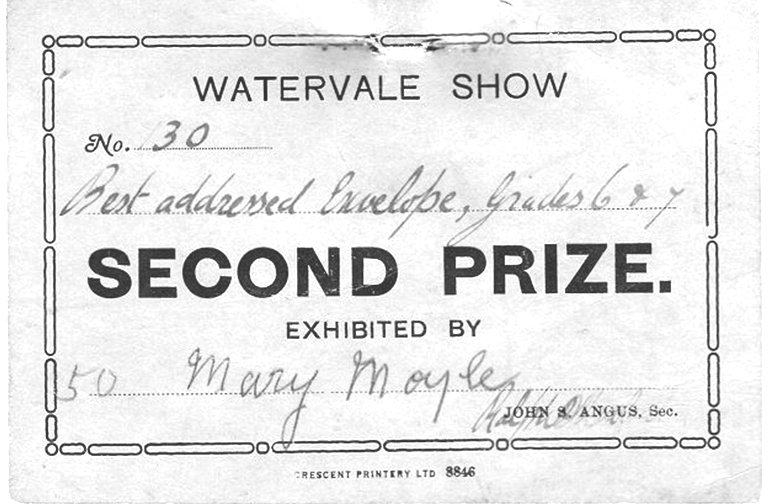
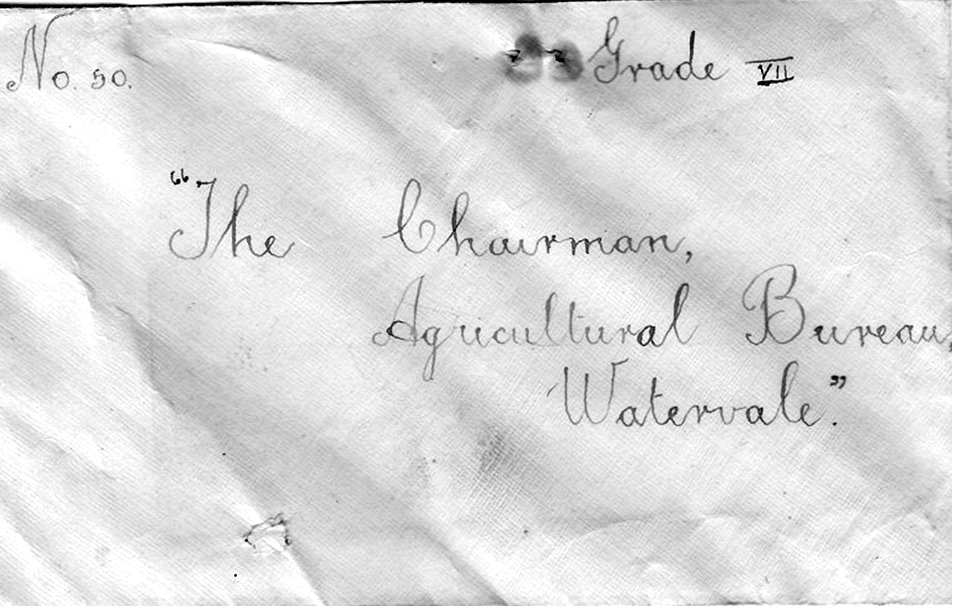
Mum always enjoyed writing as clearly and as perfectly as possible. She also loved ruling up margins for a new page and being very careful to make it as attractive as possible. Each new book was an exciting beginning.
Secondary Schooling
Mary went to the Clare High School. She stayed until completing her Intermediate level in 1926.
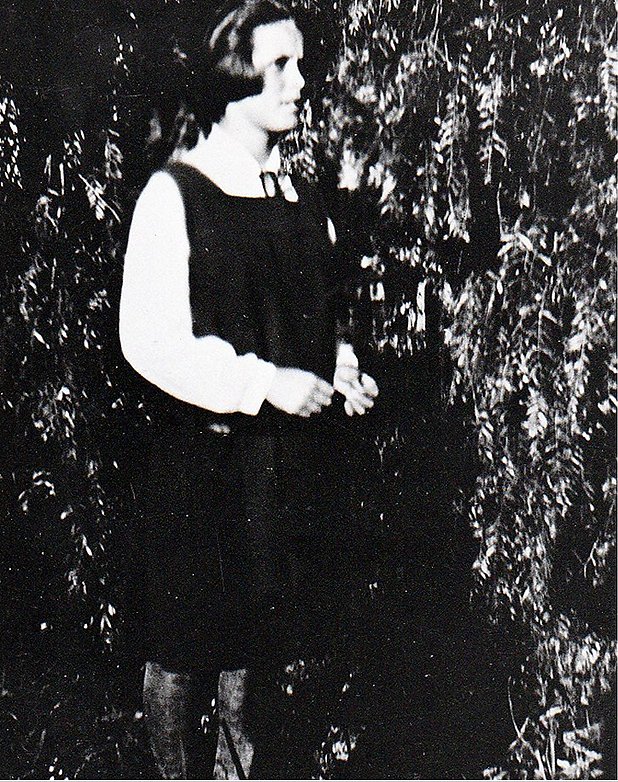
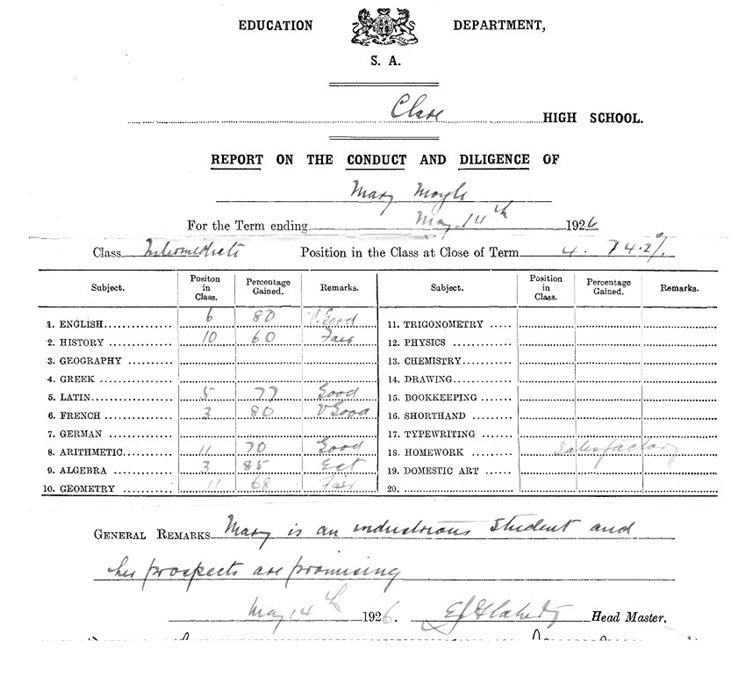
She received very favourable reports which were essential for her acceptance into Junior Teaching apprenticeship.
There are two reports from this Intermediate year. It is interesting to read the subject results and the teacher’s overarching summary .
Mum would never have expected us to be analysing and perusing these reports 99 years later!
She is clearly conscientious and not too concerned about the odd “fair” mark. However there is excellent work in Algebra, French and English. (I was surprised at the French and Algebra!! We, her daughters certainly never noticed evidence of this. )
She receives the wonderful summary of “Her prospects are promising.”
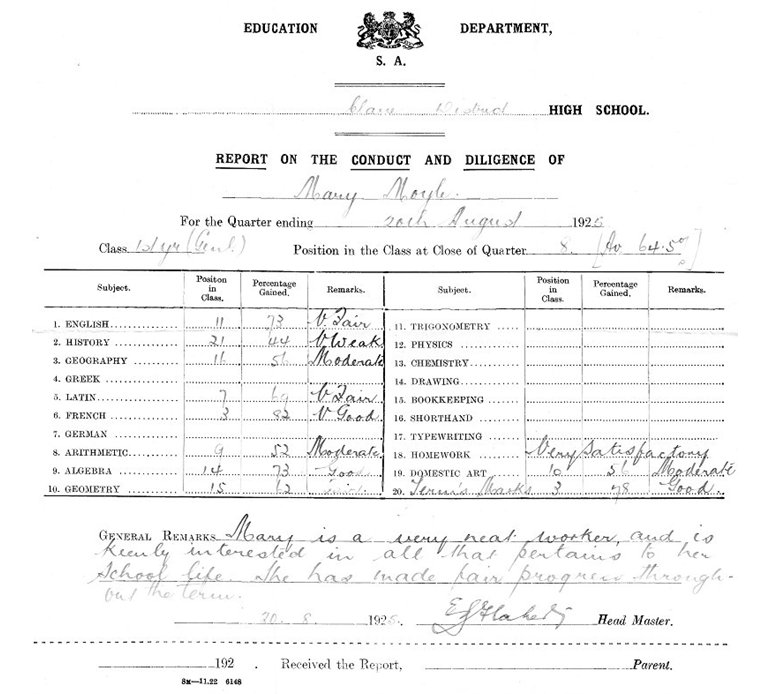
Her August report is encouraging. The word “neat” crops up again and again. She remained a careful and neat writer into her old age.
The pleasing summary here is “She is keenly interested in all that pertains to her school life.” Well done Mary the 15 year old school leaver!
Junior Teaching
Mary is now able to spend 1927 and 1928 as a Junior Teacher at Watervale Primary School. This is sometimes referred to as being a Teaching Cadet but it is essentially being a teacher’s aide and an apprentice teacher. It is an eminently sensible way to prepare for a teaching career. It demonstrates a young person’s abilities to lead, to listen, to understand, to care and to relate to the individual children.
Mary Moyle excelled at this, as the next chapters of her career will prove.
There are a few photos of her working with student groups at this stage.
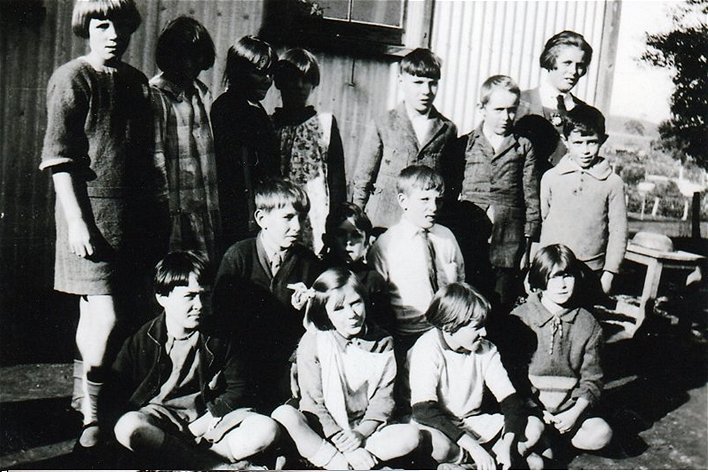
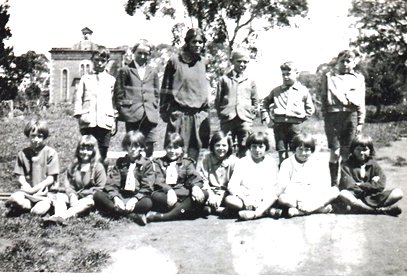
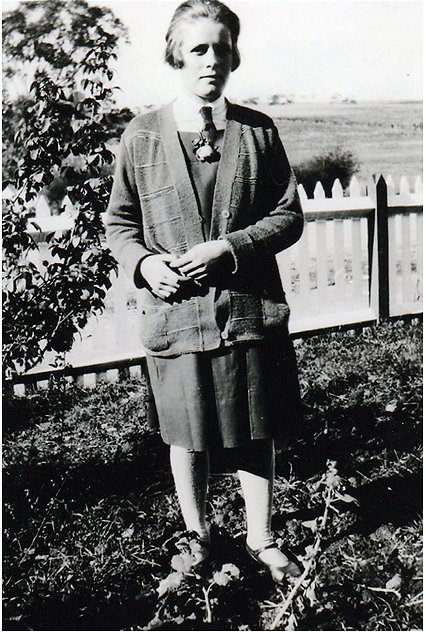
There was a shortage of teachers at this time. Schooling had become compulsory. The Education Act of 1975 made it compulsory for children between the ages of 7 and 13 to attend school.
(While Aboriginal children remained under the jurisdiction of the Protector of Aborigines, the 1875 Education Act legislated for compulsory and secular education for all non Aboriginal children aged from 7-13 years.
I never heard Mum mention about aboriginal children’s education out on the West Coast but I think it is important to know that it was not an issue for her schools in the 1930s.
It is chilling to remember that some aboriginal children were being taken away and others moved moved with their families to missions There have been huge changes in Aboriginal childrens’ education since the mid 20th century. It is an evolving and vital area outside the parameters of this story)
Children in remote areas needed to be given this opportunity and schools had to be built and serviced. Many farming families gave a section of their property as a gift to the Education Department and helped build a simple school building. This was always placed strategically between neighbouring families’ homes so the school population could be at least 10 students.
The government was debating ways of fulfilling this goal and one solution was to train teachers intensely for one year only. (This was later referred to as pressure cooker training and was happening when necessary as late as the 1970s.)
Mary joined one of these one-year training courses and spent 1929 at Adelaide Teachers College.
Mother’s limping
Mary’s mother noticed that she was dragging her leg.
Mary was the 6th child and Lucy was very busy with farming, milking a herd of cows, cooking, cleaning and caring for children in Helensville. Yet despite this huge workload, she was knowledgeable and insightful enough to get Mary to a pediatrician in Auckland. She was diagnosed with infantile paralysis and her leg was put in a caliper. Her mother made time to physically massage the leg to help Mary’s rehabilitation.
She wore the caliper for several years. Her leg was always slightly withered and lacked normal muscle development. She limped, but considered herself lucky that it didn’t affect any other part of her body. Never did she display a “poor me” attitude.
Some interesting asides about her disability. (It feels wrong to even use the word “disability” as she certainly never used it.) Mind you I do recall Aunty Nell calling her a cripple when they were playing a double match of tennis. This was one of their joking yarns. But beware. Too much teasing and they would pay!!
The girls shared double beds. This would have helped with her keeping warm at night However she wore the caliper to bed and if her bed-sharer had been unfriendly during the day she would get a swift kick in bed at night!!
Mid suffered poor circulation in that leg. This made it very vulnerable to the cold and she always suffered from chilblains. Watervale is an extremely chilly part of the world.
By her teens, she was keen on attending the Saturday night local dances. They were an important and very popular community activity in Watervale. (And most other country towns!) For Mum to dance backwards putting all her weight onto her left leg was very very difficult and quite dangerous. (Women always step backwards in ballroom dancing). She used to go to the bathroom before the dancing started and rub and rub her leg. Then it would be possible!
Her father felt she would probably never marry because of her “gammy” leg.
(How wrong he was. She had a very close relationship with Eddie Heinrich, a farmer on Yorke Peninsula but it didn’t last. She married Tom Bowman. Later as a widow she married Ralph Parker. And after he died she had several male friends as an older widow. But more details of her life will appear later.)
Walter felt she should have a good education and encouraged her to become a teacher. This was a very progressive idea. It was normal in that age, that within a large family one girl would remain single in order to care for the parent(s) as they got older. Walter ignored that and was very proud of Mary having becoming a teacher.
Mid’s physical activities were hampered by her left leg but it never stopped her from participating! I have no recollection of her ever complaining about her leg. We walked together every day to and from the Largs Bay Primary School for several years. We didn’t have a car until the late 1950s.
As an older person she used a walking stick and always walked confidently. In her mid eighties she happily used a walker which enabled her to walk for at least half an hour every afternoon.
Mum never wanted to be buried in Clare because it would be far too cold. She much preferred the idea of cremation.
The Sheoaks in the 20’s and 30’s
Visitors, marriages and grandchildren
Aunty Aileen had married Eric Giles in 1926. Colin Giles was born in 1928 and Molly in 1931. They were all living in Clare but visited The Sheoaks very often.
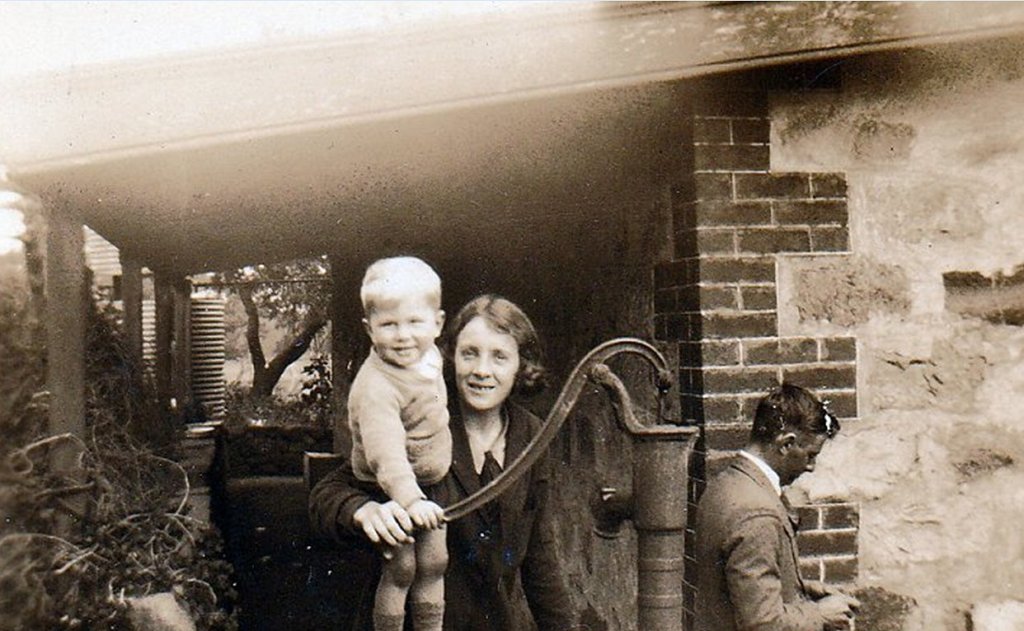
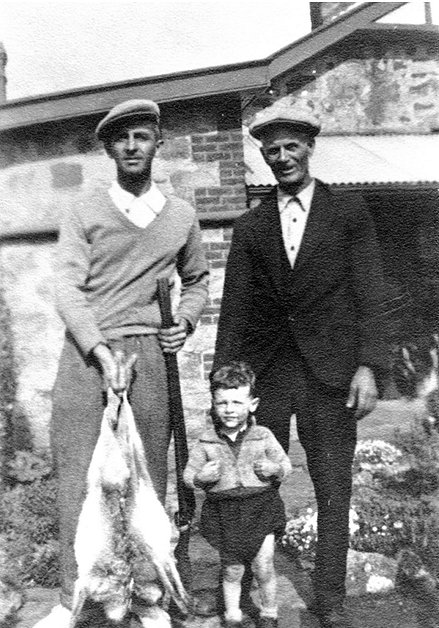
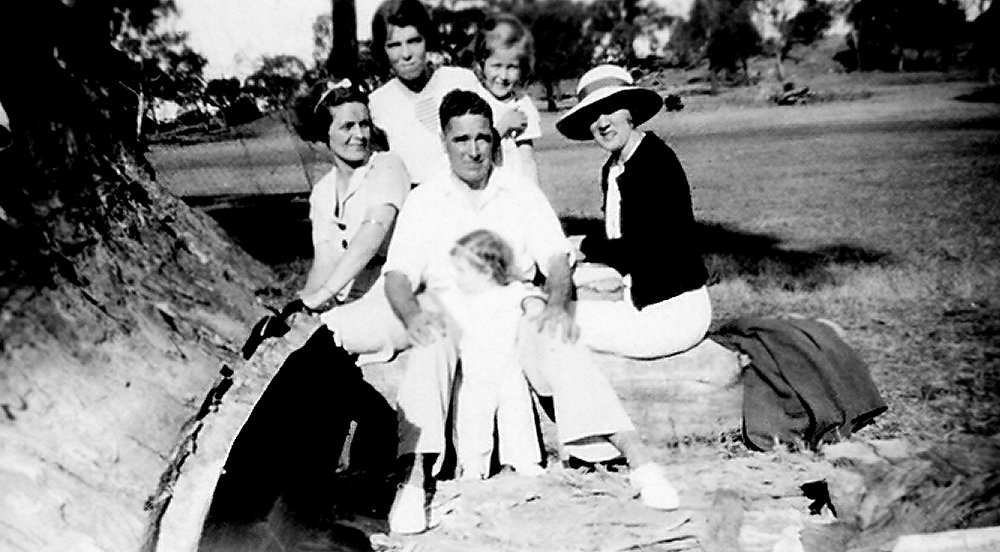
I ( Meredith Bowman) wasn’t born until after the end of the family’s Sheoaks days. My stories are from what I have heard from the aunts and from the cousins who were there at that time.
Aunty Aileen’s Colin and Molly, Uncle Les’s Wendy and Win’s Helen and Bruce all visited The Sheoaks as small children.
There was lots of singing around the piano. Mid played the piano. She never had lessons but taught herself to play and to read music. She always loved music. Music was a major feature of her life for many decades. Win also played the piano.
The family were all singers and dancers, joke tellers and competitive card players. The girls played hockey and tennis though Mid was somewhat restricted by her bad leg.
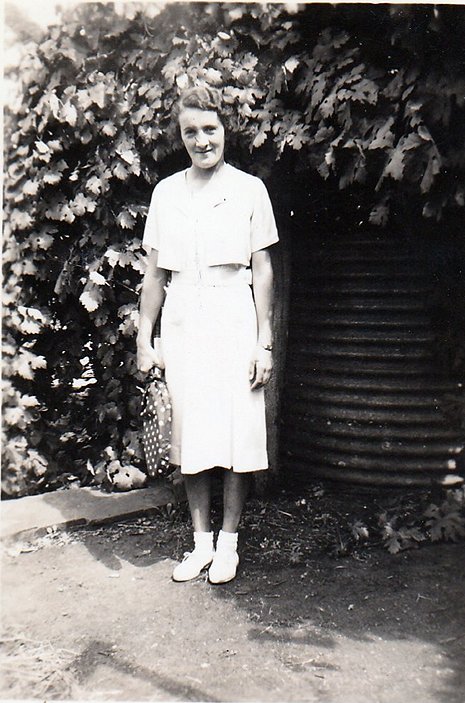
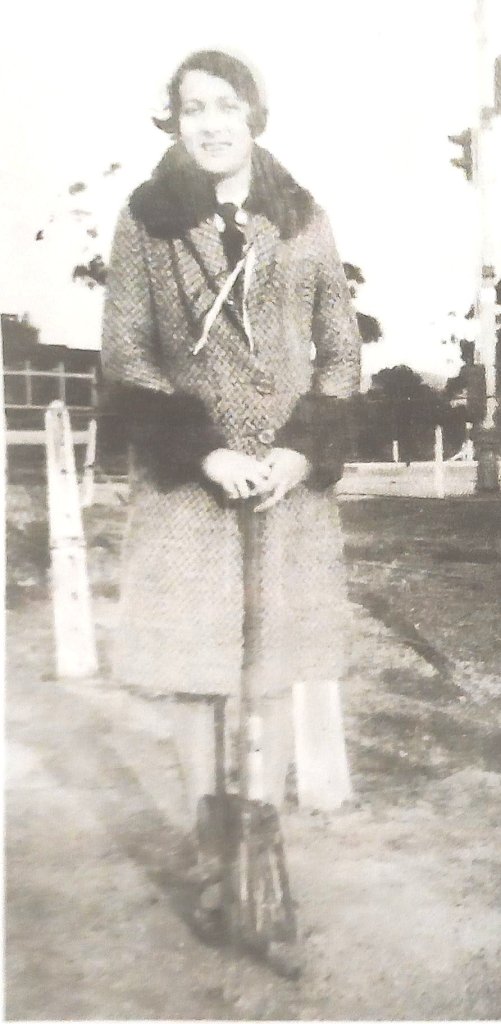
Ada was a good sportswoman all her life. As a young woman she played competitive tennis, lacrosse and hockey. As a married woman she was a croquet champion at state level, and a golfer.
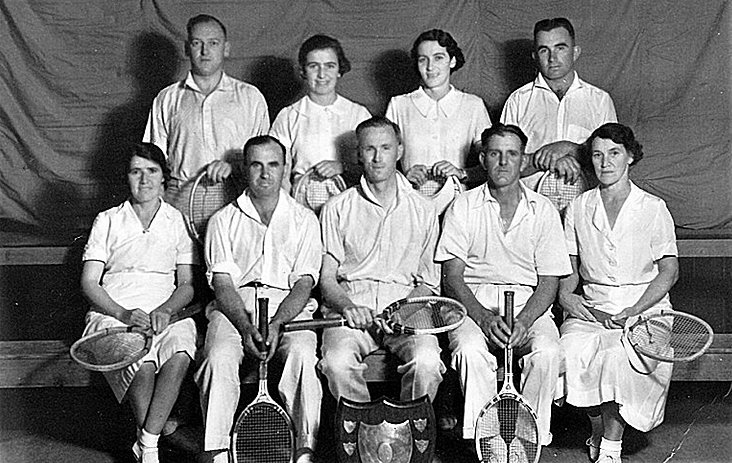
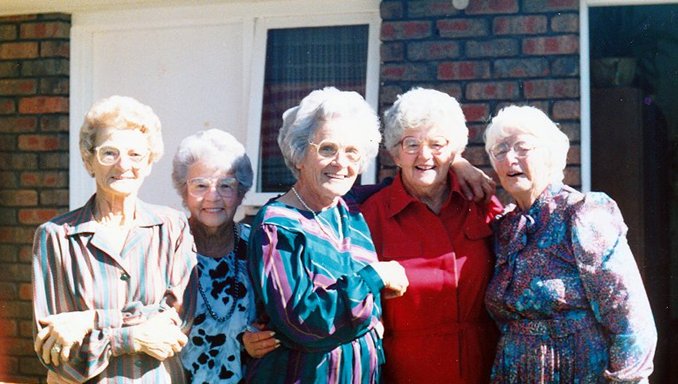
The woman on the right of the front row seems very familiar to me. Does anyone know who she is?
Bob’s skill can be seen in the photos of the picnics and good times at The Sheoaks.
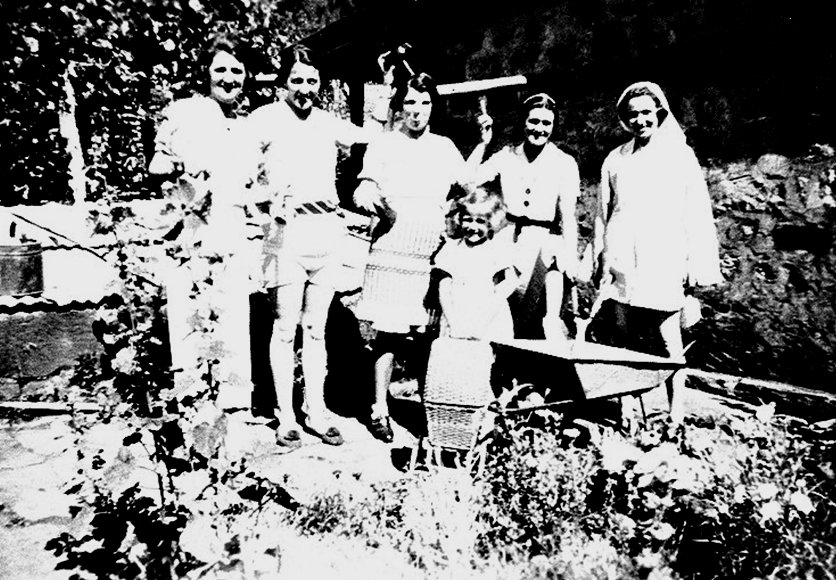
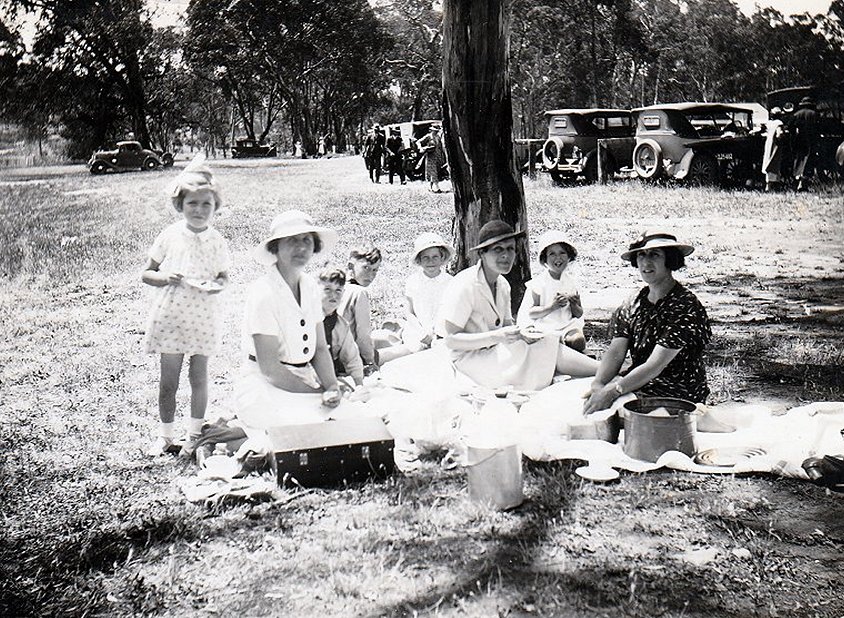
Uncle Bob was also quite a natural at visual art.
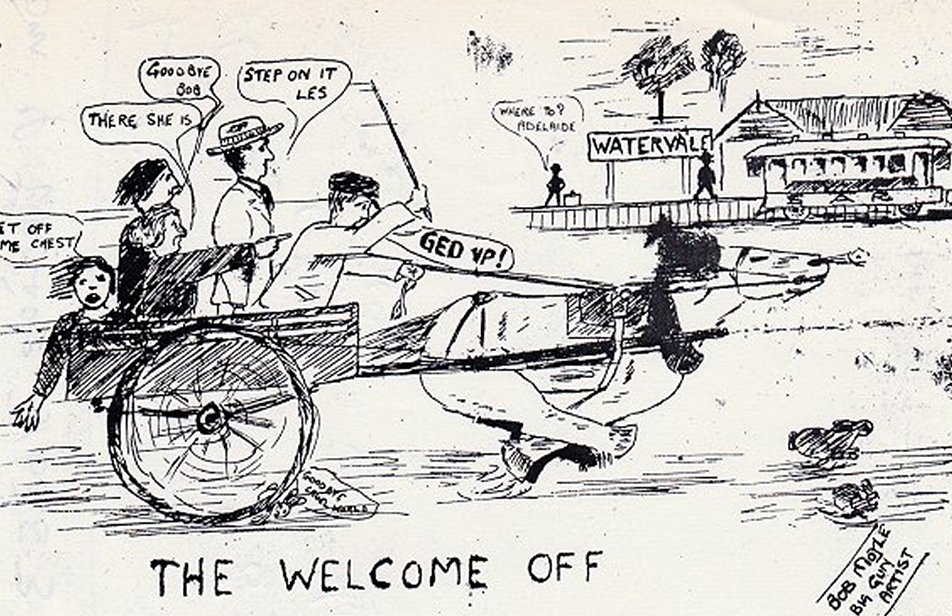
Because he was the second born son he was well aware that he would not be inheriting the farm so he needed to get himself a job as quickly as possible. He joined the Post Office and was posted to Darwin. He would have been sad to leave the good times and siblings at the Sheoaks but he was pragmatic about the new work world and enjoyed the life in Darwin. He visited with his new fiancée Phyl Osborne in the early 1930s. Phyl had beautiful blue eyes and was accepted by all the Moyle girls. It was a big ask for her to meet such a solid tribe of beautiful sisters. But they were determined to make her feel part of the family.
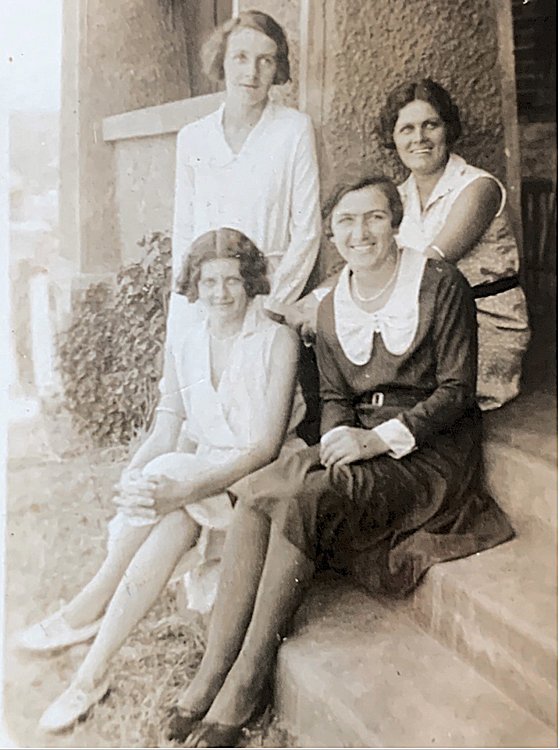
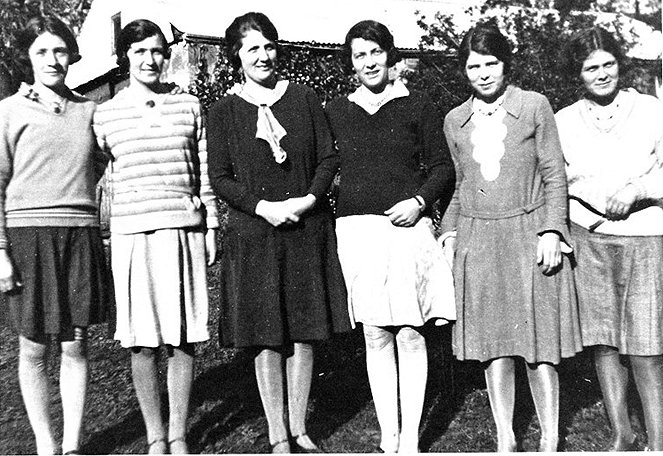
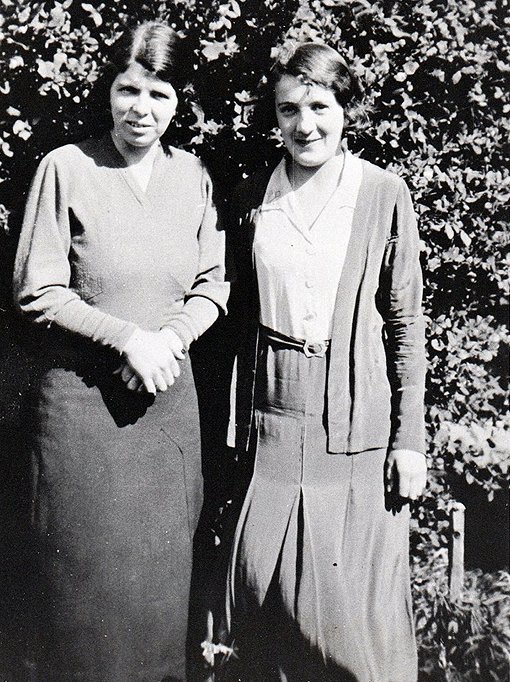
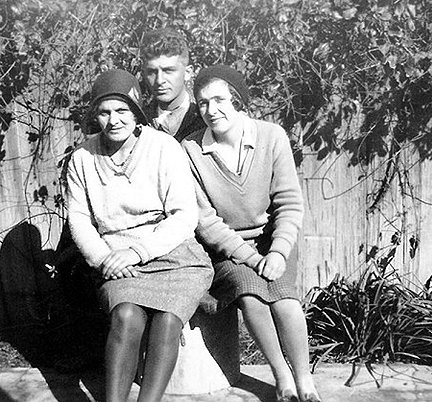
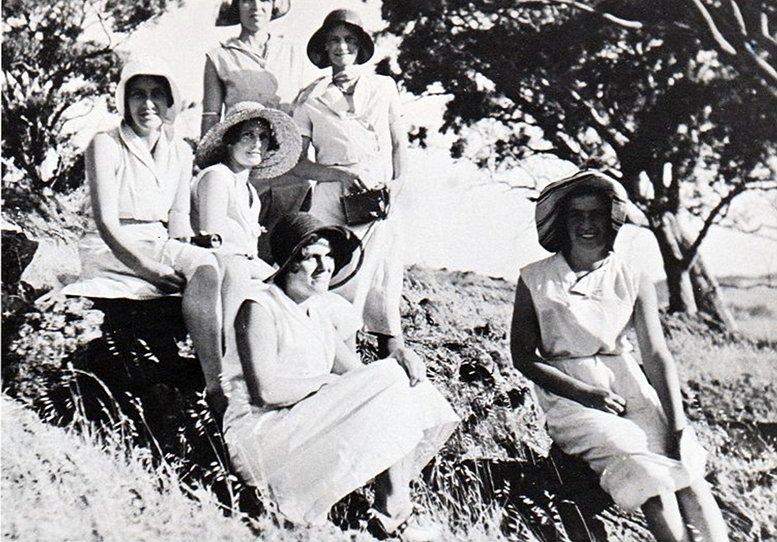
l
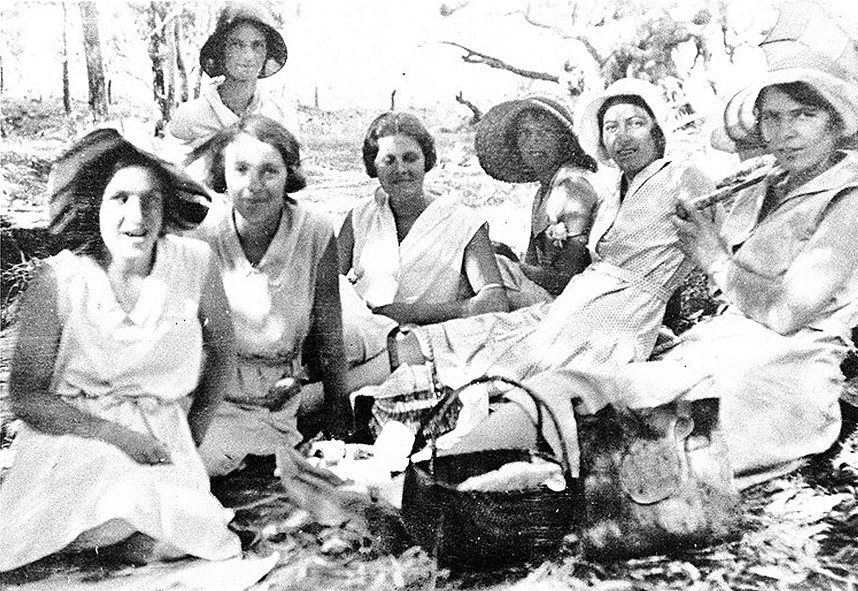
This is an Uncle Bob photo ..relaxed, natural and utterly beautiful.
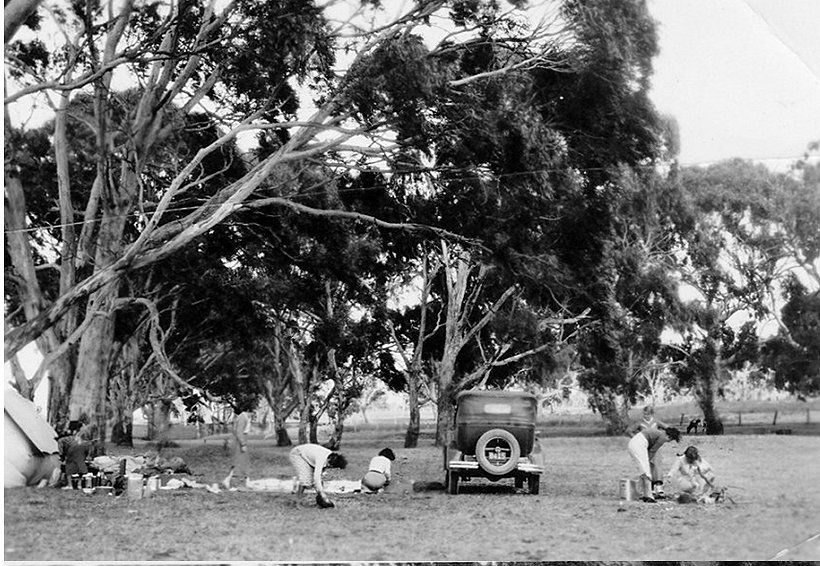
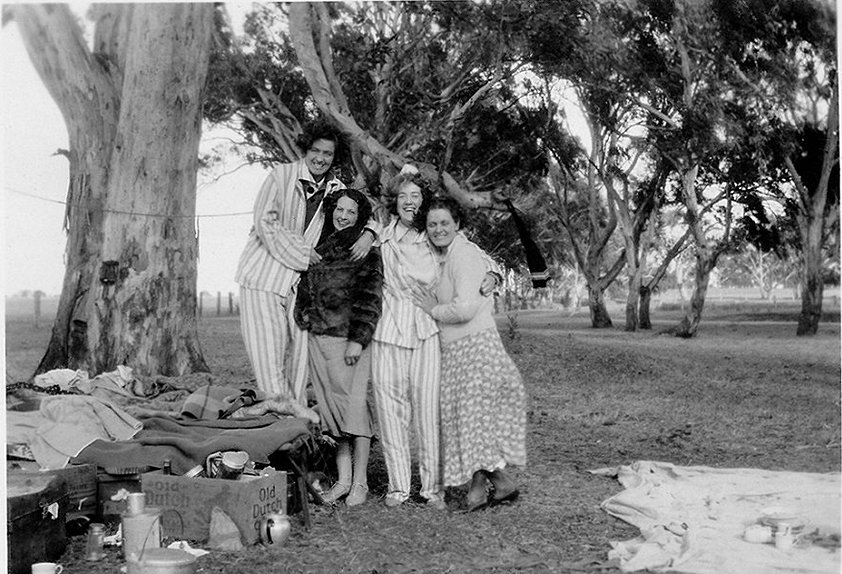
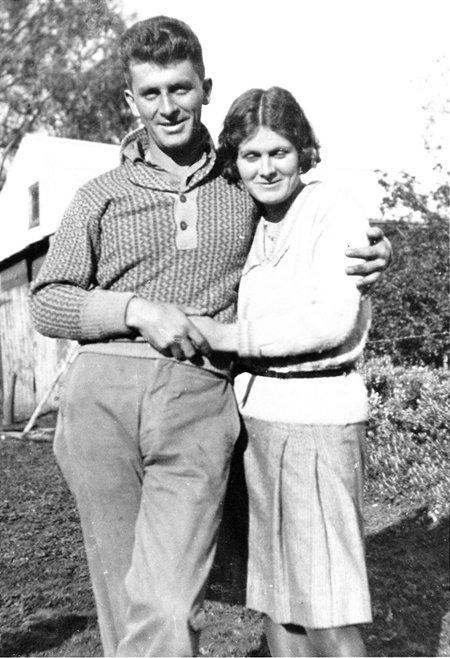
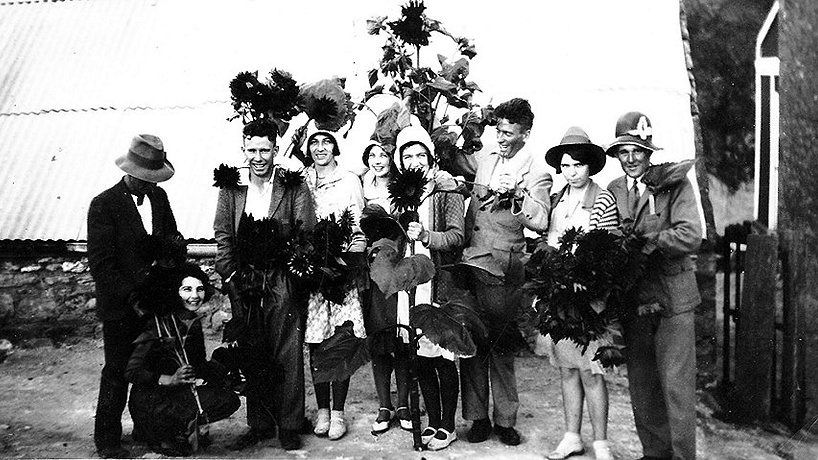
Mother told me that Uncle Bob took many of these photos but it is possible that uncle Les was also a photographer.
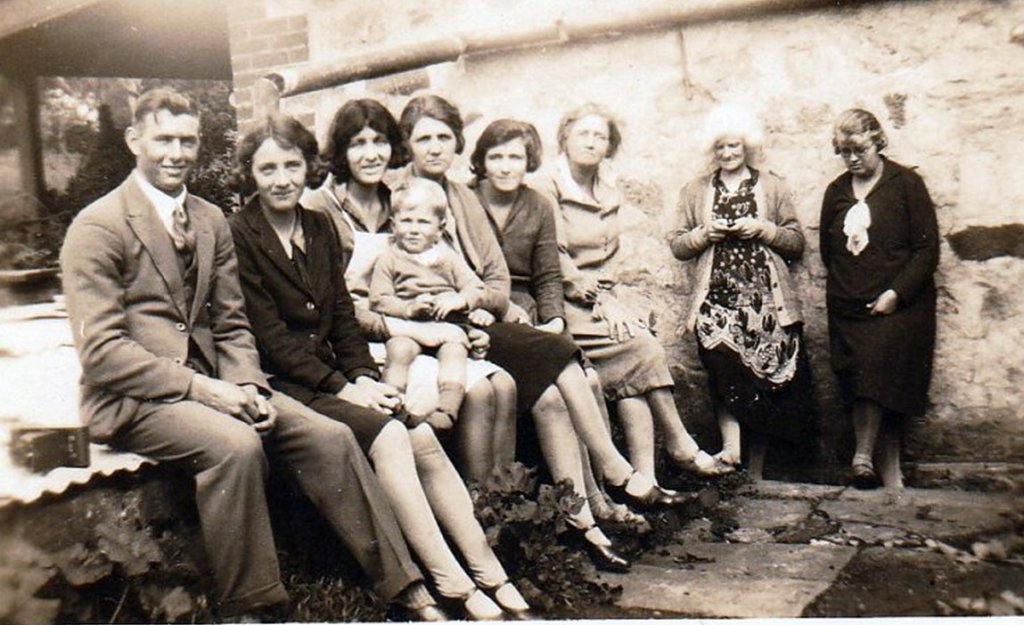
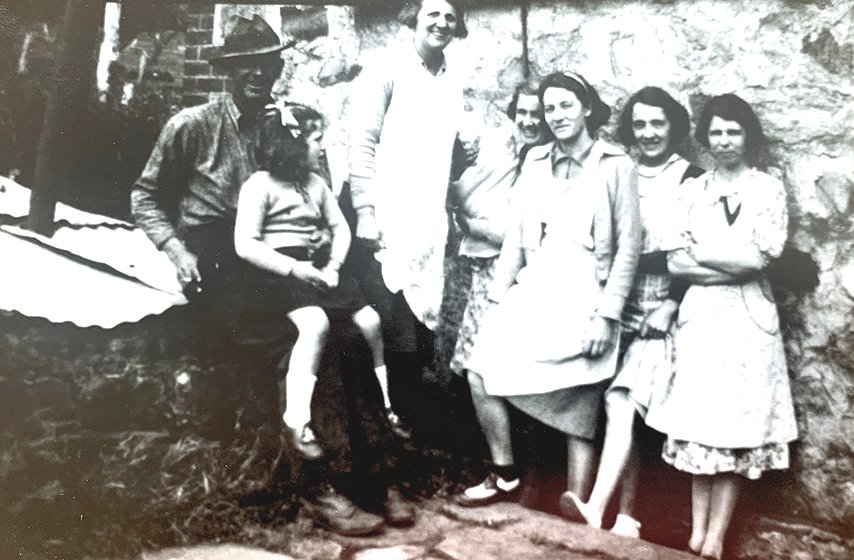
.From the left is an unknown friend (somebody might recognise him? He is dressed up for a casual visitor??), Kath, Ada holding Colin, Aileen, Nell a cousin – (Morton I think Can anybody recognize her?) Aunty Charlie and Aunty Rose.
Aunty Charlie is visiting her brother Walter and the Moyle nieces and nephews. Aunty Rose is her half sister and would also have been pleased to see Aunty Charlie again.
The family had left New Zealand in 1917. It would have been 11 years since they saw each other. There had been regular letter writing between Aunty Charlie and her niece Aileen Moyle.
Aunty Charlie kept in touch. There is a letter to Aunty Aileen which was written by Aunty Charlie in 1926. Aileen was 15 years old when they left New Zealand. She had left behind cousins and school friends. A copy of this letter is filed on the web age under Moyle family and on the McLaren line.
Adelaide Teachers College 1929
Mary greatly enjoyed her teacher training year.
She boarded with Bill Morton’s family in Alpha Road Prospect. Bill Morton was a bit younger than Mary but their cousinly friendship started at this time and continued with occasional contact for many decades.
(Bill has written a small book about his family life which can be found on the website under the Morton Line.)
From Prospect Road, Mid was able to catch a tram to and fro College every day .A halfpenny a trip she told me.
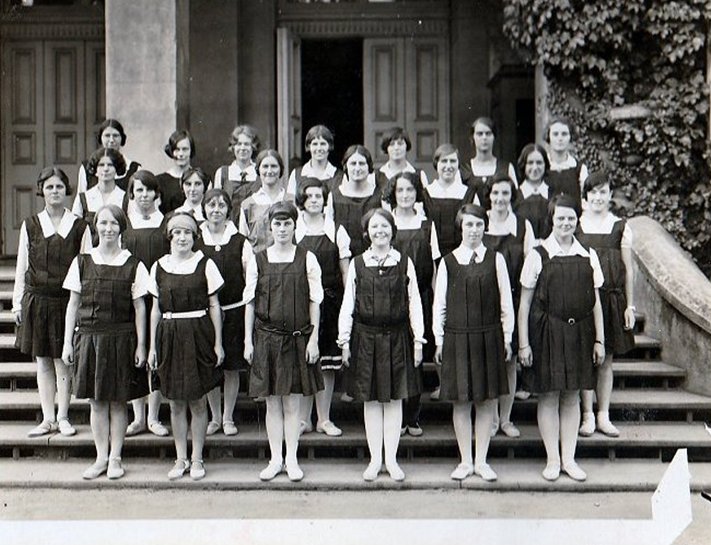
They are standing outside the “Spanish building” in Kintore Ave. It is now referred to as The Hartley Building and is part of the University of Adelaide.
They were meticulously dressed in a College uniform.
Maxine Gordon is in the front row on the right. She became a very close colleague and personal friend. Mid is in the second row on the left.
(I was appointed to a lecturing job at Adelaide Teacher’s College in this same building in 1974. )
She was sometimes attending classes at Kintore Ave and often at The Sturt St Model School.
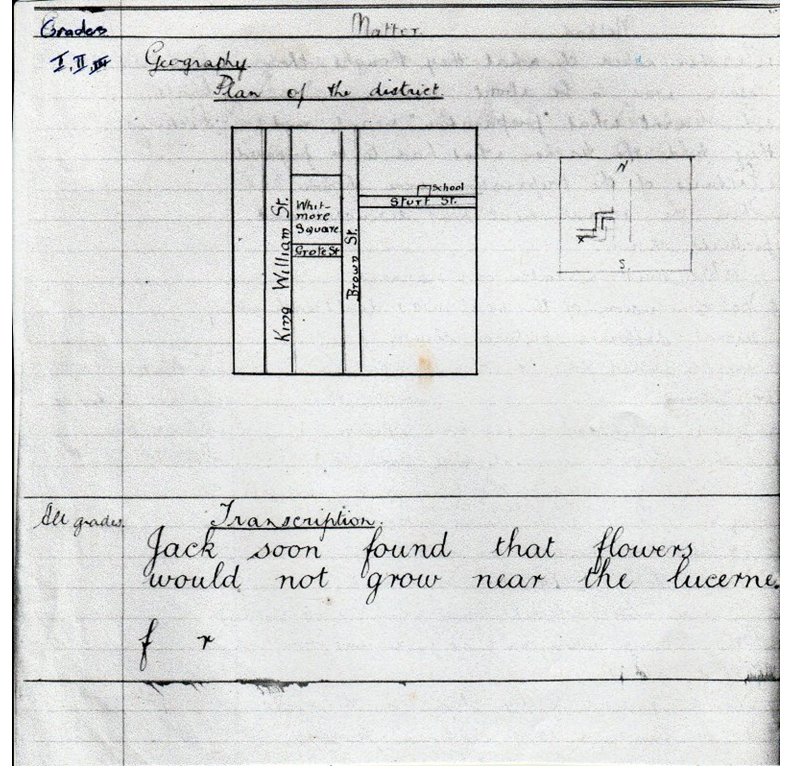
She was assiduously thorough in keeping teaching notes. This is the Book of Teaching Notes and Observations of demonstration classes. It is beautifully presented. The book is well worn from usage as well as age. A piece of cloth is stuck down the binding to secure the work. The joy of ruling up a new page, especially in a new book, was always exciting for her, her students and for us as children.
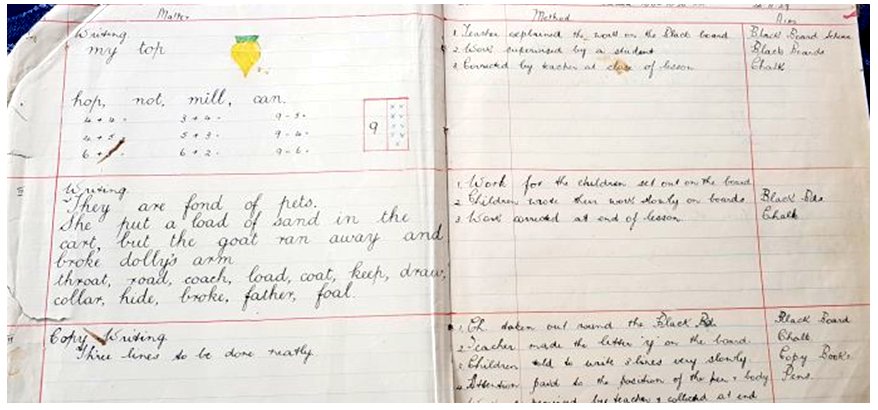
The above notes are of a lesson observed in Sturt St. school.
Each lesson is divided into the columns of Grades , Matter, Method and Aids.
At the top is Dem Teacher –Mr Wiadrowski Period 10-10.30 Date 22,4.29
Below is a geography lesson in which the children walked from Sturt St School to Victoria Square. They were discovering their home territory and learning how to record it. This diagram is not quite accurate Mary. Woops!
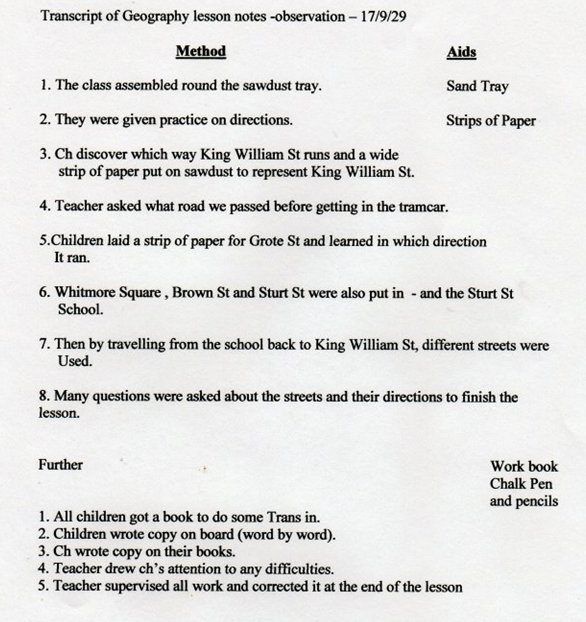
As a student teacher she learned the importance of repetition in chanting times tables. Unfortunately this continued for all of us!. I recall walking every day to the Largs School with Mum saying en route “ Let’s just go through those tables once more”. I think I remember them pretty well to this day!!
In 1981 Granny kindly cared for our children Christie and Tom while we were overseas for 2 weeks. The children had a special time with her, but among the many delightful memories is a lasting one of “Lets just do sme times tables.” Yeech!
Teaching notes – Re Principles of classroom Management
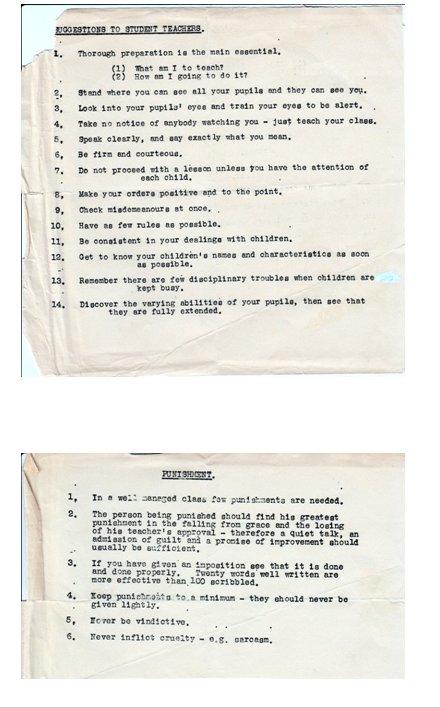
They would be quite acceptable today – 93 years later.
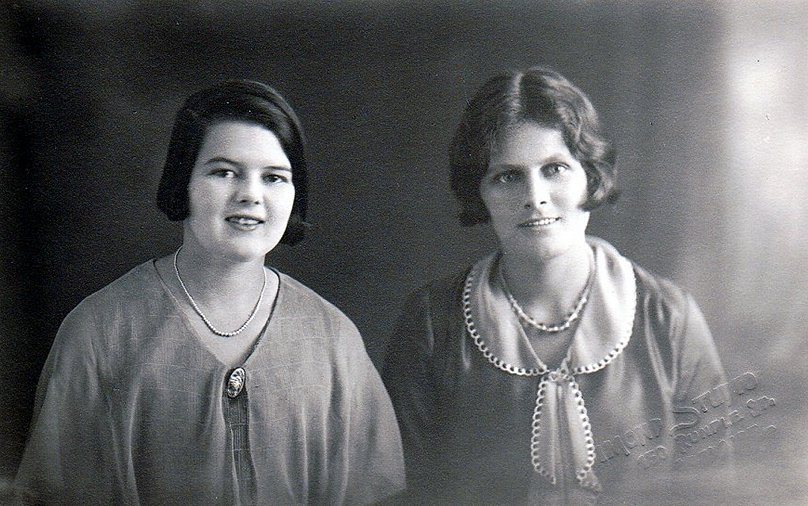
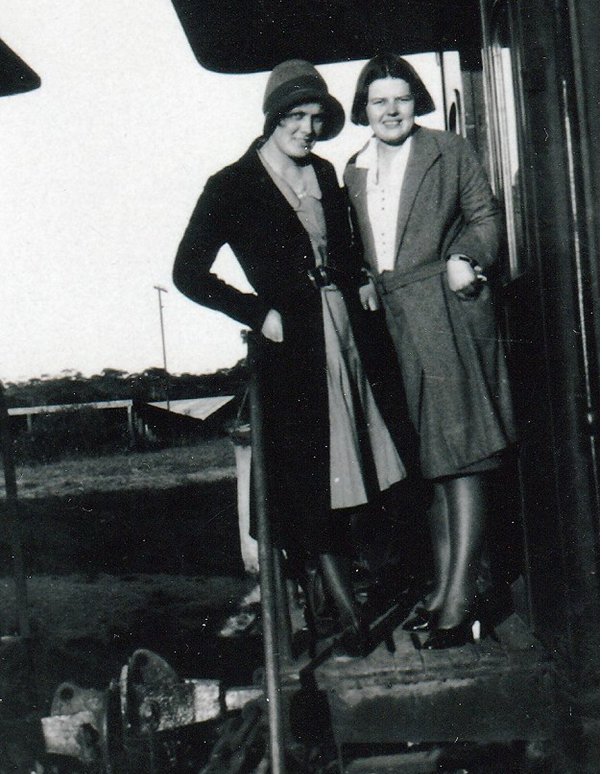
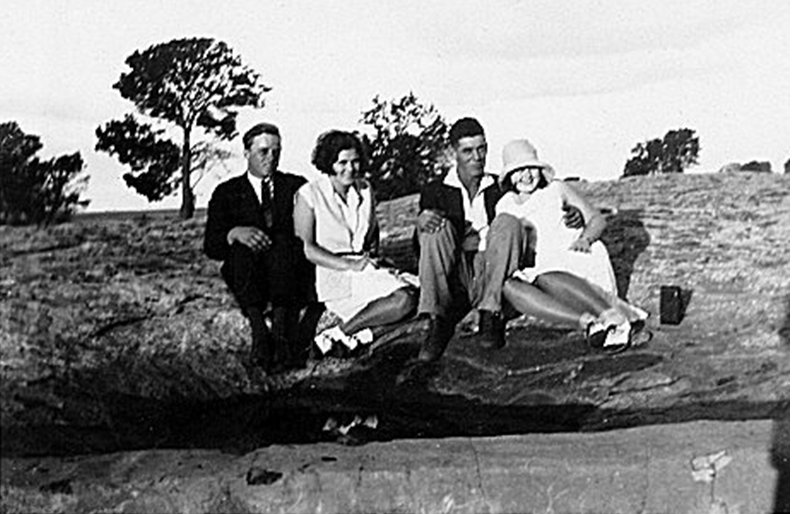
This photo captures one such social occasion.
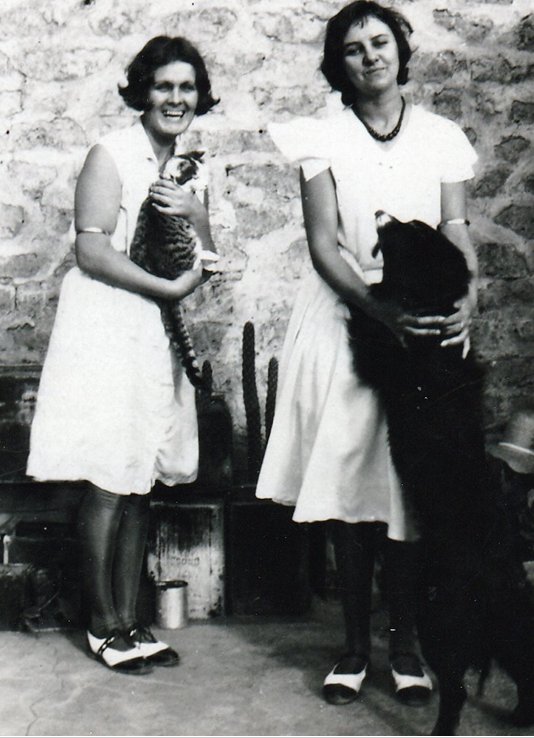
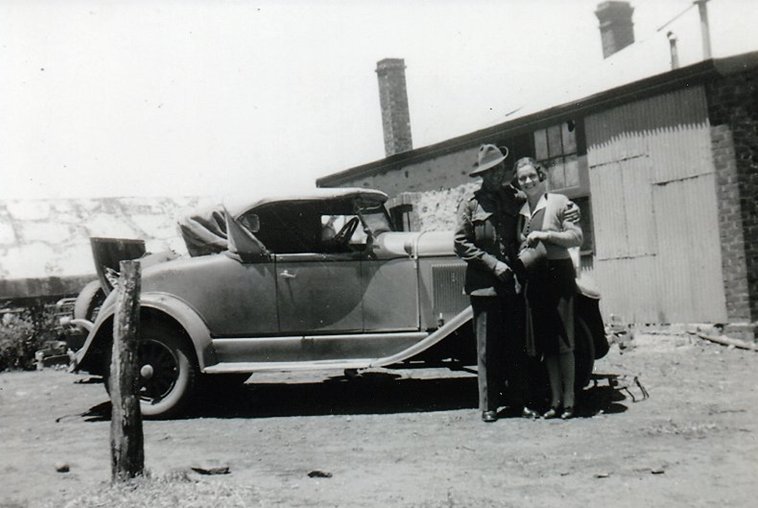
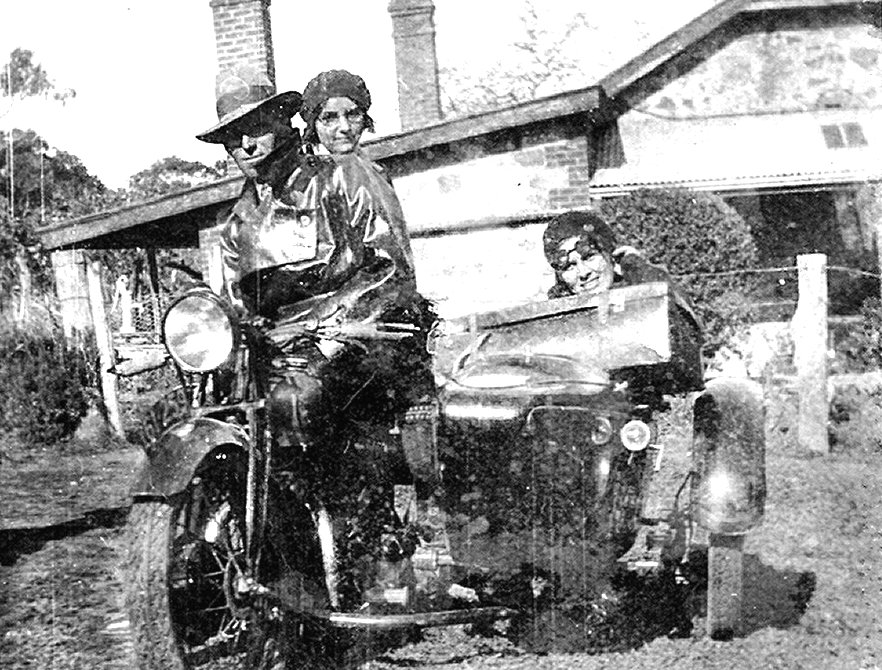
Probably heading to the railway station and then back to college.
There would have been many trips home during the term holidays.
Mary turned 18 in December 1939 and was posted to a rural school beyond Ceduna and Fowlers Bay called New Way, to begin work in January 1940.
One – Teacher Schools
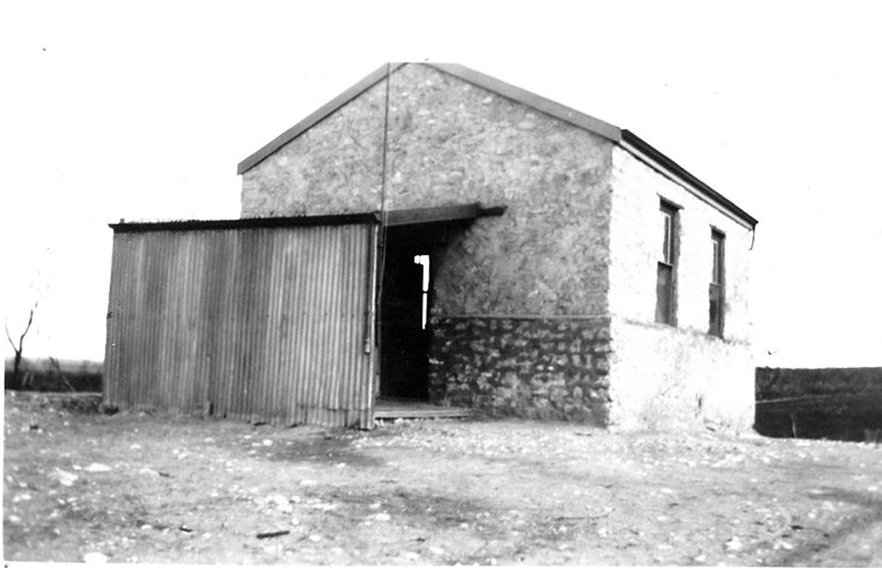
1. New Way School
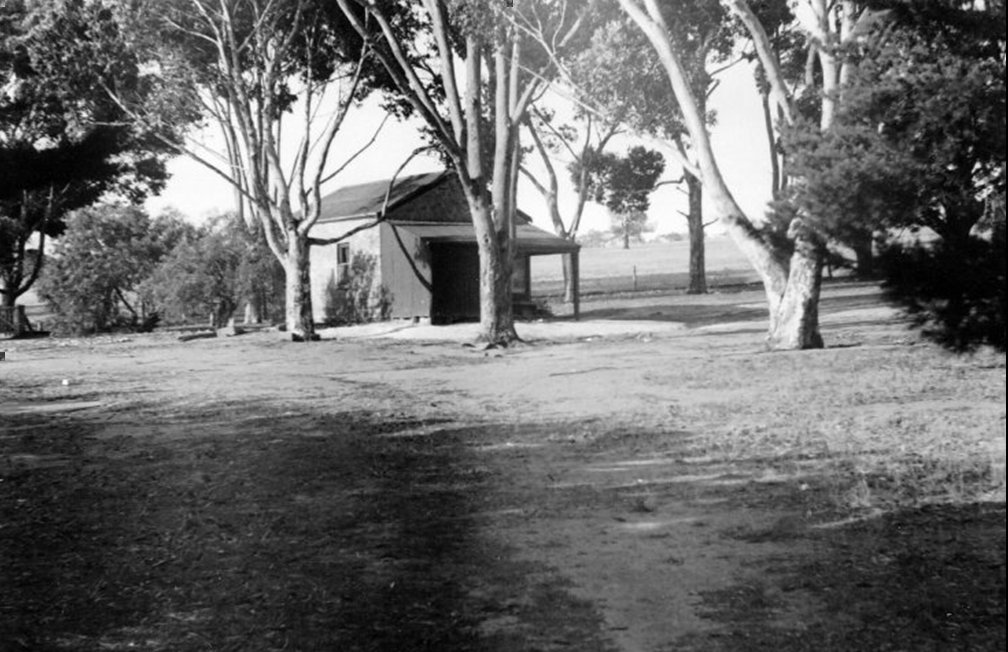
Here it is, as it stood on the stony ridge.
Our mother taught here during 1930 and 1931.
This is Mid’s first letter home after arriving at her first school on the West Coast.
She turned 18 in the December 1929 and this is the first year in fact the first days of her teaching career – January 1930. She was called a probationary teacher at first, but she was actually the only teacher and considered the Head Teacher.
New Way School
Watraba Private Bag
Via Ceduna
January 1930
Tuesday
Dear All,
I was going to write to you to catch Monday’s mail but I feel sure you will excuse me when you hear the reasons.
It has been as hot as the “diggings” since I came here on Sunday and well over 100 every other day.
Wednesday –
And as hot as ever again today with dust blowing everywhere.
Well you’ve heard of the farewell at the send off I suppose.
For the first quarter of an hour after we left Port Adelaide things were very quiet and everybody seemed lost. Then the boys gathered together a few stringed instruments and we listened intently.
Thursday –
For the first few hours everyone was enjoying the trip immensely. Sable Grivell, Elsie Wooley and others were on board so we had some good music.
It seemed very hot and stuffy inside so we stayed up on the deck – it was very cool there.
About half past 10 some of the kids were swinging over the rail.
I began to feel funny so several began walking. Max looked jolly crook and this made me feel worse.
Arnold Giles introduced me to the electrical engineer and I found Max and we went into his cabin for a while and then up to the “Bridge” and saw the compass etc.
The captain was stuffing (sic) us that we’d be lucky to get there and all sorts of rot so I was glad to get out.
I too was soon at the ship’s edge ‘feeding’ the fishes.
Ted Saunders was alongside me and making a noise like an old bull so I nearly died laughing in between times.
I was almost well again when one of the teachers (who had done the trip 9 times and was goodo) asked me if I’d like a hot pork chop for supper – there was another rush.
However at half past 11, I found Alli (?) Muller and we went down to bed.
I had the top bunk and slept well for till 3 o’clock. At half past 3 all the other girls came into our bunk and we had the banjo mandolin going – we were soon shut up.
We got dressed at 5 o’clock and went up on deck. Everyone was merry and fresh in the morning.
It was beautiful to see the land as we entered Lincoln. – we landed at about 7.
Ritchie met me and the Meth minister from Lincoln drove us home. I stayed with Phil till about 9 and the put in that wire and the parson called in again to take me up to the station. Ritchie was at work but wants me to go down there for the May Holidays.
We left Lincoln at almost 12 o’clock and for miles just crawled through country just covered with low mallee. Each time one looked out the window she said something worse than the last.
From Cummins onward the crowd dwindled off.
We played 500 and euchre for a while but most of them sat back and contemplated the agony of living in such desolated areas for 12 months.
At about 6 Max was getting off at Warramboo—the guard said that her father had just rung to say to go on to the next station and he’d meet her there.
After she went I began to feel a bit like committing suicide.
I can never sleep while travelling so I just sat round and yarned.
We stayed for 6 hours at Thevenard . I slept well for two- was just going off again when one of the boys woke everybody up in our carriage to see if we’d said our prayers – he was saying his before he reached the door to get out.
From Thevenard on Laurel Zanker and I were the only 2 girls aboard.
At 1 o’clock I was met at Watraba by a nice plain simple girl – Alice Brown. I was driven up to Brown’s in an 1858 model sulky with old Belle,
In the afternoon we played tennis and at 6 o’clock Glad and Edna Wright came to take me home.
After jogging 6 miles in an old buggy with Trixie and old Rubina my eyes were almost closed. Mrs Wright woke me at half past 8 to have some tea.
The next morning Edna and I drove to school in a dog cart affair with old Sparton.
Edna is 11 years old and weighs 10 stone. In fact I am quite slim I reckon.
The road is all sand and runs through the middle of scrub -teatrees, salt bush, blue bush and a few wild peach trees. I have to bob my head occasionally to avoid the bushes. There was a falcon tree in the middle of the track that morning and as we couldn’t shift it aside Edna led the horse between two other stumps off the track. The cart ran up one and it was on a terrific slant. I was just ready to hop over the side when Spartan stepped back and I came down bang on the seat – with the result I’m still bruised and sore.
At any rate the school was in good order – cool stone room and clean.
There’s a good 8 day clock on the wall also but I have my own.
There are only 8 children here but they are very good and I have already had 3 bunches of geraniums and rosemary and a half kerosene tin pot plants brought here .
2 Browns, 2 Brooks , 1 Wright.
The second day was spent like the first – silent reading lessons while I filled in forms.
After we came out of school the horse was gone so we had to tramp home over that sandy track with a case full of books. Brook’s horse had also gone so they walked home with us. Their brother came up for them that night. They had to drive 5 & three quarter miles to school. There are no compulsory children here.
I had certainly had enough of the West Coast after that lot.
On Sat afternoon we went down to the Watraba tennis courts. Len Wright comes home for the weekend from his camp, in his Chrysler car so he drove us down.
I played the 3rd Lady in the team and beat her 6 -3 so now Miss Moyle plays 3rd lady.
I had the loan of a new racquet and somehow I couldn’t go wrong but I had to laugh when I won.
Sat week we go to Denial Bay to play. I have to send away for a racquet too – think I’ll get a Challenge – Prosser.
In the evening Len, Scotty, Glad, Edna and I went in to Penong. We sang all the way in (Len is one of the best singers around – 24 years old) . It was half past 9 before we got there but the crowd never roll up till 10 so we were early. We did the shopping (shops don’t close til 9 and sometimes later) then I met Harry Witmitz and Lance Hicks (boys from the College). We went over to the Penong Hall where there was supposed to be a dance. The hall opened at last and quite a crowd rolled up (about 40 in all- I doubt if there were that many tho’).
Some chap started off on The Prince of Smiles. Harry told the MC that I’d help them out – so I rattled off The Painted Doll and a few other unknown ragtimes(sic). I had a real decent time but everything made us feel like laughing.
We left there and Buzzed off home – 20 miles to Wright’s.
On Sunday morning we went up for the mail. I drove the Chrysler and after receiving 3 Education letters and 1 love letter (my cheque) I wearily returned home. The trip was over 106 and so I sought the coolest place to read the Chronicle. It has been every bit as bad as that heat wave every day since I came here. The dust is something cruel. There is absolutely no feed about and every day the men have to drive the wagon 7 miles to get water.
We are drinking stock water at present and so I have been taking on tea. There were 2 dead birds in the school tank so we bring a water bag each day.
Wrights got 27 bags off over 600 acres this year.
The nights are usually cool here but the days – dust, heat, fires everywhere, sand, iron roofs with no ceiling, no good water etc.
Nevertheless the people seem very good and hospitable. I am only the second Prob teacher who has been here.
They have church in the school once a month.
Wrights have a blackfellow working for them – Wombat or Cutlia by name. I’m frightened of him but Mr Wright said you could trust him anywhere. His wurley is only a few yards from the house.
How did Kath get on with her exam? The results were not in The Chronicle.
Has Ada had her teeth out yet?
I think I left my Old Scholar’s badge over there somewhere.
The cow chewed the foot out of one of my good pairs of stockings. I tore a little hole in the back of my trip dress coming over.
If you post letters and parcels there on a Tuesday I get them the following Sunday.
Hope all are well. Love to everyone.
From Mid
Some weeks later, having had no letters from home, Mary, feeling ad and homesick, wrote again:
New Way Watraba
March 2 1930
Dear Everyone.
It is with a heavy heart that I settle down to write another letter. This week I worked like a new top and today came up for the mailquite expecting a letter from home and that parcel.
You don’t know how I felt when Mrws Brown passed me about 6 Educ forms and I didn’t get one letter.
But this place is not bad when you get a letter a week you imagine what it would be like when you’re 600 miles away and don’t get a word a week.
For goodness sake scribble some kind of a note and tell me something if it’s only 1 page. I always write home every week even if I stay up till half past 2 or 3 on a Sunday morning to get it done.
Did you receive those postal notes I sent? Things are not always safe going over so if ever I send anything over tell me in the next note so I can enquire if things are not alright.
I’m at Browns at present. Evelyn asked me at school on Friday to come up here for the weekend and go to the Bagster Harvest Thanksgiving.
On Wed night Glad and I are thinking of going up to Bagster Church to a farewell social to foll (a 12 mile ride on horseback).
Yesterday we went to O Loughlin to play tennis. Our team lost and I won single 6-2 and Teddy and I won mixed double 6-2. I got my racquet(38/6 – what my dress costs when I get it). However it got a good christening yesterday. It rained a bit and we had to come off the court once but about 3 mins later we were enveloped in dust. You should have seen the crowd when it came down. They reckon over here it’s time the chap up top had a change on the rain gauge .
I saw Fred Morcom (he plays 1st), We were about 4 miles out to sea and the evening driving home was well after midnight.
Well I’ve more to write yet(I caught Bob’s mail)
Read acc in Chronicle of fire at Clare.
Lots of love to all and for goodness sake keep up your regular correspondence ..
Mid
The Jubilee 150 Rural Schools of the West.
South Australia was celebrating 150 years since the Proclamation of the State in 1934.
“The 9 Little Schools of the West” committee applied for grants to celebrate the lives of their rural one teacher schools. There were reunions and unveilings of monuments which acknowledged the unique conribution made by these little schools and their teachers to the education of their children.
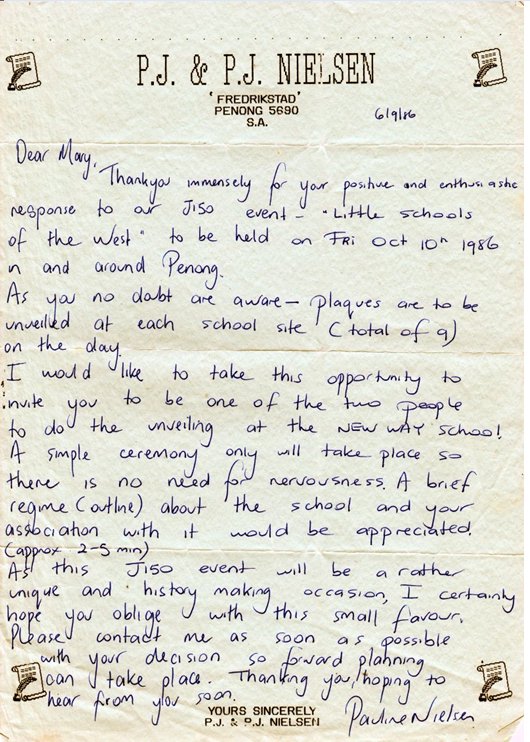
Mother was asked to speak at Jubilee 150 gathering at New Way School to be held in October 1986.
This is the letter from Pauline Nielsen explaining the request.
Despite not being able to attend the event Mother wrote a speech which was delivered on the day.
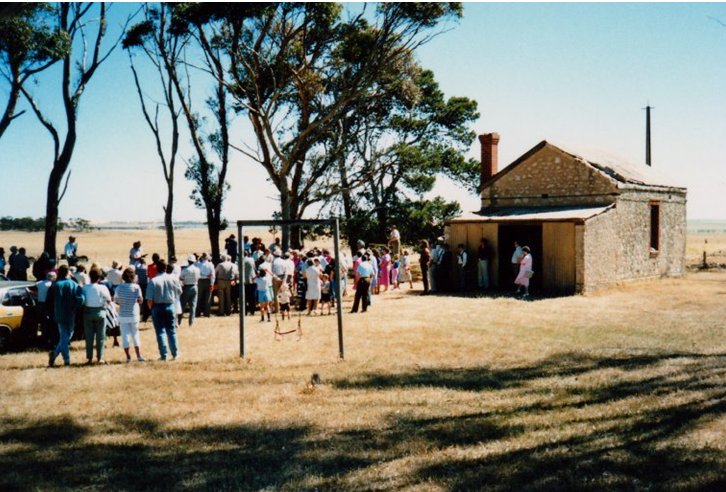
It was given to this group of ex pupils dressed in period costumes posing in front of the wreck of the dear little school.
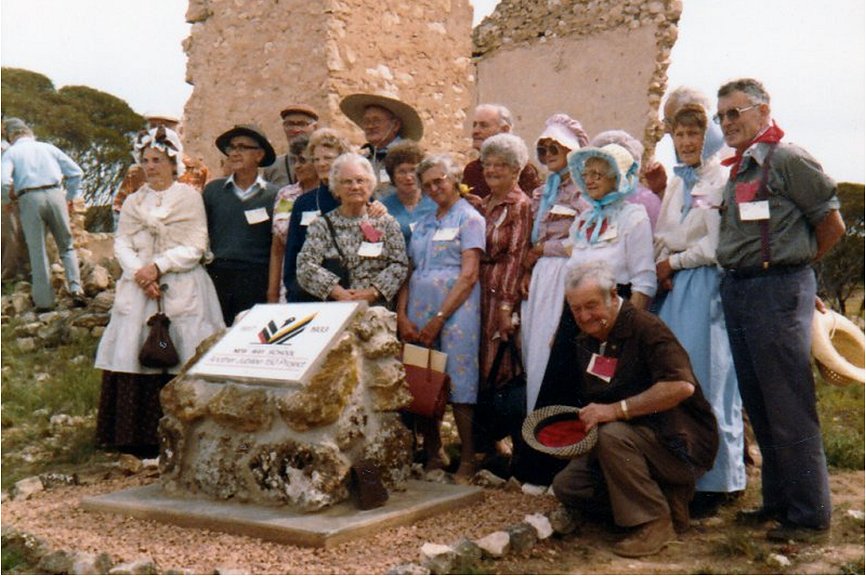
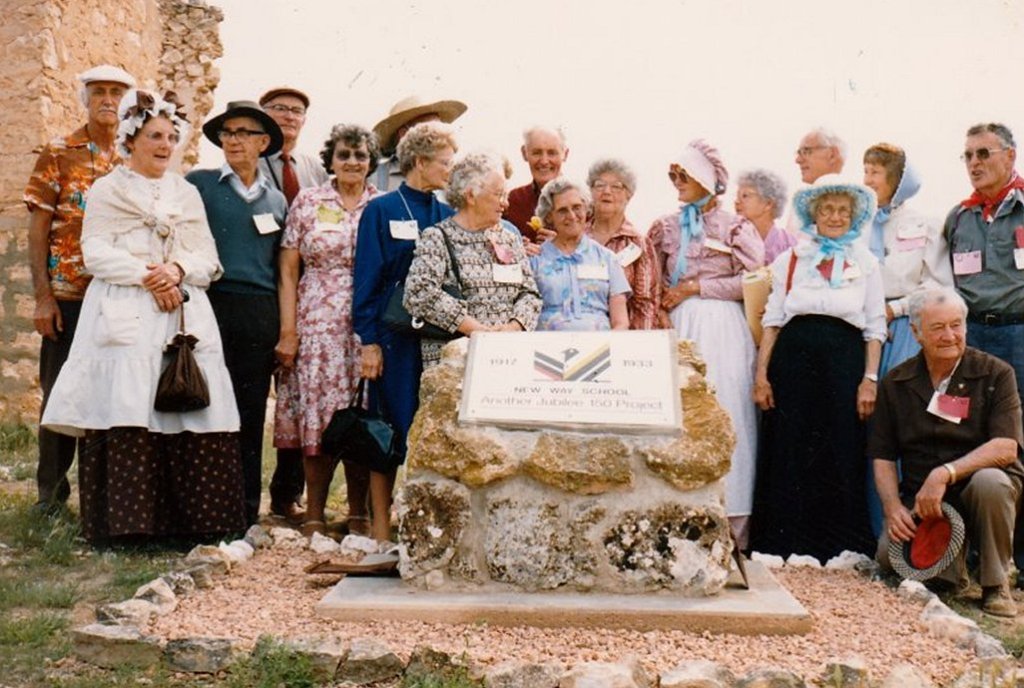
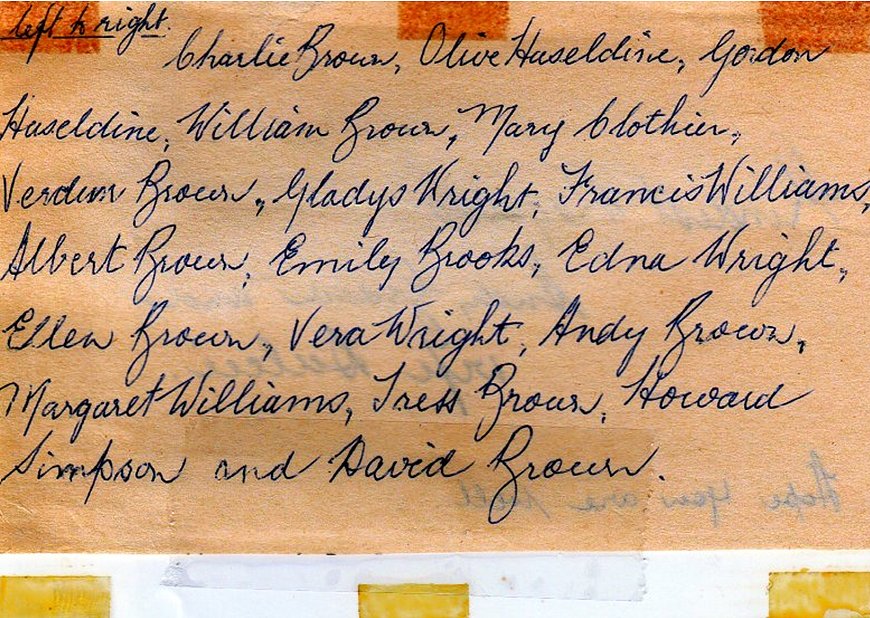
The reunion photos were sent to Mum straight after the event and she delighted in seeing many of her ex pupils. One can see the names of the children from 7 different family groups.
Mary boarded with the Wright family.
Howard Simpson is in the photograph of the reunion group. He is kneeling on the right.
The Simpsons became lifelong friends and would visit Mum years later in Adelaide. She would say “One of my ex students has just popped in for a cuppa.”
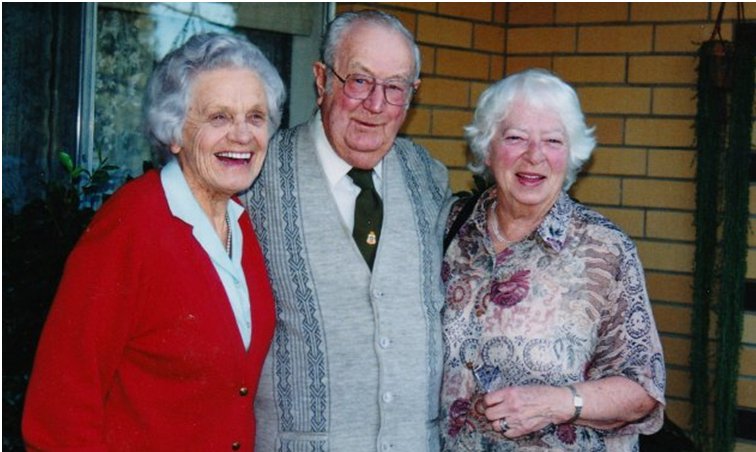
Howard Simpson was a Grade 7 boy in 1930. In 1930, he was 14 and his teacher was just 18!!!!
Transcript of Mary Parker’s speech and reminiscences of New Way
For the 150th Jubilee Project .
Hello Everyone.
My inspector wrote “New Way is an isolated place on a stony rise surrounded by scrub.” Indeed I had to go down to the Education Office to find the spot North West on the map of schools.
But we considered ourselves very lucky to be given any school in those years. We were under a 3 year Bond and went wherever we were posted.
How fortunate I was to be in an area of stable farming parents with normal happy children. Believe me I had some toughies later…especially as I followed Glenelg instead of Ports.
What a wealth of experiences for a naive 18 year old – seasickness on the old Minnipa, a breathtaking trip on the Lincoln Water Rocket, a warm homely welcome from my new home mates the Wright family and then next morning the mystery of a probe through the scrub to the spot where you stand.
I have affectionate memories of the patient, musical driver Edna and the trusted Spartan… Andrew – champion snake killer in the school, little Howard who believed he’d attain such prep??
And spare a thought for dear old Ken – the oldest pupil and head of the toilet cleaning union.
Also remember the immaculate Evely B, then the younger brigade Elle, David, Tress, Kevin. Reg. Recently I had a happy reunion with Tress and Stella.
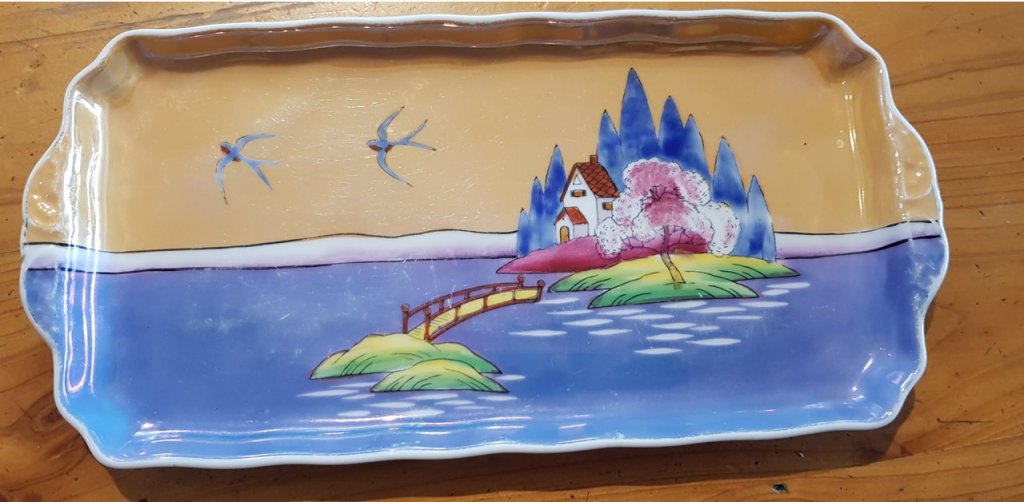
One of my treasured possessions is the sandwich tray which the children gave me when I left. It’s 54 years old and in constant use.
On behalf of all the teachers and the other old scholars of this school, Thankyou New Way and the organizers who have made possible this wonderful reunion.
Stella and I are with you in spirit . Enjoy a fantastic weekend and now back to you Len.
PS An apology from Eileen (Brooks) Tonkin
(I (Mary’s daughter) have inherited this sandwich try and it is still in constant use …The tray is now 84 years old and the story of gratitude is repeated each time it is used.
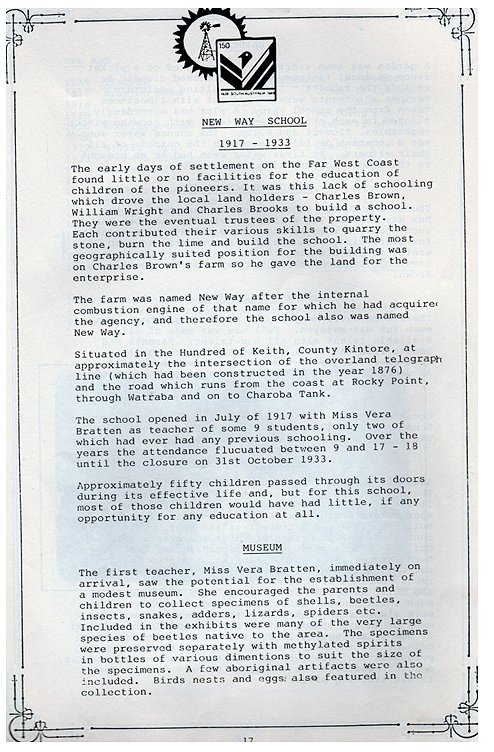
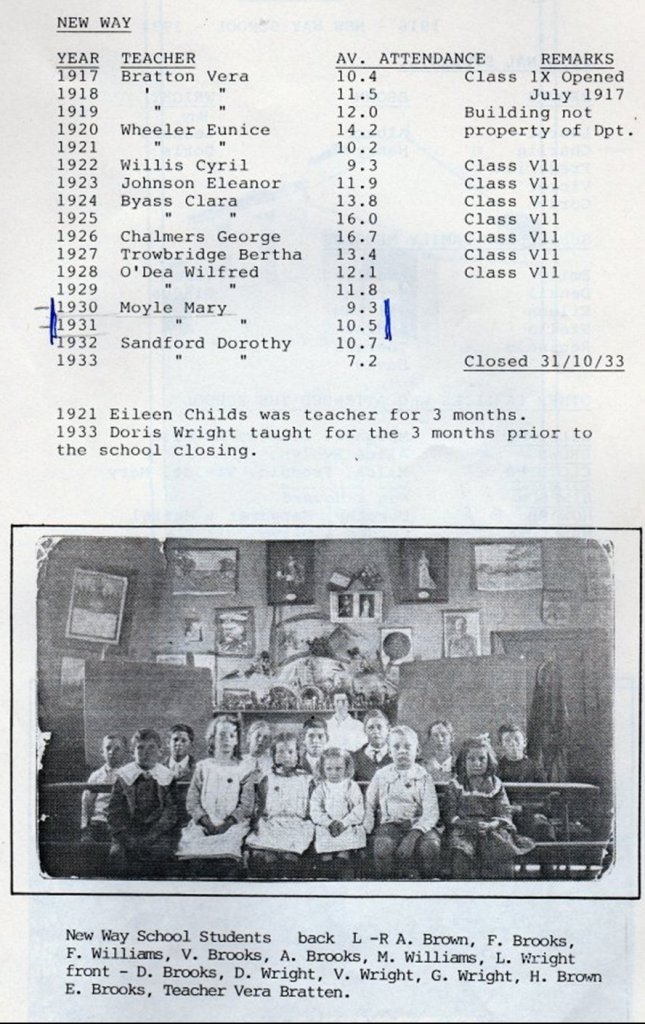
History of New Way from “Little Schools of the West”
There was a publication made about each of the 9 schools in the Penong area for the Jubilee Year
This New Way information is a typical story of how these small SA rural schools were started. It describes the generosity and determination of families who wanted their children to receive an education.
Mary’s anecdotal Stories.
There were many stories Mum would relate and retell about her time at New Way.
She appreciated the kindness of the Wright family where she boarded. Times were tough. The family had often struggled through lack of rain. Mother felt Mrs Wright was an example of pioneering strength and persistence. She had enormous respect for her. She told the story of a serious drought which occurred in the 1920s. The horses were at risk and they were absolutely essential for transport and work. There was some rain further west on the Nullarbor Plain and the farming men took the horses and stayed with them until the drought broke back at home. Meanwhile Mrs Wright and other women stayed on the farms with the children and they survived with very limited water or help. This story of resilience and hardship amazed our mother.
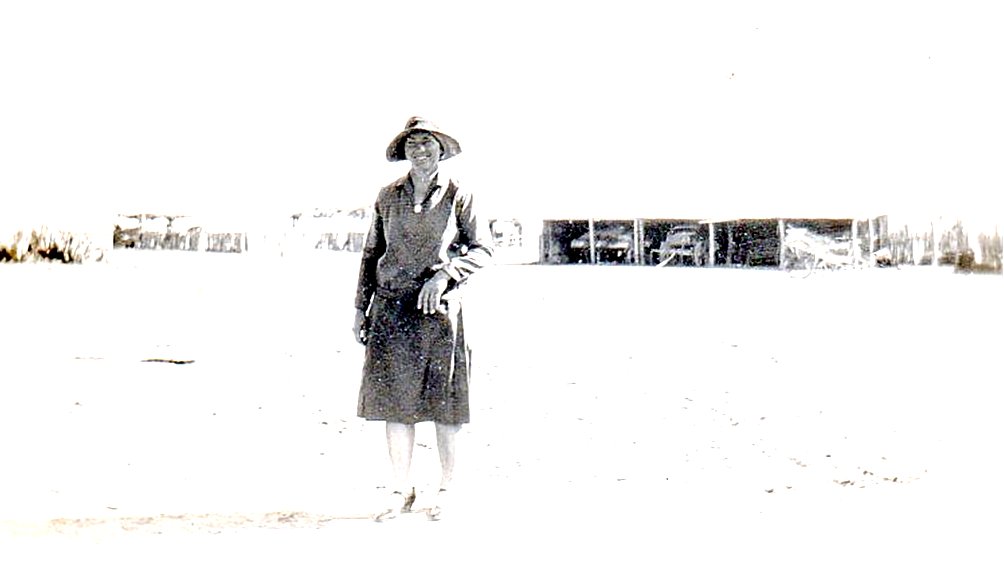
Mrs Wright insisted that Mother as the teacher should always have the first bath. This may have been only weekly. But Mother felt privileged and respected and told this anecdote often.
Getting from Home to the school was an adventure which the Wright family children enjoyed teaching their new teacher.
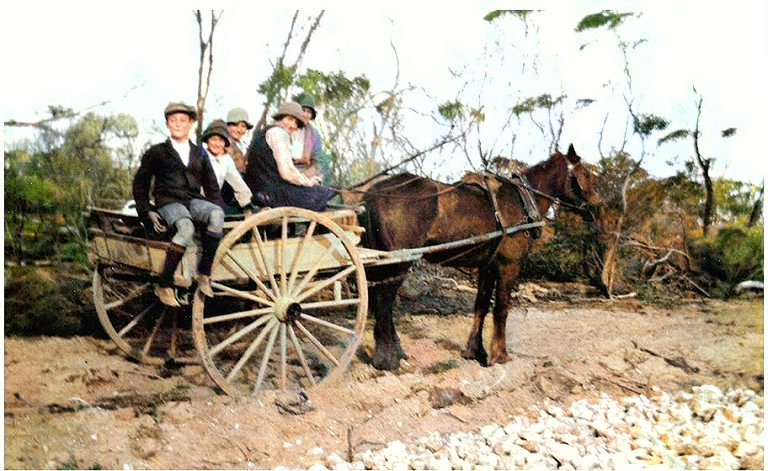
The horse and cart had to ride through scrub and low mallee for a mile or two. Mum was shown how to stand up at the back and dance by transferring weight from one leg to the other as they swayed along , suddenly ducking to avoid overhead branches. As I understand it, Edna used to sing as they travelled along and no doubt they all joined in.
In mum’s speech she refers to “the musical driver Edna” and the horse “Spartan”. Spartan would wait all day at school until it was time to take them home.
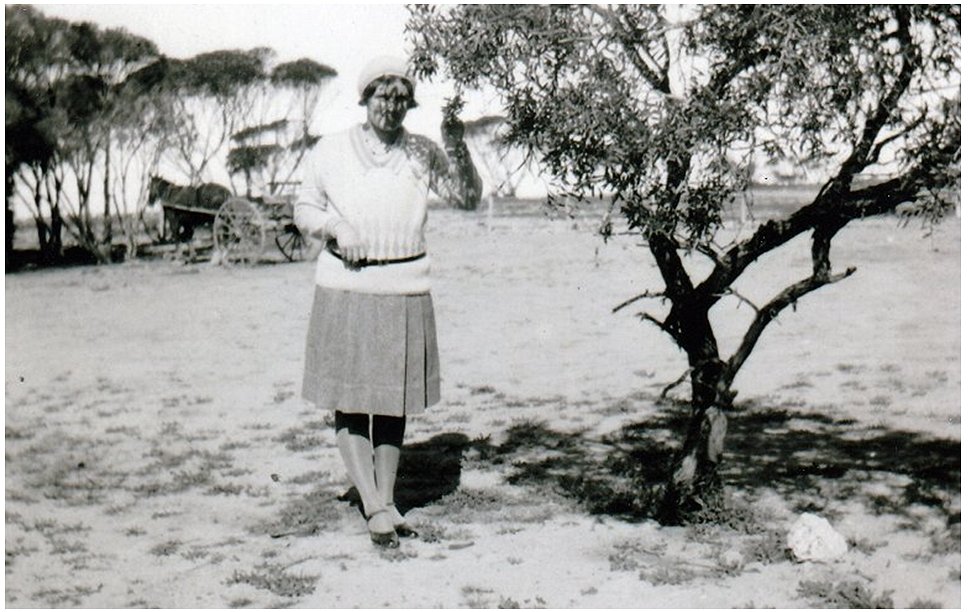
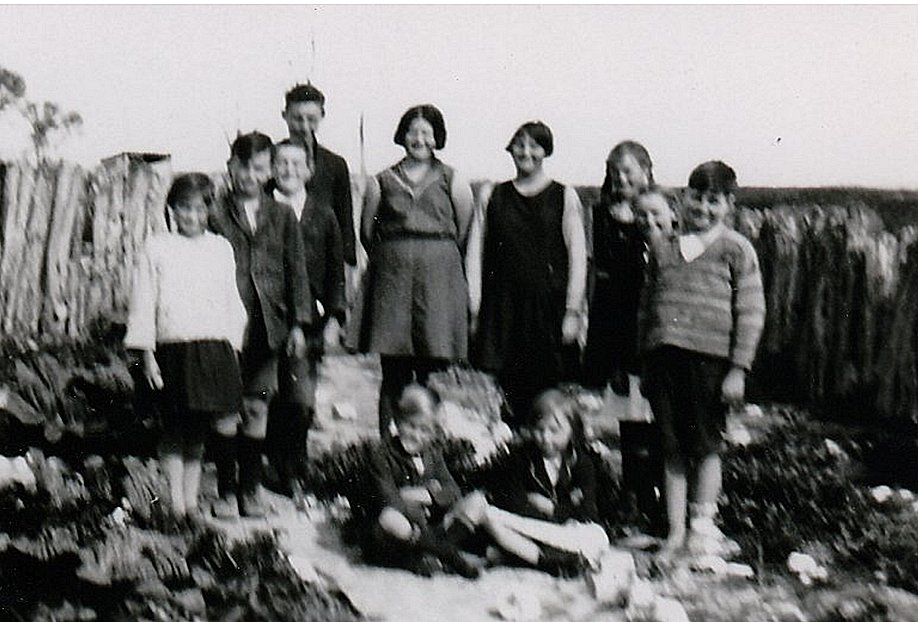
The Grade 7 boys were young men who worked on the farms and could take responsibility for many aspects of school life. Mother mentioned the toilet cleaning duties in her speech. There were also the ongoing winter tasks of collecting the wood, chopping it and tending the fireplace in the classroom.
One famous story we still repeat just as Mum used to tell it.
It was summer time and lunch time . The children were outside in the yard. Mum was at her desk. She saw something out of the corner of her eye in the fireplace on her right.
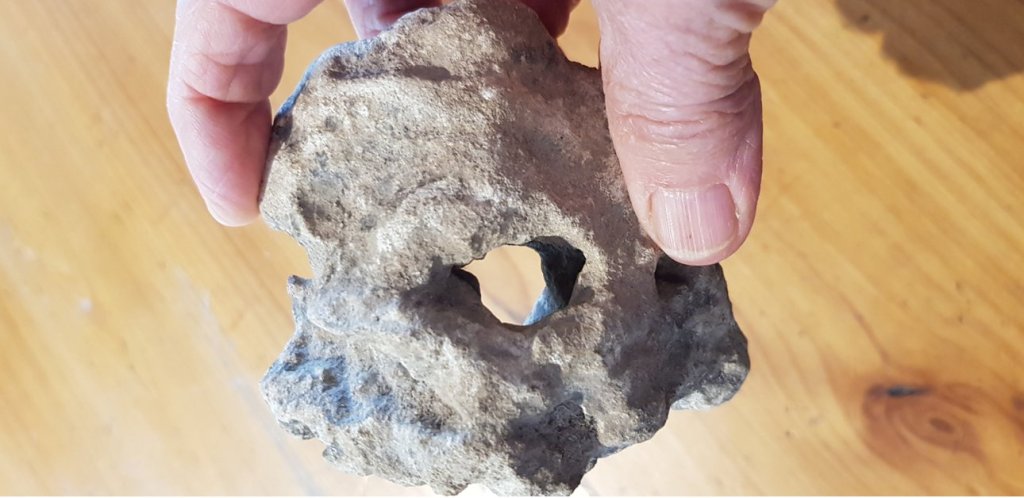
Oh No. It was a snake pushing its way through a stone. Mother had a morbid fear of snakes. It was coming straight towards her. Mum was terrified. She jumped onto her desk and then jumped from one desk to the next until she could yell through the window for a Grade 7 boy to come and help. One of the lads obliged and that was the end of the snake. Mother was so grateful and recalled the story hundreds of times.
In the late 80s Mum’s niece, Molly and her husband Ted Hughes were living at Thevenard on the west Coast. Mum went to stay with them for a few days. It was well after the Jubilee 150 event. They took Mum to where the old New Way school used to be. It was now merely the remnants of walls and piles of stones. Mum fossicked in the general area of the old chimney and Yes she actually found the rock with the hole through which the snake had come.
It is now part of the family mementoes..
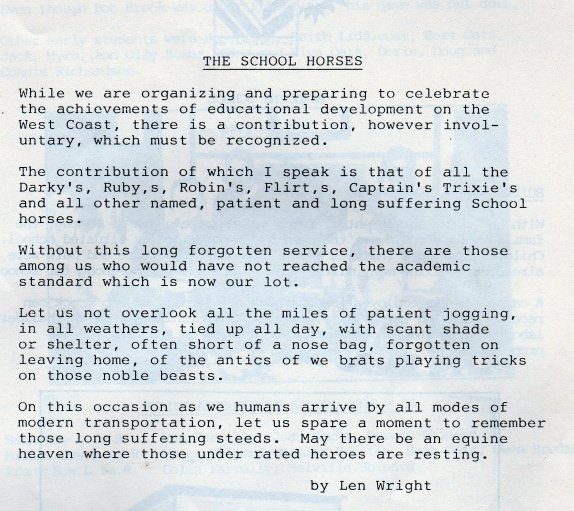
The horses were vitally important to the school community. Len Wright wrote a stirring piece in the J180 publication about giving school horses the respect they deserve.
There were free weekend times with farm activities and preparation for school work.
Riding a horse would have been a rare treat I think.
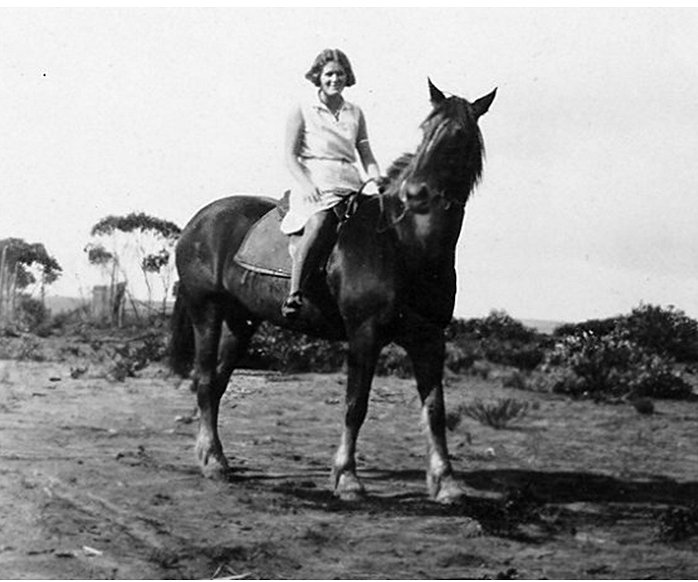
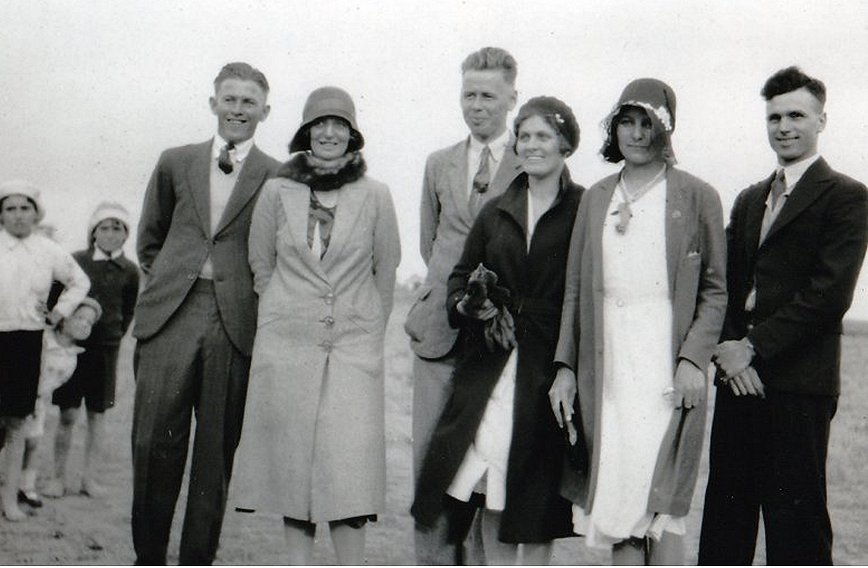
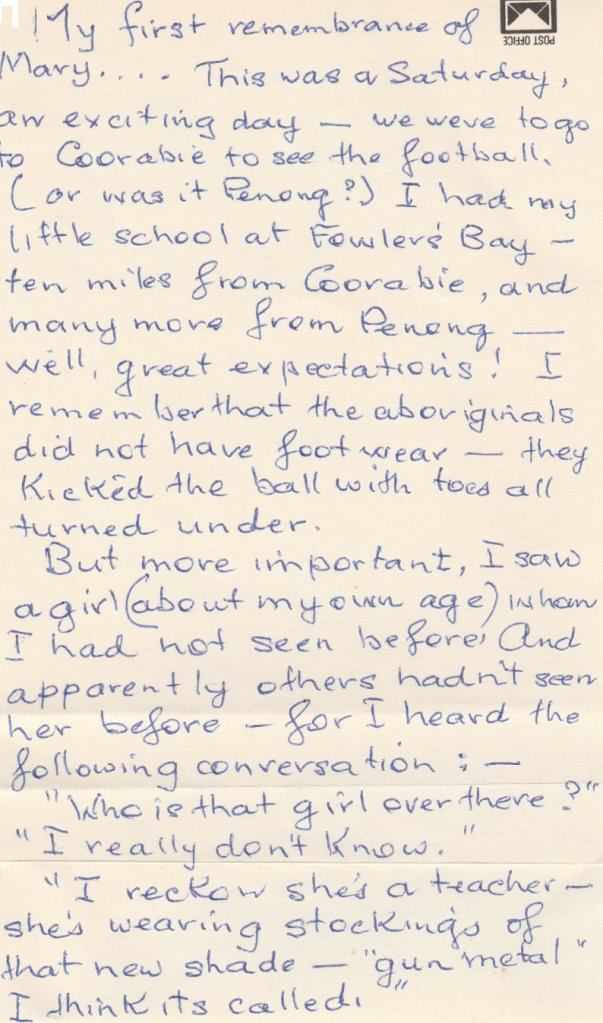
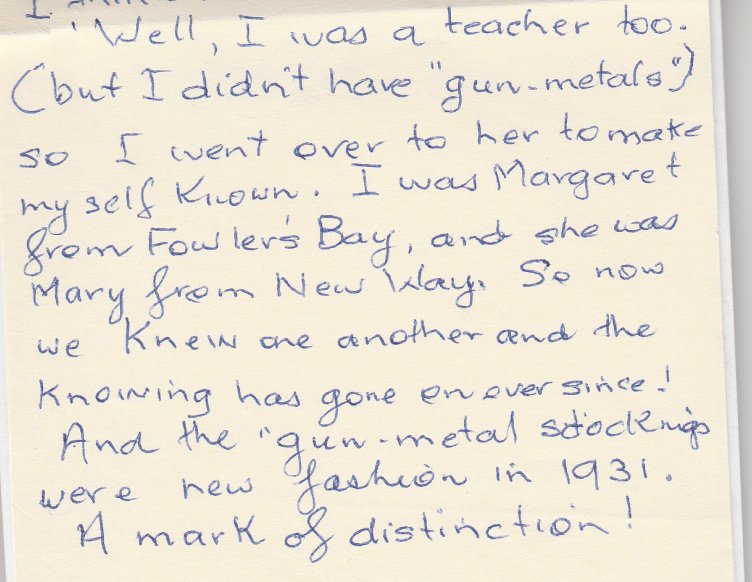
Mum told Molly that she used to sometimes meet up with another teaching friend who taught at a school nearby. It may have been the teacher from Watraba . Apparently they used to both walk a few miles along the fence-line until they met up. They could then share stories and information..
One thing they would certainly have discussed would be the dread of the visit by the Education Department’s inspector.
An inspector used to visit at least once a year.
Mum had a trick which she taught her school children. She would teach them and then check that they knew the difference between their right and left hands. Then she would ask them a general question e.g. What is the capital city of South Australia? Every one MUST put up their hand as though they are sure of the answer but be careful to only use your right arm if you’re sure of the correct answer and your left arm if you are unsure.
It worked!
The inspectors would write a brief report for the department’s records. These records are held in the State Records at Cavan. It is possible to access these records if they are longer ago then 60 years. Wayne and I made an appointment in 2022 and took a copy of the brief records of Mary Moyle at each of her schools. Here is the record from New Way.
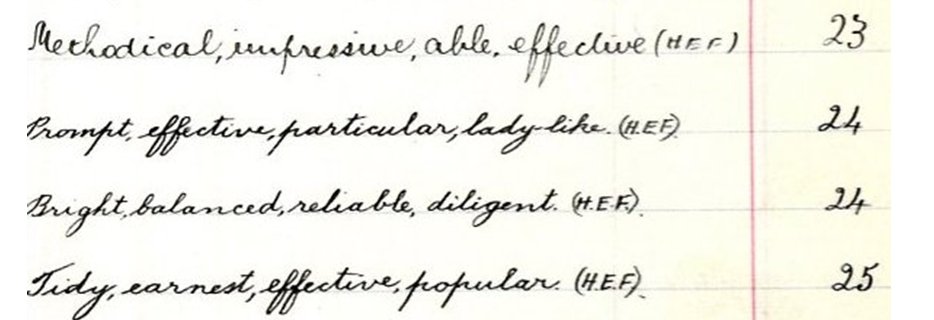
The top line is from 1930 and the bottom line from 1931. The point score is a score out of 25.
25 is excellent I think.
HEF is one inspector and MJC another

Mum would have been very pleased with these comments and there is no doubt that they are true and well earned. The students loved her.
“Inspiring” was what many said of her teaching.
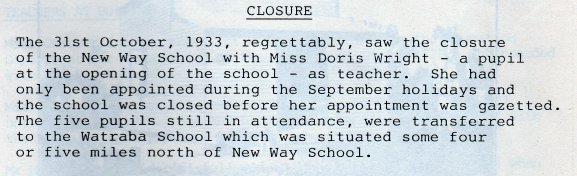
In the photos Mary gradually becomes more sophisticated and particularly “snappy” as she is clearly able to buy outfits with her regular salary. (She was also able to send home money for the family to buy things like blankets.)
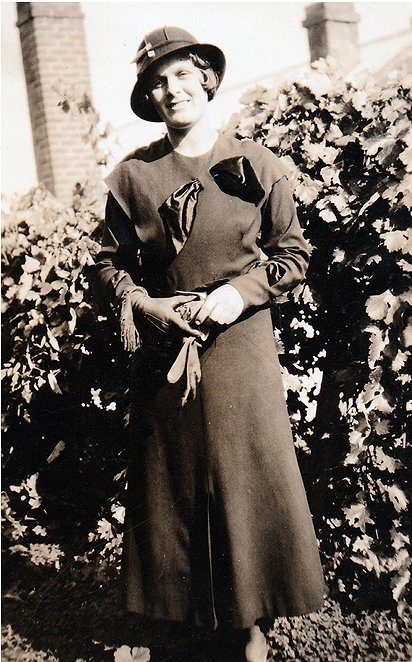
. In the photos Mary gradually becomes more sophisticated and particularly “snappy” as she is clearly able to buy outfits with her regular salary. (She was also able to send home money for the family to buy things like blankets.)
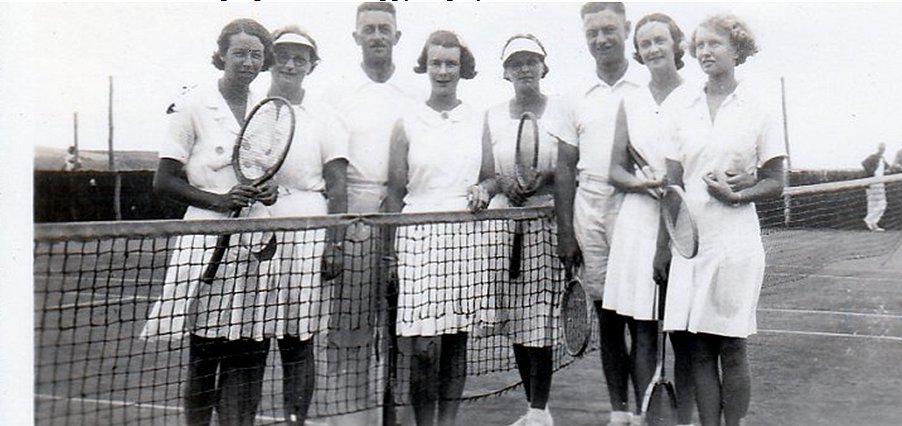
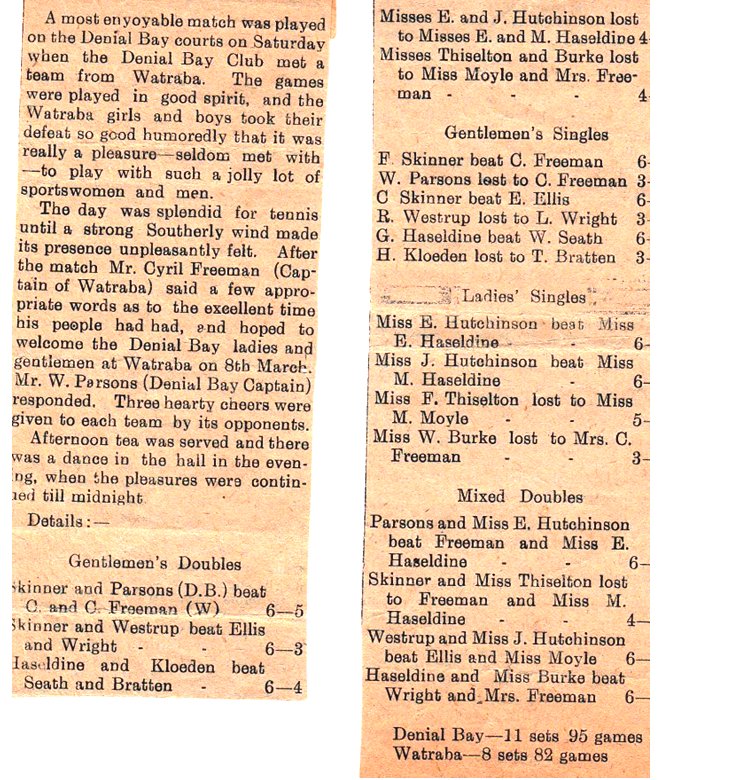
There is an interesting record that at one stage Mary was playing tennis for Watraba. No matter about the limping, she was happy to play doubles as best she could.
.
2. Wheatleigh School
Mary’s second school was Wheatley on the Yorke Peninsula.
She was there for four years1932 -1935 inclusive.
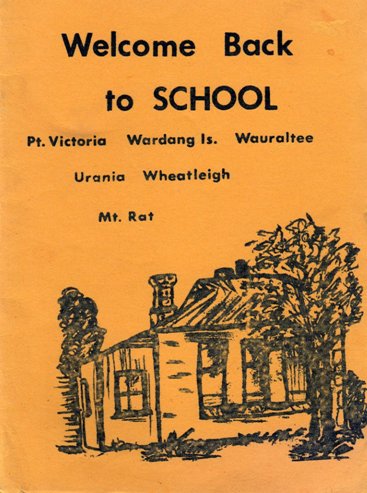
According to this little booklet of Yorke Peninsula Rural Schools, the Wheatleigh School opened in 1915 and was closed in 1947.
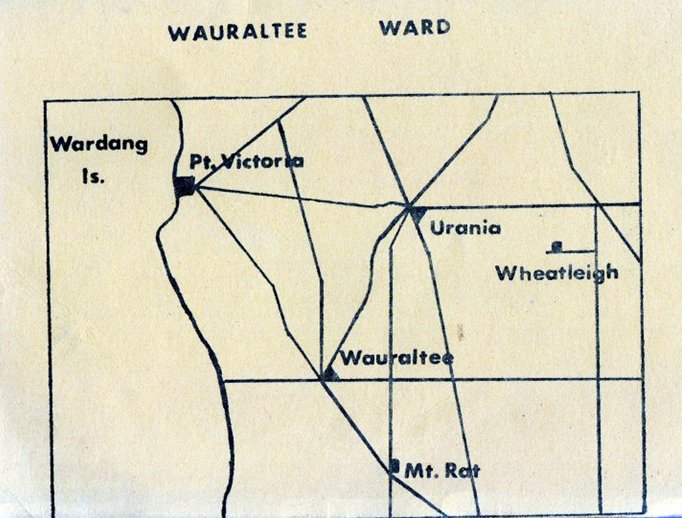
It was one of 6 one- teacher schools in the central area of Yorke Peninsula (the Wauraltee Ward).
The other schools were Wardang Island, Port Victoria , Urania, Wauraltee and Mt Rat. The largest town nearby was Maitland.
In 1915 they knew there were enough children to justify a new school. The families of Linke, Schulze, Nelligan, Hall, Verrall and Edwards each donated 10 pounds towards the cost of building a stone school building and the land was donated by Mr.Nelligan.
Further details of the building of the school were contained in this new booklet for the 1988 reunion
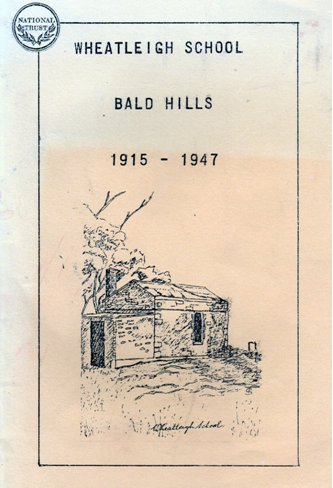
“The parents carted the limestone, from which the porch and school were built, by horse and dray. Lime was burnt at a kiln on the Edwards property. Mr Fred Scholz and his brother assisted by the parents built the school. Mr Scholz was a relative of the Linke family and the Linke children used to take morning lunch to him at the school site. One morning he broke his cup so he built it into the wall of the school”
For around 60 pounds the school was built and opened free of debt. It was rented to the Government who then supplied the teachers. The first class was in 1915.
The school was set high on the hill and sugar gum trees were planted to surround it.
This school was originally called Bald Hills but because there was another area called Bald Hills near Yankalilla the name was changed to Wheatleigh in 1921. Wheatleigh was the name of one of the neighbouring farms.
The area is a grain growing area producing many years of bumper crops of wheat and barley.
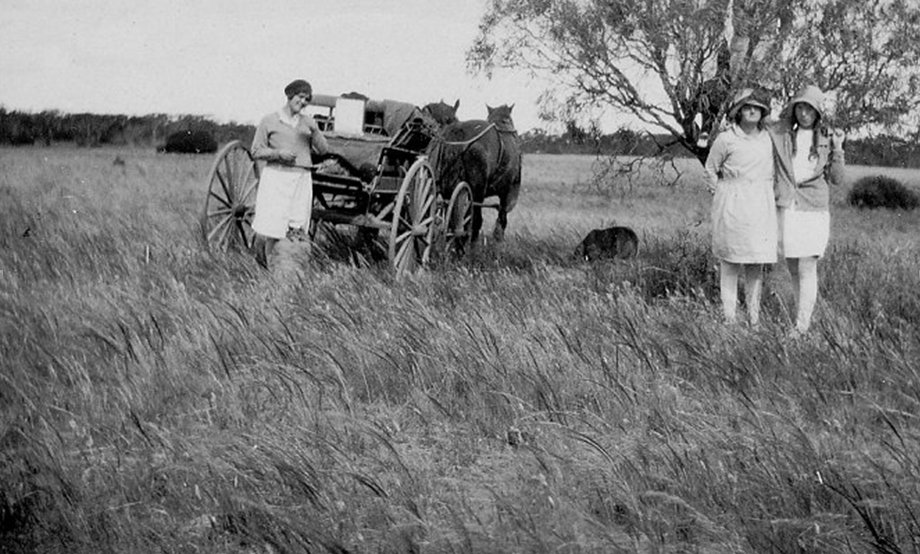
For Mary it was a very different area geographically from the land surrounding New Way School.
However socially it was similar. The country attitude of respect for and welcoming of the new teacher was the same. She appreciated being part of the Wright family at New Way and the Schulz family at Wheatleigh.
Mary enjoyed teaching in both of these schools.
She was skilled in relating very personally to each child and the sense of mutual acceptance, respect and enjoyment was in evidence in both schools.
Mary boarded with the Schultz family for the next 4 years. It was walking distance over the paddocks to school. An easy everyday walk to work.
The family included her in their activities. Without a vehicle, she was dependent on others for being taken to dances, local events, tennis matches, church on Sundays etc.
She appreciated being involved in the social life of the area. Whilst there she developed a very close relationship with Eddie Heinrich. They were engaged by the end of the four years at this school.
Holidays were spent back at The Sheoaks whenever possible.
Wheatleigh on the Yorke Peninsula was much closer to the mid-north than New Way had been. I assume it would have been a coach trip connecting with a train trip to Clare.
The letters between Mary and the Sheoaks would have been constant. The sisters would have been wanting to share the home news of what everyone was doing and Mary wanting to explain the ins and outs of her new life as a teacher. It would have been at least one weekly letter in both directions.
During 1934, Win was married to Oliver Burford. That would have been a very special family event in Watervale.
There were occasional special events. Grace Bagshaw was a friend from Saddleworth and she and Mary planned a holiday together in Tasmania. It would have taken several years to save for this trip. I think their holiday was in 1938ish.
There were only 7 children in the school when Mary started teaching at Wheatleigh.
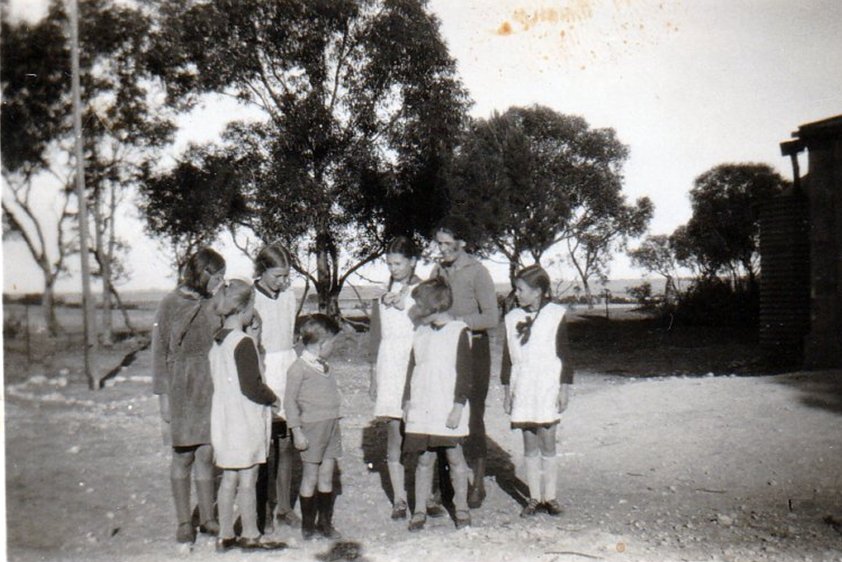
Here, Mary and the children are preparing for a school photograph to be taken in 1932.
The trees had grown well by the time Mary was at the school.
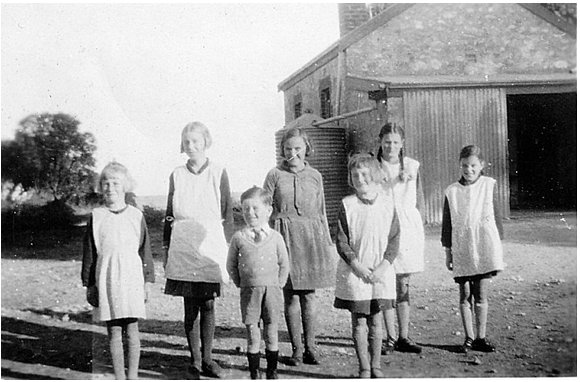
There were 6 girls and one little boy.
In this photo from the left are Kath Fletcher, Edna Burrows, Little John Fletcher or Glen Cook, Gwen Borgemeyer, Eva Fletcher, Kath Andrew, and Pat Andrew.
Numbers were often a problem for this small school. Each school was supposed to be serving 10 or ideally 12 children. Despite this, Wheatleigh survived.
I think “little John Fletcher” was quietly(?) admitted before being 5 which explains why he was referred to as “little John”.
However another comment about this photo was made by Beryl Neumann. She asked Mary “Could the little boy in the photo be Glen Cook? I remember him saying that he was the only boy among six girls.”
So maybe little Johnny or Little Glen?? Does anybody know?
The Rules of Conduct were up on the school walls.
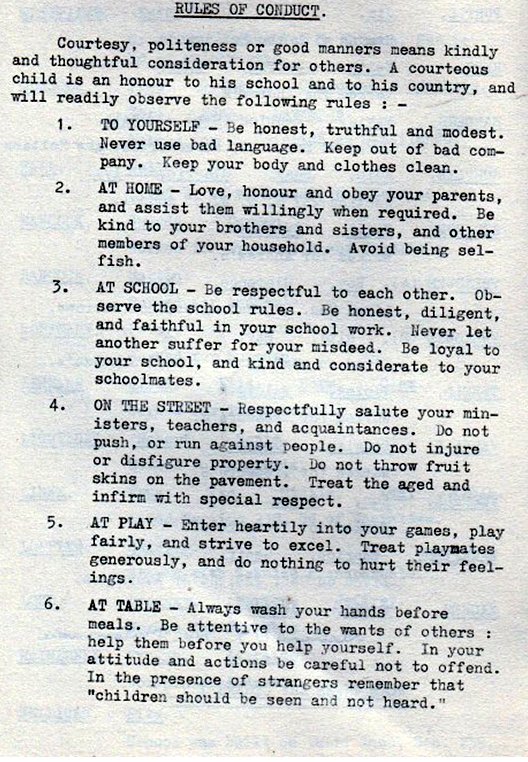
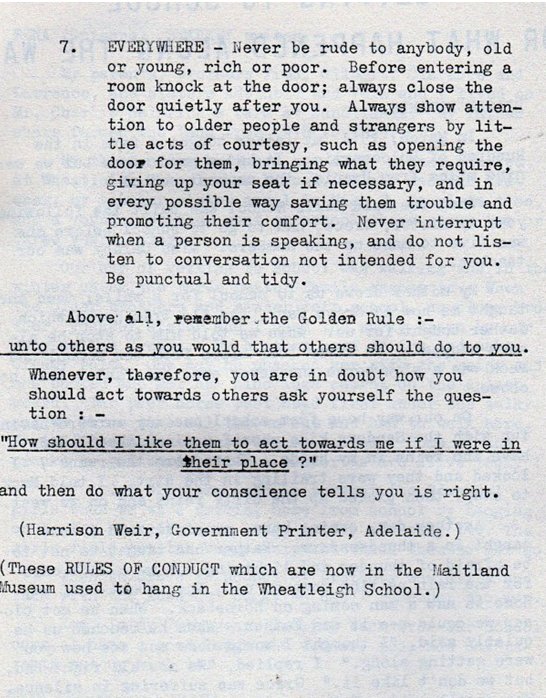
As well as the Rules of Conduct there would have been charts of multiplication tables and maps of the British Empire and Australia: also, drawings, poems and examples of excellent printing and cursive writing. Mary always loved teaching and would have made the room as interesting, stimulating and pleasant as possible.
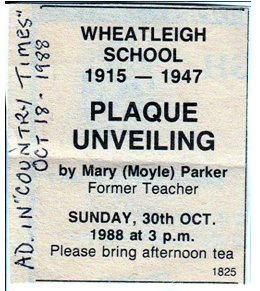
The following invitation was posted to all ex students and teachers inviting them to participate in the 1988 reunion. It demonstrates the country attitude of welcoming of ideas, memories and contributions of all sorts –including afternoon tea.
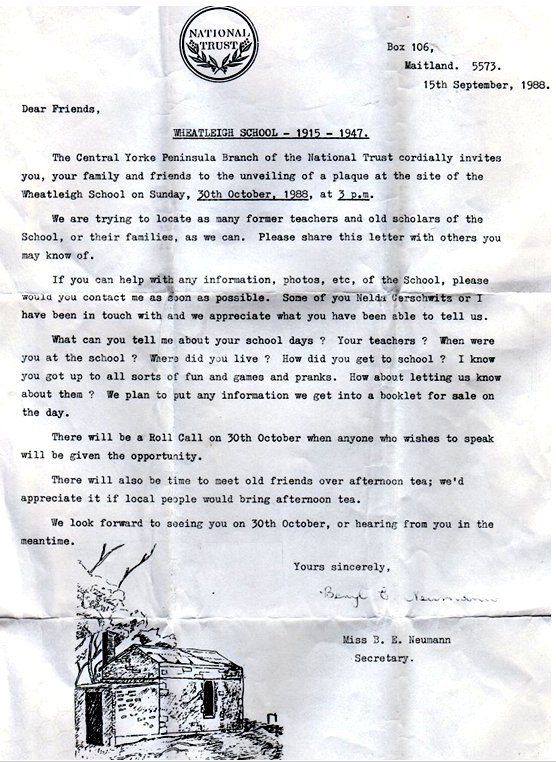
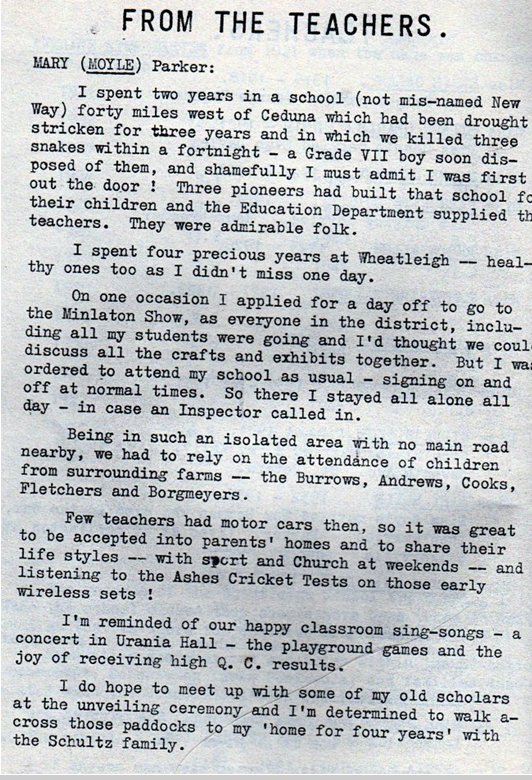
Mary responded to this invitation and wrote a short summary of some memories of her four years at the school.
This writing takes pride of place in the Wheatleigh School booklet .
There’s a photo in here that I can’t delete or open? I’ve put in another copy. Please remove if you can.
This writing has the first mention of Mary’s love of music. The class “singsongs” were obviously a memorable feature. If there were musical instruments available they would have been included. A piano would have been a blessing, but not one of the rural schools where she worked had such a luxury. Never mind, the singing was a delight. And they had a concert at the Urania Hall. Concerts were a favourite form of entertainment in family homes and in the local halls. The families would all have loved these school items in the local concerts.
I notice also the importance of the QC (Qualifying Cerificate) results. There are few records of the lesson content/ curriculum of these small schools. It was a controversial topic in some of the parliamentary debates. I know Mary would have taught English, History, Geography, Arithmetic and tables!! Music and more music. But there are no records I can find.
Colin Thiele in his book “Grains of Mustard Seeds’ (page 148) refers to a criticism being made of the teachers sent to the country schools with only one year teacher training. A man called Gold had commented in “a moment of perception and pessimism that the short courses actually “hindered the life of outback communities”.
The following responses to this criticism by an educator Mr Charlton are gems with sparkling elements of truth.
Charlton commented that “some of the best is to be found in the small far off schools.” “For here and there among the back blocks was a teacher blessed with rare insights and understandings: one who ignored official timetables, ranged widely through the natural world, and on wet days gathered her half dozen bare footed disciples around her before the roaring fire. There while blucher boots and sorely darned socks dried out in front of the flames she read to them all day long –poetry and history and magical stories of ancient Persia, Yucatan or the wastes of Antarctica – until it was time for them to saddle up their hairy hacks or spring cart horses and plunge home through the wins and rain. The educative power of such a person in a one-teacher school was something tat research would never be able to ticket nor all the pedagogues in Christendom analyse successfully. There were unquestionably people living in South Australia who would have said of their outback teacher, as Rex Ingamells did of his Miss Singwood that she “Had, of all people, not even my revered parents excepted, the strongest influence on my life.
Although this is a romantic view it contains elements of truth and many of Mary Moyle’s students I feel sure, would have agreed. I know she would never have mentioned the Yucatan or Persian poetry but the children may well have dried off their socks as they were singing songs or reciting poetry or listening to stories and of course she would have taken advantage of any opportunity to rechant the times tables.
The point is that the South Australian children all had to do the Qualifying Certificate exam at Year 7 level. This was a serious and difficult set of tests. Students needed to pass this in order to be able to proceed to High School. It had question covering General Knowledge, Arithmetic, Grammar, English, History etc.
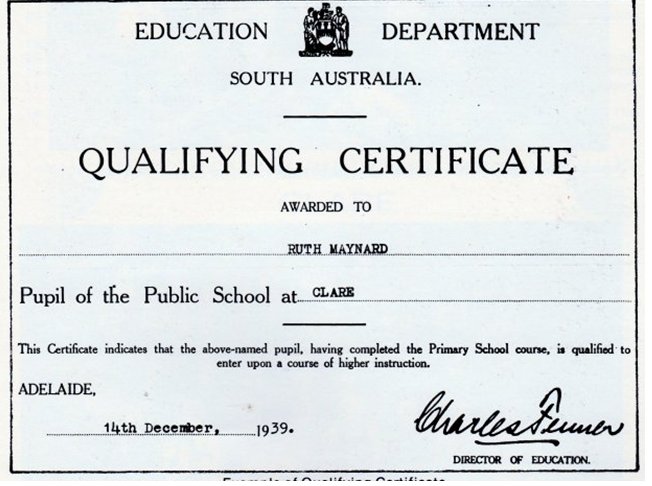
Mary reports that her students had “the joy of high QC results”.
In the reunion booklet, Gweneth Walsh (Nee Borgmeyer) wrote: “I attended from grade IV to Grade VII (around 1936). There were 7 of us at the school and when Cyril Stringer left John Fletcher came to keep the school open.
Mary Moyle was the teacher.
I had to go to Maitland to sit for my QC (Qualifying Certificate). It was so strange. I knew no one and was so very nervous”.
It was a huge hurdle for students. They couldn’t sit for it in their own familiar school environment. But they did it and Mary reports the results were very good. So the curriculum in her school was covered very satisfactorily.
The reports from the inspectors of these 4 years are quite glowing. The points given to her teaching have risen to 25 which I think is the highest they can reach. How she would have loved to have seen these records!
One can’t help but reflect on the difference in today’s high tech society where nobody does a QC at year 7 and even passing year 12 exams is downplayed as an important precursor to university entrance. Up until the 1980s there was great rigor in working to be accepted into High School and then working diligently to be accepted into courses at University level.
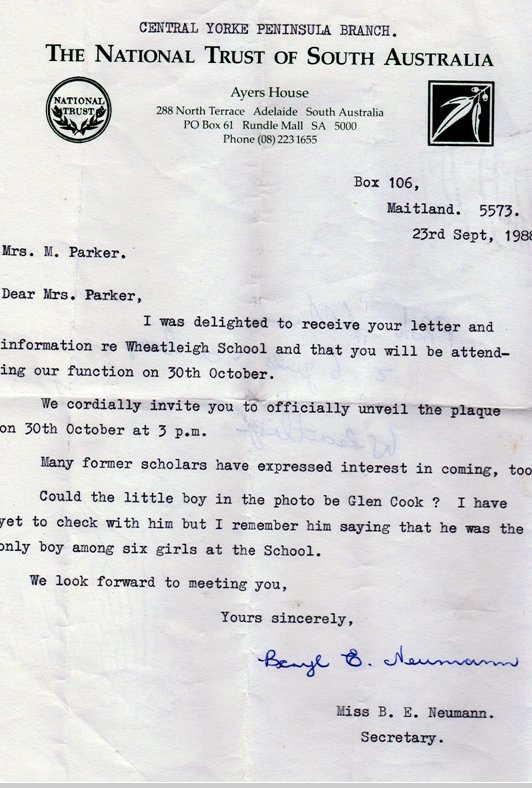
A Wheatleigh school reunion was planned for October 1988. The National Trust gave financial support to this reunion and the creation of a memorial plaque.
Another letter from Beryl Neumann invited Mary to unveil the plaque.
This little ad was in the Country Times in early October 1988
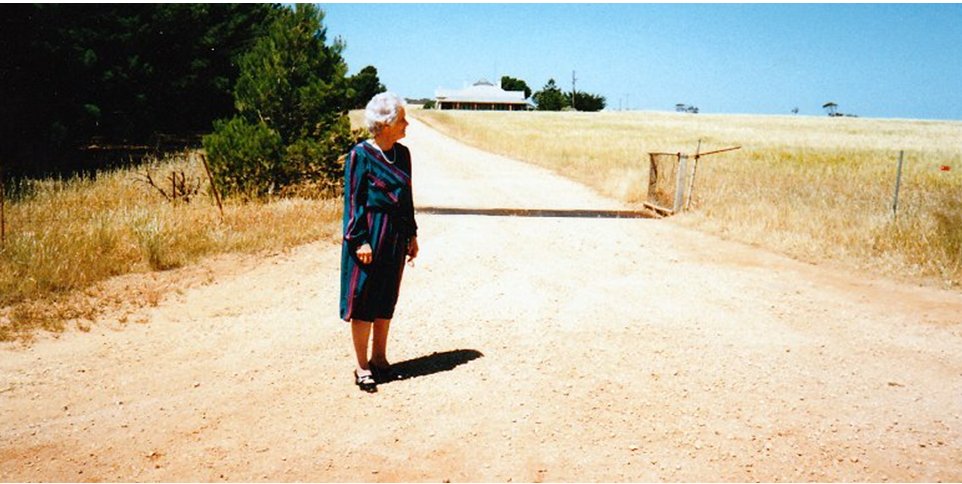
Mary accepted and together we drove to the York Peninsula.
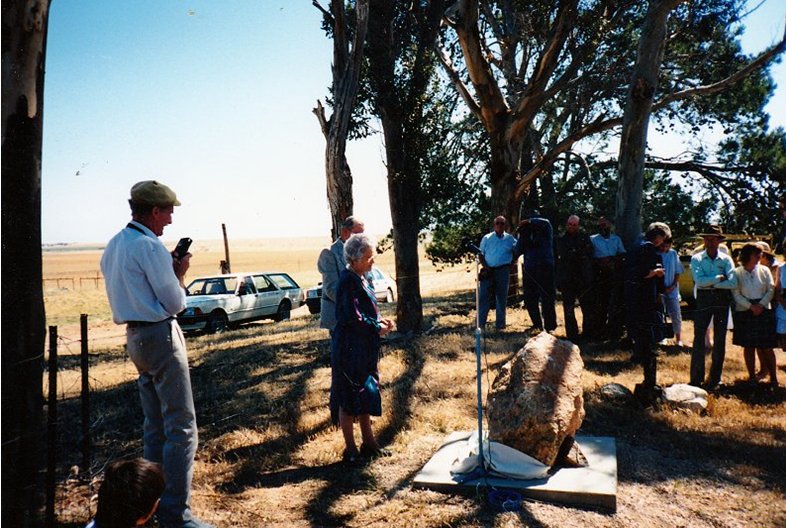
The reunion was a wonderful and very memorable event.
The photos speak of the enjoyment experienced at this special reunion and the affection between all members.
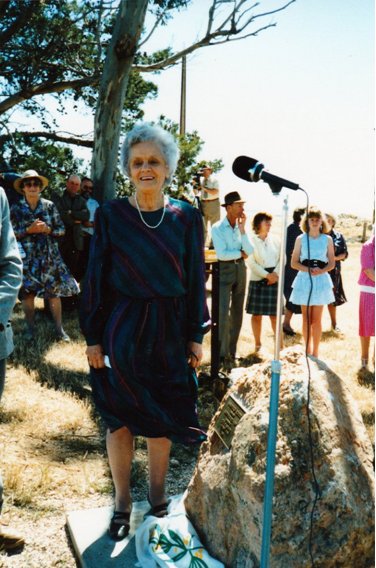
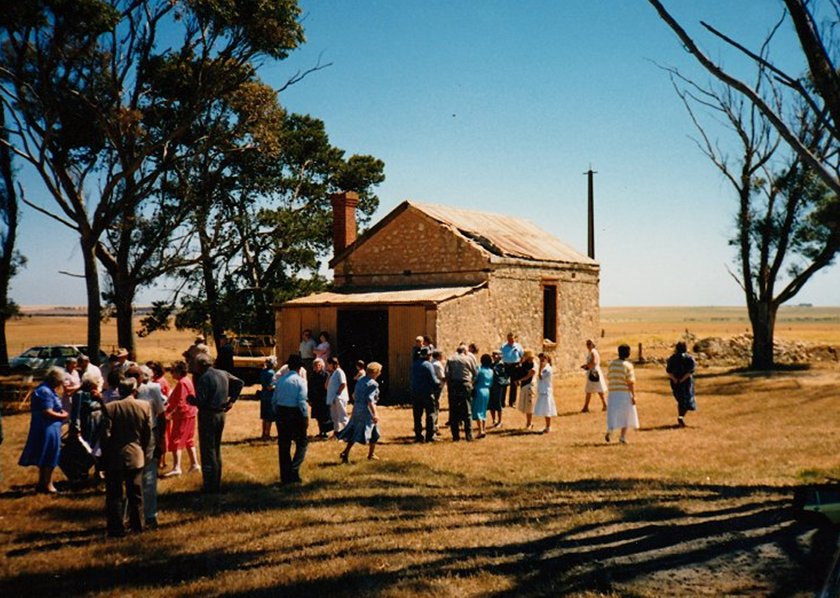
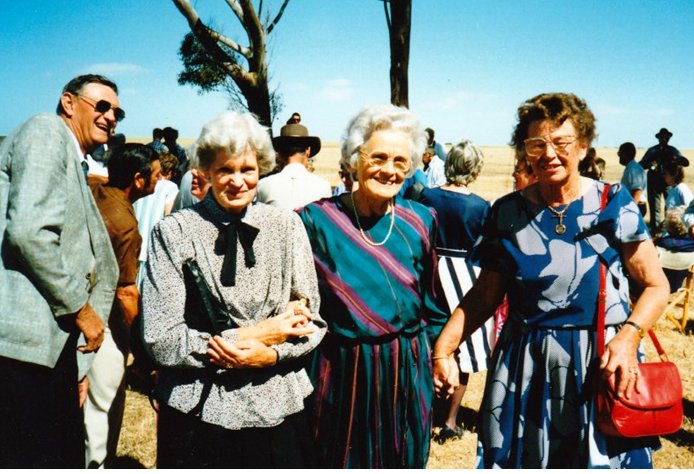
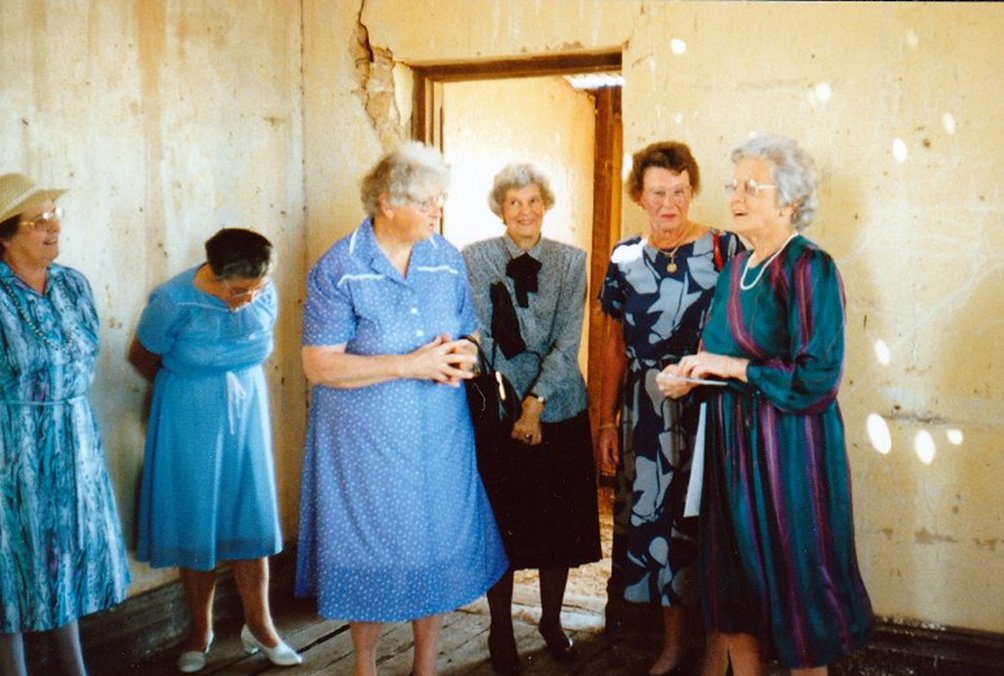
The teacher and students look as though they could be sisters. Beautiful people.
I posted questions about Wheatleigh on Facebpook in 2022 and a child of an ex student responded saying that the building has suffered from some vandalism over the years and the last time this she visited this old building there were two owls living in it. How appropriate.
In 1936 Mary was appointed to Burnbrae in the South East
3. Burnbrae School
In 1936 Mary was appointed to Burnbrae in the South East.
Burnbrae was another one teacher school , a few miles north of Naracoorte.
This was a very different experience for Mary.
There is one photo of the school but none of the school children in Mary’s box of memoirs. There are just enough letters to know that Mary was restless and wanting to be posted to either the West Coast or the mid north.
I remember her pointing out the school to me when we were travelling to visit Aunty Nell in Victoria. As we neared Naracoorte she would point to the tree hiding the school on the eastern side of the main road. There was no emotion. Just an acknowledgment of “That’s the school where I used to teach.”
I have a letter which Mid wrote to her father on March 1st 1936.
I will quote a few lines which help to draw the picture of her new life at Burnbrae.
Burnbrae was another one teacher school, a few miles north of Naracoorte.
This was a very different experience for Mary.
She loved teaching always, but she was restless for the first time..
There are just enough letters to know that Mary was hoping to be posted to either the West Coast or the mid north.
I remember her pointing out the school to me when we were travelling to visit Aunty Nell in Victoria. As we neared Naracoorte she would point to the tree hiding the school on the eastern side of the main road. There was no emotion. Just an acknowledgment of “That’s the school where I used to teach.”
We could have got out of the car and walked around the school but she was in a hurry to get to Victoria in order to see Aunty Nell and I guess I wasn’t particularly interested at that stage.
I have a letter which Mid wrote to her father on March 1st 1936.
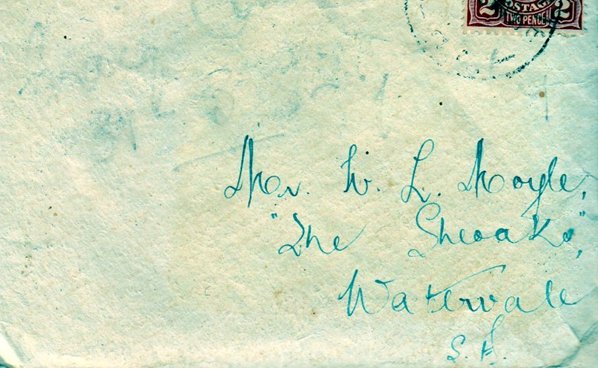
(I have shown the envelope containing this letter to prove that her excellent writing on any envelope has continued to develop. I reckon she could still win an envelope addressing competition at the local show! )
It is also interesting to note Mid’s mature handwriting style. It was expected in those days of writing with pen and ink, that your writing style was to be distinctive , fluent and easy to read.
I tried to copy this style in my late adolescence and never got further then the M in my name.
I will quote a few lines from the letter which help to draw the picture of her new life at Burnbrae. It is a private letter so I haven’t included the whole transcript…just some interesting thoughts and episodes.
“The people here are very conservative. Still I’m getting used to it now and am quite content . There are no arguments or fuss or ill feeling here and the school days fly, but weekends drag a bit. The girls dress up and go off to tennis but they don’t include me. Compare this with the Coast!
It’s good country here. It’s mainly grazing country but they reap quite a few hundred acres of wheat – very little of barley. They use an auto header and have a couple of tractors. They were reaping after I came down – no fear of dust-storms here so they take a couple of days off to go to the races – such a thing wouldn’t be considered on the Peninsula.
There are 8 cows and there’s a butter factory in Naracoorte.
It’s quite a drought for these parts at the moment. The family have been using well water for the kitchen and the bathroom for weeks.
They told me today that for a well on the plains around here you strike water 5ft 6 inches down!”
Mid took a while to get the response she wanted from the children but she comments in this letter:
“After our combined frequent singing of “Swim Sam Swim” and a few such lively tunes their faces are beginning to smile.
One girl made me smile. The other day I asked some questions out of the Grade 7 Geography book “How do captains of ships off the West Coast of Australia let the Govt meteorologist know what kind of weather they’re having?” …A year 7 girl said “Throw a bottle over”. Never mind. Any answer is better than none.”
Eddie Heinrich had been visiting. And she wanted to share some of this information with her Dad He was suffering from hives and had visited a local herbalist. He apparently commented that she wasn’t a “clairvoyant” and Mid commented “I don’t know what that is!!”
Another note was added about Eddie’s trip home. Apparently some friend in Lockleys gave him a joey to take home to the Peninsula. Mid thought it was quite amusing to imagine this joey sitting up next to him in the front seat.
She comments in her letter to her Dad about the house improvements happening at The Sheoaks.
“The old home will be quite a mansion if you keep up with all the improvements. That bathroom idea is a great one and I’ll save up 5 pounds to help you on with it Dad. We may as well have a decent job of it while we’re about it.”
“You’ll have to get used to your teeth before the wedding or you’ll be like Gran and put them in your handkerchief!!”
“I have left this before finishing to have a game of ping pong. – 5 sets all and very even! They’re all pretty good at it and I think I’ll be able to ‘cane’ you all next holidays. They have a special pingpong table – green with white lines. “
“Please write again soon Dad. As there’s little likelihood of me making friends down here and I rely on letters from home.”
Love to all
Mid
PS When you write would you give me Auntie Charlie’s address so I’ll write her a letter – or Beryl.
She stayed at Burnbrae for 2 terms only and was then posted to Hill River.
The inspector never visited her there, so there are no official comments recorded for Burnbrae.
She would have been happy to have been posted to the mid-north.
Hill River is close to Clare and not very far from Watervale.
4. Hill River School
Near Clare in the Mid North of South Australia
Hill River 1937 and 1938
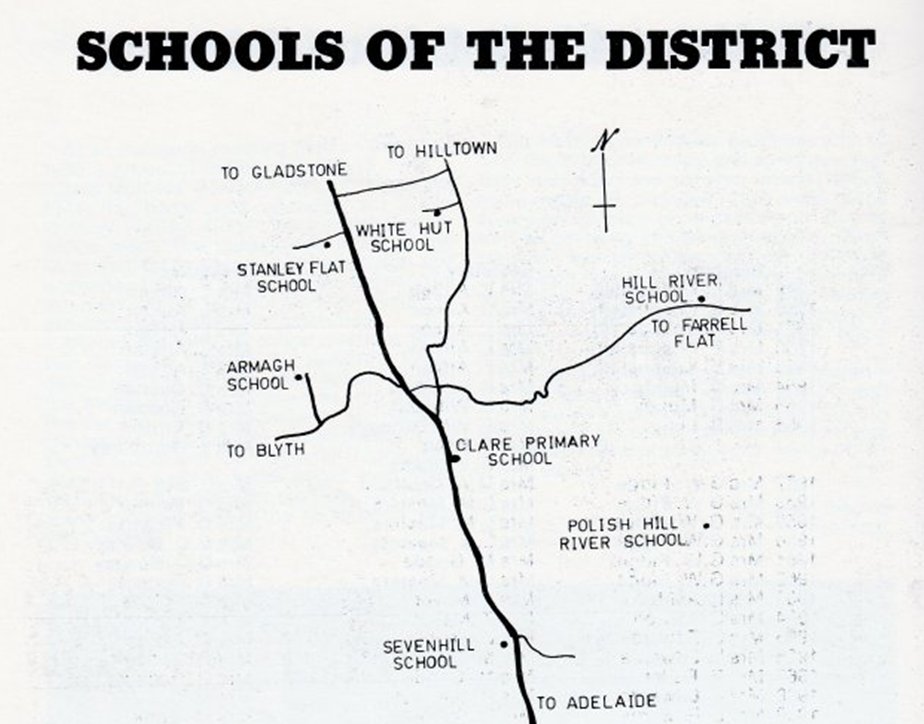
There are no letters from Hill River and very little information. But many photos.
I do recall her pointing out the old shearing shed which had been upgraded to be a school premises. It was on the road from Clare to Burra and up in the Clare hills. The old stone buildings are the connection I make with the Hill River photos
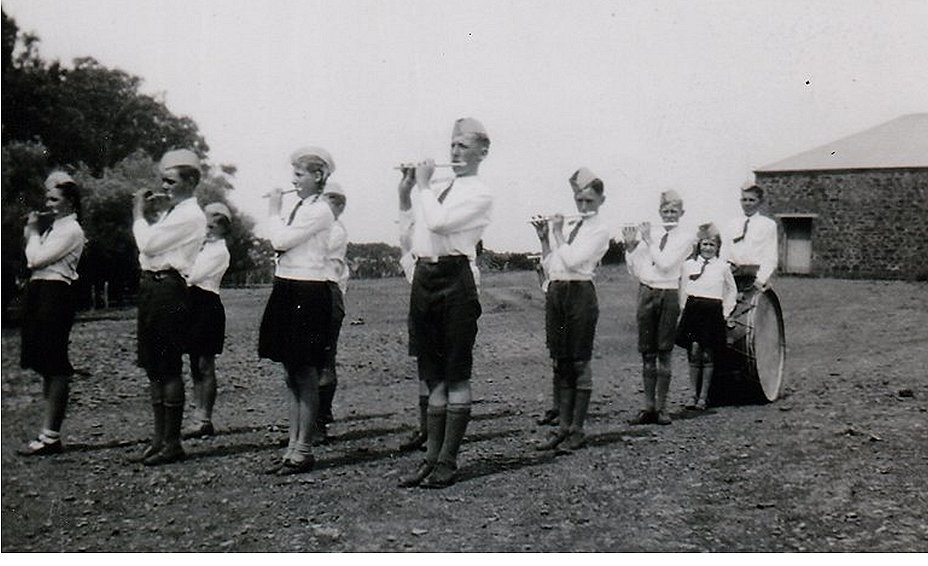
She enjoyed her time at this school and loved the musicality of the pupils. The fife band was a delight and held in high esteem by the community.
Here is the fife band in their very snappy uniforms. Maybe not all the members were present for this photo
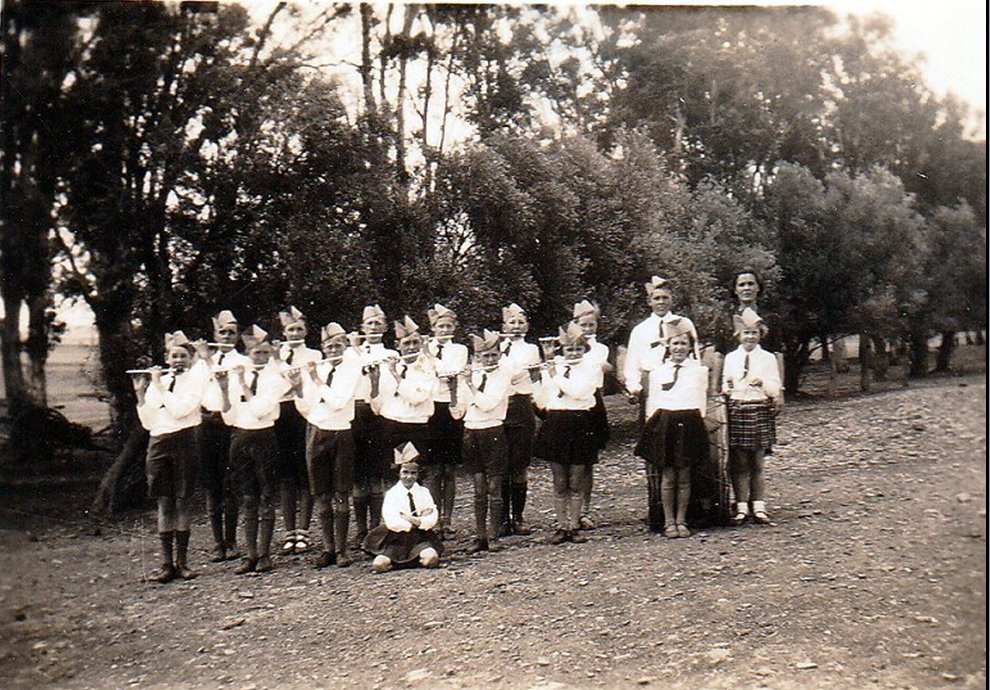
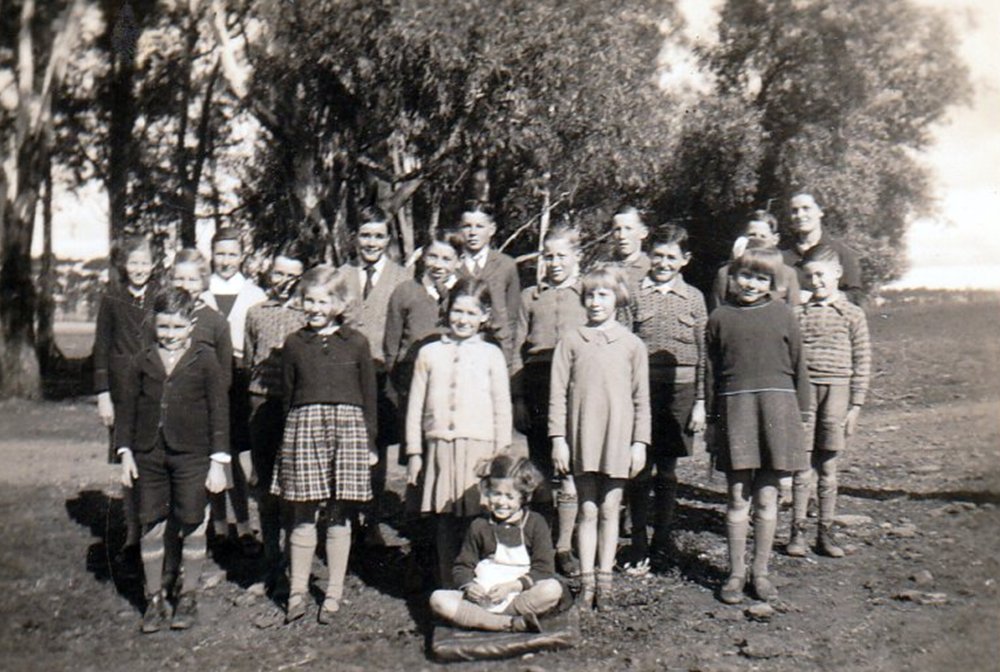
The school children, Mary Moyle the teacher posing with them. This is a large class for a one teacher school. But I think it is the Hill River class. After all the band has at least 10 members. The little girl in the tartan skirt appears appears in several photos. As does the little girl in the front.
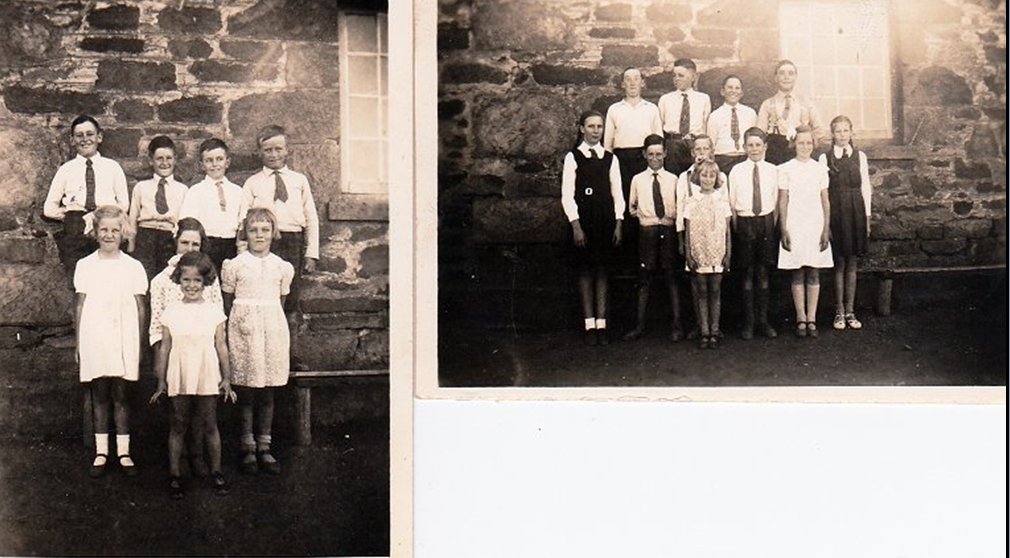
I wonder if the children on the right are actually from Burnbrae??? The girls in uniform look to be ready for High School. But the building looks like Hill River.
I wish I could check these photos with Mum . She would even have told me their names.
I would welcome any comments from people who can solve this dilemma.
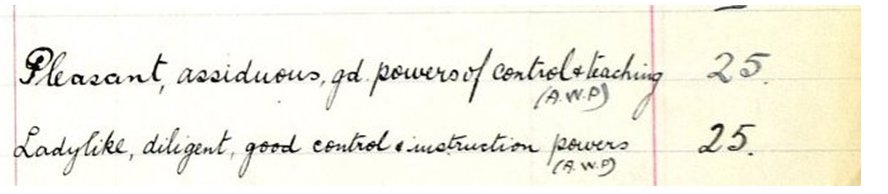
Her teaching report from the inspector (A W P) who visitied Hill River on two occasions is outstanding.
I understand 25 was the maximum possible for teaching points .
The enthusiasm of the fife band is a good indicator of the positive effect Mary had as their teacher. Her love of music – the playing of instruments and singing was an important base for her teaching .
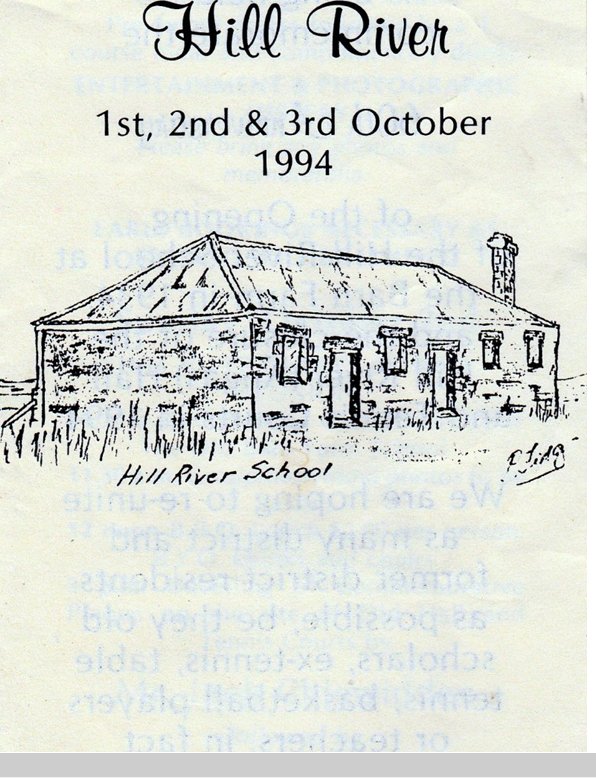
There was a reunion in 1988 and Mary attended.
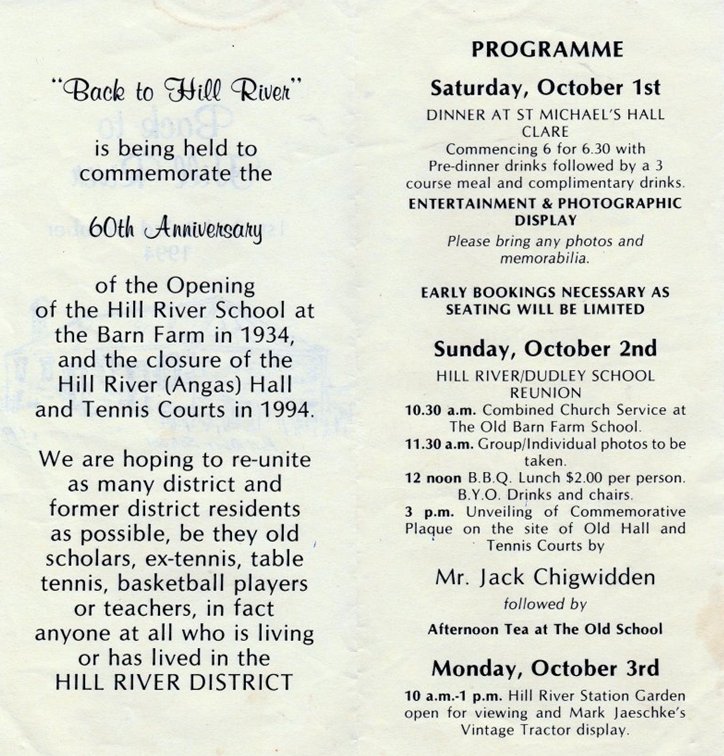
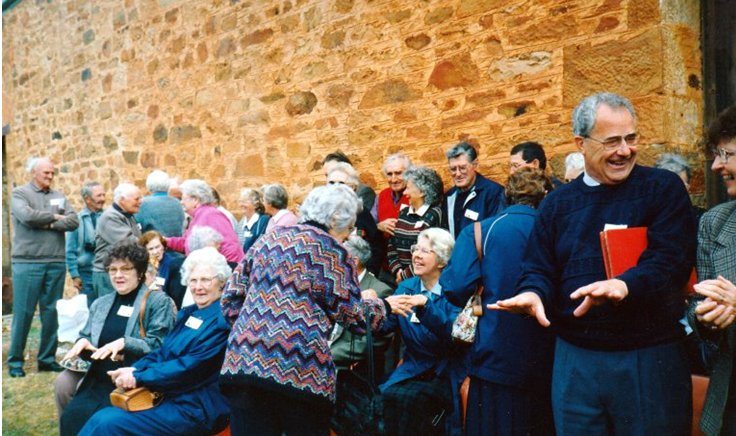
Many were delighted to see her again and she was so pleased to see them herself…..51 years later.
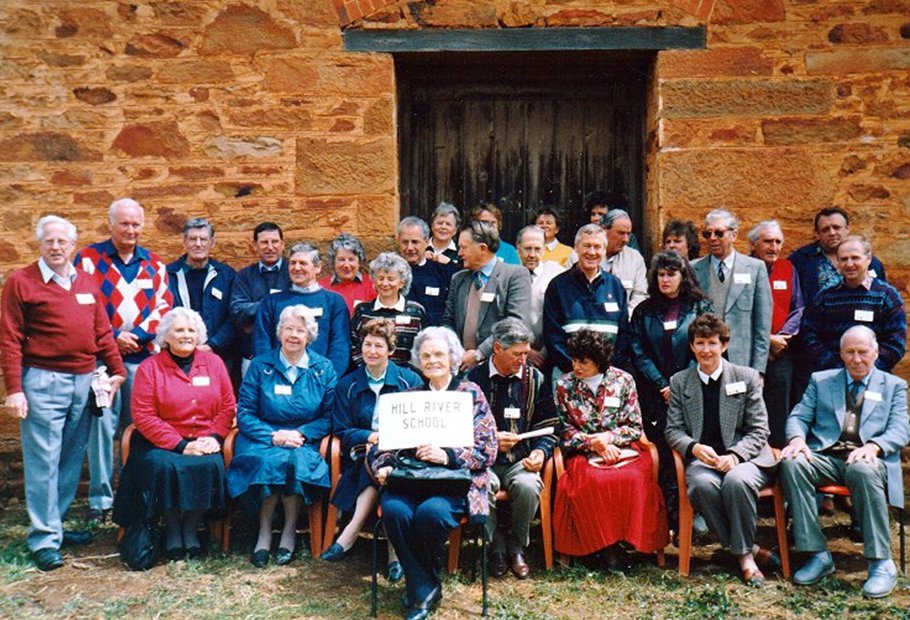
This is a surprising number of students. Mum would have taught about 20 of them I think. I think they are all ex students who had attended over the several years that the school was open.
It seems Mary was the only ex teacher present.
She loved School Reunions. It was always a positive experience for everybody.
5. Edilillie School
On the far West Coast of South Australia
EDILILLIE – 1939 &1940
Mary was happy to return to the West Coast.
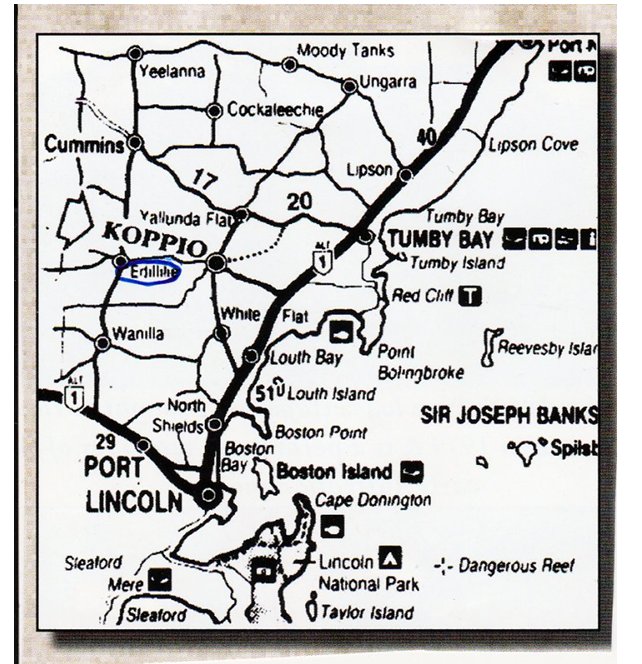
Mary worked at the one teacher school in Ediliillie for all of 1939 and two terms of 1940.
Edillilie is a small town on the West Coast. Mary was boarding and the name of the family with whom she boarded I think was Jourdan.
Koppio is marked boldly because it has a museum which is run by the National Trust and is a tourist attraction. Wayne and I visited it in 2022 and were surprised and somewhat amused that it has the most extensive barbwire collection in the world. Closer to our interest was the One Teacher School which had been rebuilt on the museum site.
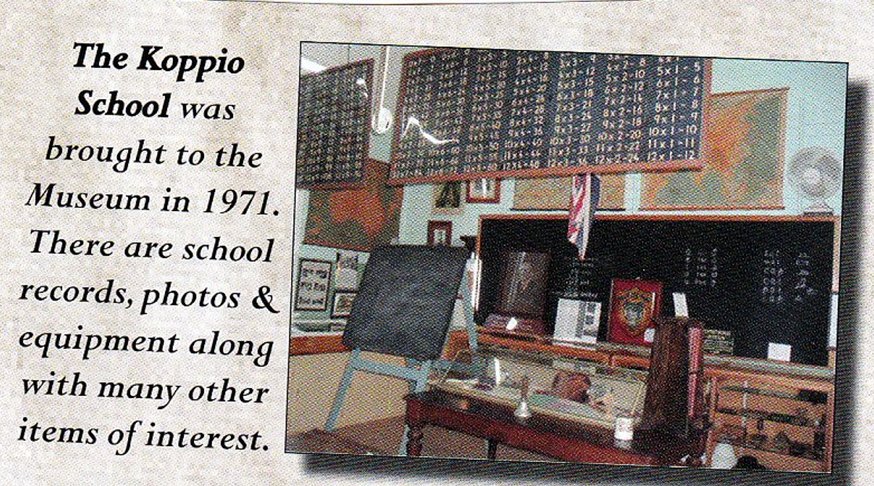
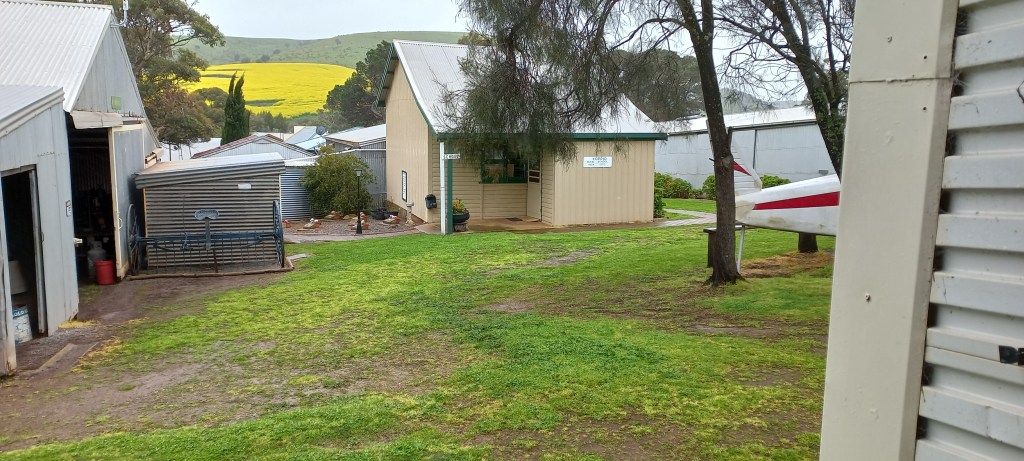
It is a relatively recent school built of wood not stone. I don’t think it was Mary;s school. I think these transportable classrooms were from the 1950s. But the schoolroom atmosphere is just as Mary had described . I note that the multiplication tables dominate!! And the world map was not the British Empire!!
What is missing is a corner fireplace!
This school would have been closed when rural schools were taken over by regional schools. Buses were now used to pick up the farming children and return them home after school.
This is an excellent little museum of rural teaching in this extensive and beautiful Koppio museum. .
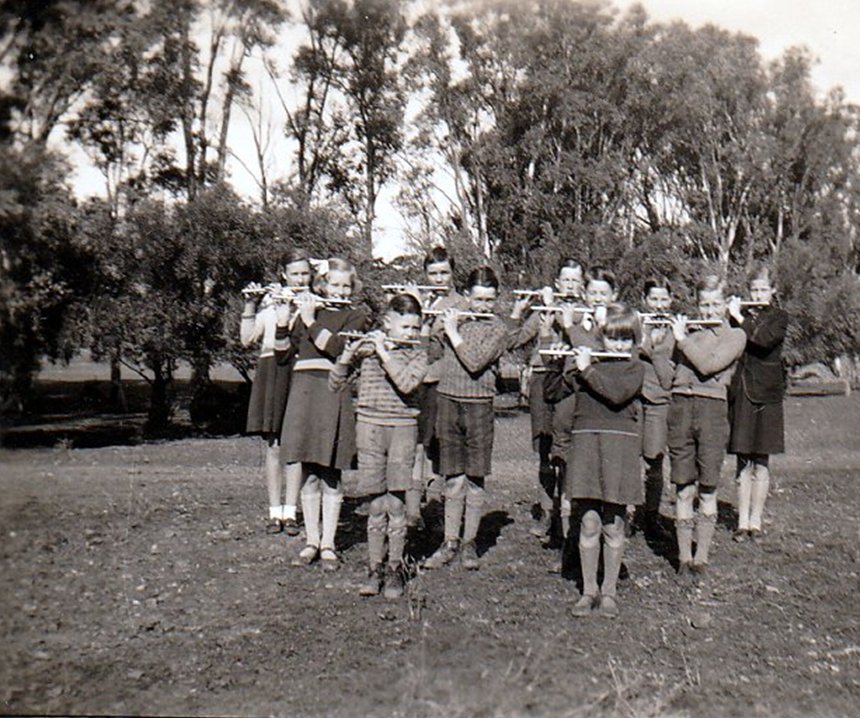
Her teaching style was well established by now. Music would always be part of her curriculum and a means of relieving tension, creating focus and simple enjoyment.
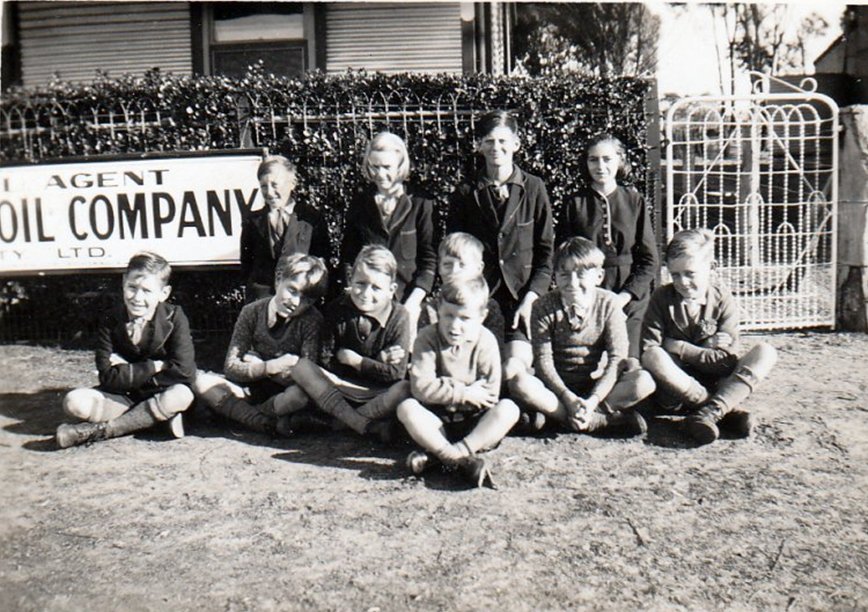
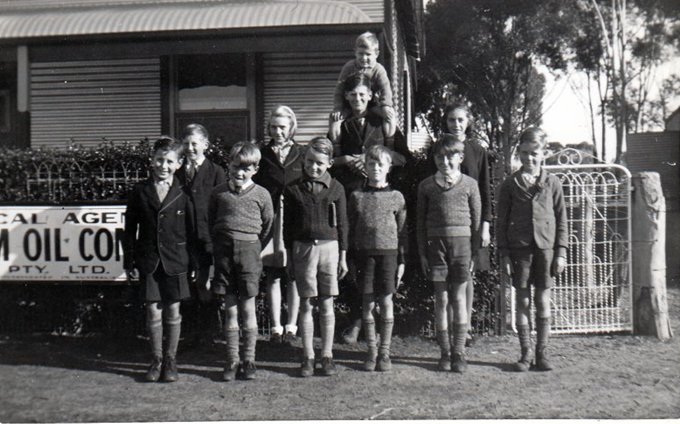
I am not sure that these are the correct photos for Edillilie, but if anyone can enlighten us I would be delighted.
The inspector’s reports were both excellent. Again Mary scored the top mark for teaching quality. I know these are accurate as we collected them from State Records at Cavan.

If only she had known how well the establishment had judged her teaching.
She knew the students were happy and the parents appreciative but not precisely what the inspectors had said of her teaching.

