Index
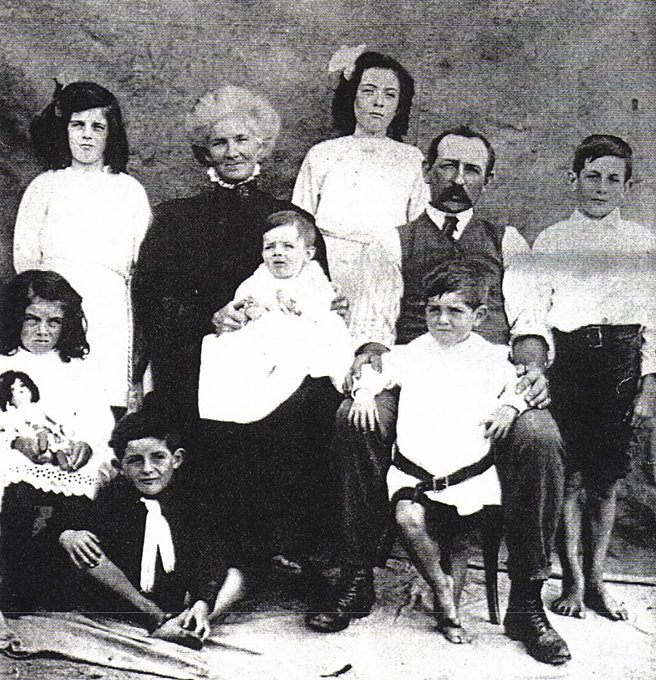
This material was written by Michele Gregg and provided by Jan McLaren, a granddaughter of Ben and Frances, to Meredith Bowman, a granddaughter of Walter Lindo Moyle and Lucy Anne Morton.
In 1900 Walter Moyle’s sister Frances, also known as Aunty Charlie, who was married at the time, eloped with Ben Howie and they moved to New Zealand.
In 1905 Walter and his wife Lucy, with their then two children Aileen and Les, and several siblings sold all their property in the mid-north of South Australia and moved to New Zealand to try their hand at farming there.
The other six siblings, including of course Mary, were all born in New Zealand.
Benjamin HOWIE / Robert Benjamin (Ben)MCLAREN (1872 – 1973) Frances Jane MOYLE (1876 – 1955)
Story file – Compiled from 2006 by Michele Gregg nee Flanagan (mzgregg@gmail.com) Last revised 4 Jan 2021. See Also: Family connections through WikiTree [https://www.wikitree.com/wiki/Howie-689] Ben McLaren
Benjamin HOWIE (Robert Benjamin McLAREN) b. 31 May 1872 McLaren Vale, South Australia, Australia; d. 27 Jan 1973 Tokanui Hospital, Te Awamutu, Waikato, New Zealand; m1 29 Sep 1897 St Lukes Church, Oamaru, Otago, New Zealand to Charlotte Annie DALE b. abt 1876 Timaru, New Zealand; m2 …??… to Frances Jane HOCKEY nee MOYLE b. 5 Aug 1876 Jamestown, South Australia, Australia; d. 20 Aug 1955 Hamilton, New Zealand
Other spouses of Ben
First marriage of Ben HOWIE, at age 25, on 29 Sep 1897 St Lukes Church, Timaru, New Zealand (Divorced Sep 1903) to Charlotte Annie DALE b. 5 Sep 1876 Timaru, New Zealand; d. 5 Sep 1954 Parramatta, NSW, Australia; Burial: Sep 1954 St. Bartholomew’s Church of England Cemetery, Blacktown, Sydney, New South Wales, Australia
Charlotte Annie DALE m2 on 3 Dec 1902 Adelaide, SA, Australia to Hubert Thornton WILLIS b. 1860 Cheltenham, Gloucestershire, England; d. 28 Jan 1916 Port Darwin, Northern Territory, Australia
Charlotte Annie WILLIS m3 on 3 Sep 1907 Sydney, NSW, Australia to Henry James WATSFORD b. 1872 Sydney, NSW, Australia; d. 1 October 1946 Parramatta, NSW, Australia; Burial: Oct 1946 St. Bartholomew’s Church of England Cemetery, Blacktown, Sydney, New South Wales, Australia
Other spouses of Frances
First marriage of Frances Jane MOYLE, at age 20, on 12 May 1897 Jamestown, South Australia, Australia (Divorced Dec 1902) to Frederick William HOCKEY b. abt 1873 Montacute, Yeovil, Somersetshire, England; d. 18 Jul 1966 Parkside South, Adelaide, SouthAustralia, Australia; Burial: Jul 1966 Enfield Memorial Park, Adelaide, South Australia, Australia
Frederick William HOCKEY m2 on 5 Apr 1905 Jamestown, South Australia, Australia to Anne Mary Elizabeth SANDERSON b.1884 Robertstown, SA, Australia; d. 28 Apr 1968 Fullarton, Adelaide, SA, Australia; Burial: Apr 1968 Enfield Memorial Park, Adelaide, South Australia, Australia
Ben’s early years
Benjamin Howie was born on the 31st of May 1872, at McLaren Vale, in the Willunga district of South Australia. His father, Robert Howie, was a horse trainer and farmer, and his mother was Caroline Rebecca Howie nee Prior. Ben’s family lived in McLaren Vale where his mother’s parents, Rev Isaac Prior and Jane Quantrille nee Fletcher also lived.
Ben was only four years old, when in 1876, his mother Caroline Howie passed away. She died at McLaren Vale, South Australia, on January 23rd, 1876, leaving five young children all under the age of ten: James, age 9; Arthur, age 6; Agnes, age 8; Ben, age 4, and newborn baby Maud, who was only a week old.
Ben was six years old, when in 1879, his father Robert Howie, married three years after Caroline’s death, to Elizabeth Maria Lawrance who had been their housekeeper. Robert and Elizabeth remained in McLaren Vale and together had five sons. Ben was eight years old when his first step-brother was born.
Ben’s step-mother Elizabeth was good to him and he was well cared for, but as the second family grew, he was left to look after and fend for himself and as Ben relayed later to his daughter Beryl, he didn’t make a very good job of it. Ben had a great affection for his two sisters Maud and Agnes, and said they had looked after him until they moved to Perth. By all accounts Ben’s father was a reasonable man until his wife died and then it is said that he took to drinking.
Ben’s maternal grandparents, Rev Isaac Prior and Jane Prior nee Fletcher, also lived in McLaren Vale and were said to be a well to do rich family. Isaac Prior was a congregational minister, an Elder in the church and a school master.
Apparently the Priors’ did not approve of their daughter Caroline’s marriage to Robert Howie, a poor farmer and horse trainer. Caroline’s family were gentle folk but strict church goers, and were said to have overwhelmed Ben a bit, especially two of his aunts. Ben recalled that he wasn’t allowed to read a newspaper on Sunday. They obviously disliked Ben’s father, a struggling farmer and horse breaker who was anything but church minded. It appears that the Prior grandparents had less to do with the children after Caroline’s death in 1876.
Ben’s grandfather Isaac Prior and uncle Matthew were more understanding of a young boy, and helped all they could. Ben’s Uncle, Matthew Prior was in charge of a church-school and took over Ben’s education when he was about 11. Ben later told his daughter Beryl that in two years he learnt more from his uncle, who was a teacher, than in all the rest of his life. His uncle Matthew Prior saw that Ben passed enough exams to become a teacher and tried to get him into a teaching job but that wasn’t in Ben’s line at all. Ben realised that he wasn’t going to be happy in such a profession and so he tried all sorts of jobs and wandered around different farms, before eventually making his first trip to New Zealand.
In 1887, while living at Mt Pleasant under his uncle Mathew Prior’s care, Ben placed in the Mount Pleasant Show, in two penmanship competitions, one for Best specimen of Smallhand Writing for boys under 16, receiving 2nd place out of 10 boys and a prize of 2 shillings 6 pence. He also received 2nd place with prize money of 2 shillings, in the class for Ornamental Penmanship for children under 16 years.
By the end of 1887, Ben, age 15, had passed his pupil teacher examination where a total of 308 candidates presented themselves and only 169 passed. The Education Department results were published in The Mount Barker Courier and Onkaparinga and Gumeracha Advertiser on October 28, 1887.
Ben’s brother, James Howie, known as Jim, was a good friend to Ben, according to information that Ben relayed to family. Interestingly Ben told family that Jim did not return from a trip to New Guinea and it was thought that he was killed by natives. Whether or not Jim made a trip to New Guinea or Borneo is unknown, however it is now confirmed that Jim left his wife Edith Martin and their two young daughters, met Rubina Constance Smith in Western Australia before moving on to New South Wales where they had a son, Jack Howie, in 1910. Jim lived for many years in Sydney, New South Wales, where he passed away in 1960, aged 92.
Ben’s brother, Arthur Robert Howie, may have been hotelier and publican in the Willunga district of South Australia. In 1897 he lived in Bellue Vue hotel in McLaren Vale. Arthur married Florence Annie Binney and they had seven children. The family eventually moved to Narrung to farm and later to Strathalbyn, where Arthur passed away in 1948, aged 77.
Ben had an older sister Lillian Agnes Howie, known as Agnes, and a younger sister, Caroline Maud Howie, known as Maud. Agnes and Maud both became milliners. Agnes eventually left McLaren Vale to live in Perth where she married in 1901 to Samuel Thomas Moore. Unfortunately, Ben and his sisters didn’t correspond and they lost contact with each other. Ben’s younger sister Maud lived in McLaren Vale where she married in 1906 to James Campbell Nelson (Jim) Whittington. Maud resided in McLaren Vale until she passed away in 1919, aged 42.
Ben’s father Robert Howie trained, bred and sold horses at his McLaren Vale property. Ben would have been involved with horses from an early age. As well as saddle horses, cart horses and working horses, Robert Howie also owned racehorses.
In 1887, The Mount Barker Courier and Onkaparinga and Gumeracha Advertiser, reported the action at the McLaren Vale Races, when 15-year-old Ben Howie took first place as jockey on his father’s thoroughbred Polly.
The Mount Barker Courier and Onkaparinga and Gumeracha Advertiser – 22 April 1887
“Bridle. Whip, and Spurs, one mile, R Howie’s Polly first, R. Jarvis’ Stringybark second, P. Dryer’s Bob third.
This race was splendidly ridden by Ben Howie; as the other two neared the post with Howie in the rear the latter let drop his whip and the little mare answered gamely by going between the two and winning amid rounds of cheers.”
In 1897, Ben’s father , Robert Howie was made insolvent and not long after, Robert and his second wife moved to Western Australia, where they were living in Collie by at least 1903.
At some stage around the turn of the century, Ben changed his name from Benjamin Howie to Robert Benjamin McLaren. One reason given to the family for this change was to do with a drowning incident Ben was said to be involved in while sky larking in a boat with two other boys. The story was told that the stress between father and son only intensified after this incident, resulting in Ben moving away. Family also presumed that the death of his brother Jim (allegedly killed in New Guinea by natives), had also left Ben feeling more removed from his family than ever and perhaps part of his reason for leaving Australia.
Knowing also that his father was made insolvent in 1897, may have contributed to Ben’s reasons for leaving the district, however it seems that the main reason for Ben’s name change and permanent move to New Zealand, was due to his involvement with Frances Hockey nee Moyle.
Ben to Otago, New Zealand
In the late 1880s, as a young lad in his teens, Ben made his first trip to New Zealand where he worked teams of horses on a wheat farm in Timaru. Returning to Australia he went to work in a mine for a period of time, but decided mining wasn’t for him. He also worked on Kangaroo Island in South Australia at some stage.
It may have been in about 1892 that Ben, aged 20, returned again to New Zealand and arrived in Dunedin where he found work wheat chaffing for £1.0.0 per week. Later at age 100, Ben told the Hamilton Times that he had walked all the way from Dunedin to the job in Timaru and lived in a tent for two years until he had saved enough to get back to Australia.
It is possible that Ben participated in sporting events while in Timaru during 1895 and 1896. Results for B. Howie competing in 100 yards and 120 yards can be seen in the local papers, Timaru Herald and Temuka Leader, during this time. In January 1896, B. Howie competed at the Timaru Caledonia Society sports winning the 100 yards final with a time of 11 2/5 secs and prize money of £2. In the 120 yards’ event, in which 8 competed, B. Howie won his heat and placed 3rd in the finals to receive prize money of 10 shillings.
Ben’s marriage to Charlotte Annie Dale
In early 1897, during his time in South Canterbury and Otago, Ben met Charlotte Annie Dale. About six months after becoming acquainted, they married. The ceremony took place at St Luke’s Church in Oamaru on the 29th of September 1897. Marriage documents show that Ben, age 25, was still using his birth name Benjamin Howie. He gave his occupation as engine driver. Charlotte, age 21, identified herself as a nurse and used the name ‘Caroline Annie Dale.’
By all accounts, Ben departed for Adelaide on the day of their wedding and Charlotte returned to Washdyke in Timaru to nurse her sick mother until her recovery, when she planned to meet Ben in Adelaide in three months’ time. The last time they saw each other was at the Oamaru railway station on the day of their wedding. They corresponded for several months and by December Charlotte was ready to join Ben but no money had arrived.
By March 1898 Ben wrote to say that his plans had changed due to uncertainty of employment. The last communication Charlotte received was in August 1898 when Ben implied the marriage was over and any further correspondence should be directed to his brother Mr A. R. Howie, of McLaren Vale.
The proceedings from the court case were published in Adelaide newspapers at the time. When Charlotte finally arrived in Adelaide she made her way to Arthur’s home looking for Ben. She subsequently took up residence in the area where she began divorce action. It was reported that Charlotte had never lived or cohabited with Ben and there was no issue from the marriage. The divorce was granted on the grounds of adultery and desertion. The Decree Nisi was proclaimed on 29 Nov 1902 and the divorce became absolute on September 12th, 1903.
Charlotte did not return to New Zealand, she remained in South Australia, and married, at age 26, to Hubert Thornton Willis. They were married in Adelaide, South Australia, on the 3rd of December 1902. Interestingly her divorce from Ben did not become absolute until the 12th of September 1903.
Charlotte’s third marriage, at age 31, was to Henry James Watsford. They were married in Sydney, New South Wales, Australia, on September 3rd, 1907.
Charlotte Annie Watsford died, at age 78, in Parramatta, New South Wales, Australia on the 5th of September 1954.
Ben meets Frances
It appears that when Ben arrived back in Adelaide in 1898 he had difficulty securing employment and with no family help, travelled north looking for work. He eventually found employment in Jamestown working as a cab driver, where he was operating a horse drawn hansom cab. It was during this time that he met Frances Jane Hockey nee Moyle. They met when Frances was catching a cab to take her mother, Eliza Day, to hospital.
Frances’ early years
Frances Jane Moyle was born on the 5th of August 1876 at Belalie near Jamestown, in South Australia. She was the daughter of Walter Moyle, a farmer, and Eliza Moyle nee Lindo.
In 1878 tragedy struck the Moyle family, when Frances’ father, Walter Moyle, passed away at age 45.
Frances was only two and a half years old at the time. Frances’ mother Eliza was left with three young children; Robert, age 5; Frances age 2½, and Walter just 6 months old.
Frances was six years old when in 1882 her mother Eliza married Henry Day. Eliza and Henry Day had five children, however the first born, Effie Day, did not survive infancy. The four Day children were Violet Alice (Alice) Day, Albert Henry Day, Edgar Washington Day and Emma Rose (Rose) Day.
Being the only daughter, Frances would have assisted her mother a great deal with her younger half siblings. Frances was almost eight when Alice was born in July 1884 and age 14 by the time the youngest, Rose, was born in 1891.
When Frances was younger she would sometimes stay with two of her Lindo Aunts and it was from these two Aunts that Frances acquired her nick-name “Auntie Charlie.” Frances was always known as Auntie Charlie and was spoken of lovingly by family and friends. Frances may have also been referred to as Fanny by the Lindo Aunts.
When Frances was 12, a typhoid epidemic raged in Jamestown. There was a water shortage at the time and rabbits had crowded the water supply. As a result, Frances’ older brother Robert died due to sickness caused by water contamination. He was 16 years old. Frances was also very unwell at the time and when Robert passed away his body was taken out through a window so that Frances would not see her deceased brother being carried from the house.
Under the terms of Walter Moyle’s Will, his two surviving children, Walter Lindo Moyle and Frances Jane Moyle, would inherit the land at Jamestown when they became of age. Frances’ brother, Walter Lindo Moyle, later bought her share of the farm in about 1904. By this time Frances had been living in New Zealand for about four years.
Frances’ first marriage
It is thought that Frances had a good education, but it is unknown if she attended a school in Jamestown or a boarding school in the Clare district. At age 20 she married 24-year-old Frederick William Hockey. They were married at the Baptist Church in Jamestown, on the 12th of May 1897.
Frederick and Frances Hockey had three children:
Children of Frederick Hockey and Frances nee Moyle:
- Leslie James (Jimi) HOCKEY b. 9 Dec 1896 Adelaide, South Australia, Australia; d. 3 Nov 1917 Belguim
It is believed that Leslie was born to Fred and Frances before they were married. Leslie was adopted, or raised by William Hockey and Charlotte Ann nee Turner of Mt Lock, Hornsdale, near Jamestown, in South Australia. Leslie was 21 when he was killed in action, at Ypres, Belgium, during the First World War.
- Geoffrey Keith HOCKEY b. 1 Nov 1898 Jamestown, South Australia; d. 1980; m Hilda KEMP JEWELL
Geoffrey lived and worked in Adelaide. He had two daughters. He was a quiet and modest person, a keen rifleman, fishermen and cricket enthusiast. He passed away in 1980 from cancer, aged 82 years.
- 3. Ivy Kathleen HOCKEY b. 23 Dec 1899 Jamestown, South Australia; d. 1973; m Harry Leonard BR0OKS
Ivy married John Brooks and lived most of her life in Broken Hill. She had one son and one daughter. Ivy passed away in 1973, aged 73 years. She died from a heart attack while in a doctor’s surgery. She was well loved by all the family and had beautiful white hair.
Frances’ husband Frederick worked for a firm in Jamestown that produced sauces and pickles. The company had also built a factory in Adelaide and Frederick spent several months of the year, during the season, away from home.
Apparently it was during one of these absences, that Frances became involved with Ben Howie, a cab driver in Jamestown.
Ben and Frances Leave Adelaide for Melbourne – 1900
By about 1898 or 1899 Frances had met and became involved with Ben Howie.
In March 1900 Frances left Jamestown to take a fortnights holiday in Adelaide. Unbeknown to Frederick, she had arranged to meet Ben. When Frances did not return after a fortnight, Frederick became suspicious and caught the train to Adelaide. By this time Frances had taken a train to Melbourne ready to leave for New Zealand with Ben. Still pursuing Frances, Frederick caught the next train to Melbourne. As it happened Ben was also on the same train making his way to Melbourne to rendezvous with Frances. On the train’s arrival in Melbourne the next day, Frances was on the platform expecting to meet Ben when Frederick appeared. As Frederick approached Frances he remembered that he had left his rug on the train so he rushed back to get it. By the time he got back to the platform, he saw Frances hurrying off with Ben. He pursued them for some distance but eventually lost them in the crowd.
Frederick Hockey took it very badly and apparently it was no idle threat what he would do to them if he found them.
Frances never returned to her husband. Her two infant children, Geoffrey, age 15 months, and 3-month-old Ivy remained in Jamestown with their father, recalling also that her first child Leslie was raised by William Hockey and his wife Charlotte.
Changing their names so that they could not be easily pursued, Ben and Frances left Australia and sailed for New Zealand where they started a new life together in Auckland.
Frederick filed a public notice for divorce action and proceedings commenced in July 1901. The decree nisi was finally issued on 27 May 1902, stating that if the action was not contested the divorce would be made final in six months.
Colin Giles writes:
“Reading between the lines I don’t think that Hockey would have been a very endearing person. He may have been very unstable in a Victorian sense but according to my Mother (Aileen Giles) the old Aunties (Lindo) didn’t condemn her for leaving Hockey but they did for leaving her babies. My guess is that she chose a life with Ben over a rather miserable existence with Hockey.”
Relative Erica Hockey writes of Fred Hockey:
“Fred became a foreman in a pickle factory at Jamestown and later in Adelaide. He remarried a Miss Sanderson after Frances left him. They adopted another girl and that was all the family they had. He was a very energetic and industrious type, very much loved by all his family.”
Fred’s second marriage was in 1905 to Anne Mary Elizabeth Sanderson. Fred passed away in 1966, at age 98.
Ben and Frances to Auckland, New Zealand
Ben and Frances arrived in New Zealand in about March 1900. They became known as Robert Benjamin McLAREN and Frances Jean McLAREN. A wedding date of 20 September 1900 in Adelaide was given to the family, however, records to verify this have not been found to date. It is thought by some, that Ben and Frances may have actually been married later in New Zealand but once again no documentation has been found to date that proves this.
On arrival in Auckland, Ben and Frances first went to Upper Pitt Street. Their first child, Eileen was born on the 24th of July 1901 at the Pitt Street Hospital. On the 8th of September 1902 they had their second child, Leslie McLaren, who was also born while they were living at Pitt Street.
It is not clear what types of work Ben carried out after his arrival in New Zealand.
Ben and Frances may have had a general store, possibly a fruit shop. It is also remembered by Beryl Christian that they had a book shop during this time.
Helensville 1902 – 1911
In 1902 Ben, age 30, and Frances, age 26, left Auckland city and moved about 45 kilometres north to Ohirangi, a small district near Helensville. They purchased property on what was then the end of Bradly Road. They lived on this property for about eight years. The McLaren’s grew strawberries on their small farm, which Ben would sell on the train between Helensville and Auckland. Most of their eight children were born in Helensville.
Ben’s occupation was recorded as farmer on his daughter Beryl’s birth record as well as in the 1907 Helensville directory.
In 1902, when the McLaren’s arrived on Bradly road, James Lochead Bradly, aged 43, had been on his farm for about two years and was working in degrees at clearing the scrub and fern with the help of his sons.
In June 1905 Frances’ brother, Walter Lindo Moyle, moved to New Zealand with his family and purchased a property on Bradly road adjacent to the McLarens. Walter and his wife Lucy had two young children when they first arrived: Aileen Moyle, age 3, and 1-year-old Leslie Moyle, who were similar ages to Ben and Frances’ children at the time: Eileen, age 4, and Les, age 2 ½. Walter’s family also included Alice Day, age 21; Edgar Day, age 18, and 14-year-old Rose Day. The Day children were Frances and Walter’s half siblings from their mother’s second marriage to Henry Day.
During the early years there were only three families living on Bradly Road; the McLaren’s and the Moyle’s at the end of the road and James Lochead Bradly’s family at the beginning of the road. James Lochead Bradly and his wife Bridget had six children. When the Moyle’s arrive in 1905, the children of James and Bridget Bradly were similar ages to the Day children: James William Lochead (Jim) Bradly, aged 20; John Wyborn (Jack) Bradly, age 17; Alice Teresa (Tess) Bradly, age 14; Annie Elizabeth Lilian Bradly, age 15; Hilda Maria Bradly, age 11, and 10-year-old Russel Robert (Bun) Bradly. Alice Day later married, in 1912, to Jack Bradly, the second eldest of this Bradly family.
As was usual in those times, the three neighbouring families would have had a lot to do with each other and helped one another out in the neighbourly way which was customary of those times.
To enable the McLaren and Moyle children to get to the railway to catch the train to school, Jack Bradly formed a road from the McLaren and Moyle properties down to the main road. He cut through the scrub with discs and plough. There was already a track that the McLaren’s and Moyle’s used to get to the main road but it was fairly rough and unestablished. Jack Bradly followed the contours of the existing cattle track to create what is now Bradly Road. The road was later taken over by the Council, further developed and eventually metalled properly after the Second World War.
So it wasn’t until Dorry started school in October 1908, that both Eileen, age 7, and Les, age 6, also started. Ben would use the horse and sledge to take the children to the O’hirangi train station in the morning where they could catch the train to school. In the afternoon he would make a return trip with the horse and sledge to collect the children.
It is thought that the children attended Te Pua School. Records from local school registers show that the Moyle children went to both Te Pua school pre 1915 and then Helensville school in 1916.
It appears there had been a maori settlement on or near the McLaren’s land before they lived at Bradly Road.
In the book, ‘The Bradly Line’, researched by Mark Bradly, there is reference to the J.W. Bradly property:
“On a historical corner of the farm, near it’s junction with the forest is the site of an old Maori church, said to have been dismantled because it was tapu. Two Norfolk pines planted by Bishop Selwyn stand near the church site, while a Maori burial ground lies within the forest.”
It is thought that the two Norfolk pines (no longer there) were on the McLaren property.
In 2002 John M Bradly wrote:
“As you leave the railway line, heading north, on the skyline against the forestry you can see the two Norfolk pines. These were hit by lightning a few years ago, which altered their shape quite a bit, but they recovered. They are said to have been planted by Bishop Selwyn.
The Church of England had a church beside the two pines. It is no longer Church of England land – it was bought by Mr R B McLaren many years ago. I remember seeing the receipt for the land and giving it to my brother Jim for safekeeping.
Down on the little sandflat below the pa, Mr and Mrs Fosbrooke (an English couple) had a camp where the two poplars are. They were school teaching at Woodhill School and used to shortcut through Phillips’ property on horseback to the Woodhill School every day.”
There is a story that involves the McLaren property, supporting the fact that there was a maori burial ground on the farm.
In 1902, while the McLaren’s were living on their Bradly Road property, the Barquentine ‘May’ was shipwrecked on the coast at Muriwai beach. A maori boy by the name of Wattie Dunn, a capable swimmer, was the sole survivor of the wreck. After swimming some distance from the sinking vessel to the shore, he had walked through the sand dunes and further inland looking for help and had eventually come to the McLaren farm. He knocked on the door in an exhausted state and was given assistance by the McLaren’s. However, when Frances McLaren told him where he was he took off. He wouldn’t stay and accept further help as the farm was Tapu, on sacred land.
The following extract from the Auckland Star, 18 October 1902, provides further detail:
The Kaipara Casualty – Wreck of the Barquentine May – statement of the survivor
A PLUCKY MAORI –
‘’After leaving- the’ beach. “Wattie Dunn” crossed the sandhills and reached the cottage, of a man named McLaren, who clothed and fed him and gave him a rest, for by this time he was becoming dazed, both from the effects of the awful swim and from a blow on the back of the head inflicted by portions of the wreckage. He insisted on proceeding to Helensville with the news, and after recovering slightly he went to the Ohiranga station to catch a train, Mr McLaren giving him a shilling to pay his fare. As this was only a flag station the guard did not stop, evidently failing to notice the Maori boy there. The plucky fellow therefore continued his journey, bare footed as he was, and made straight for the steamer Wairoa, lying in the river at Helensville. He was in a most agitated, though exhausted, state, and after telling the news he became almost unconscious. During his swim he wore his pants, shirt, coat and the medal which he had won for swimming. The distance he travelled on shore was ten miles. He now lies in a bunk in the Waiwera, another of Mr Harrison’s vessels, and is under the care of Dr. Morris.’’
In 2002 John Mervyn (Jack) Bradly, son of Jack and Alice Bradly, wrote his recollections of family trips across the sandhills to the coast:
“Once or twice a year we would have a day out at the coast to get toheroa. All available horses would be caught and we would set off across the sand-hills. It was about four miles from home to the beach. After a day at the beach, coming home would not be so pleasant, as you would be very lucky if you had a saddle and you would most likely be sitting on an old draught horse about 2’6″ across the back, on a sack which had both ends tied and slit across the middle so as to put toheroas in each side, and with a combination of sunburn, salt water and sweat from the horse’s back, you were pleased to get home!”
By about 1911 the older McLaren children would have also made this trip across the sand-hills on occasions. Eileen, age 10; Les, age 9; Dorry, age 8; and 5-year-old Beryl. Beryl recalled the big horses that the family had and how several children would climb onto one horse and ride along, sitting on cushions and singing happily together.
Beryl Carswell, granddaughter of Ben and Frances recalls:
There was no forest at Woodhill in those days. It was all sand-hills. And also they told me that when the McLaren children were growing up, that every year they use to go to Muriwai and spend weeks out at
Muriwai. Granddad made a wooden floor and wooden walls for their tent, and they use to take this tent out there and that’s why they all got so fond of Muriwai, and why Bruce called his house Muriwai. Because the whole family always went to Muriwai for the summer. She [Frances] must have taken all the kids out there and I suppose Granddad [Ben] stayed at home. Whether he had a farm there or what they did up there I don’t really know. But as far as I ever heard there was never anybody up there except the Moyle’s and them. I know he grew these strawberries there, but what else they did up there I don’t really know.”
Beryl’s husband Alex recalled one of the Bradly’s telling him that they planted ‘cutty grass’ which stopped the sand from blowing in.
By early October 1910, the McLarens’ farm on Bradly Road was for sale. The following advertisement was placed in both the Auckland Star and New Zealand Herald during October 1910 advertising the Clearance Sale of Mr R. B McLaren at Ohirangi.
Auckland Star – 29 October 1910
Ohirangi (KAIPARA LINE) Thursday November 3
At 11am
The undersigned have received instruction from Mr. R. B. McLaren, who is retiring from farming on account of ill-health, to sell, as above
5 Milch cows, 4 Heifers, 3 Calves, Medium Draught Mare, Hack, 10 Pigs, Light Dray, S.F. Oliver Plough, Disc and Tine Harrows, Garden Cultivator, Wooden roller, Separator, Sundries, etc. Also,
His farm of 42 acres, being par Wharepapa, Block No. 2a, Kumea Survey District, four miles by road to Helensville, 2 ½ miles from Ohirangi railway station, four miles from creamery; well watered by springs; 6 paddocks, sheep-proof fences;
House, 5 rooms; 2 barns, dairy pig-yards, 40ft brick well, 1 ½ acre orchard’, ¼ acre strawberry plants, ½ acre pears, ½ acre onions, ½ acre potatoes, 4 acres young grass, 6 acres ready for sowing. All in good order.
Land Transfer Title.
Luncheon Provided.
Alfred Buckland and Sons
The Moyle’s, Bradly’s, Day’s and McLaren’s had often enjoyed picnics on the sand flats at Muriwai where there was a stream running down and the young children could swim.
After the McLaren’s left the area they would still make day trips back to Helensville and Muriwai to visit.
Muriwai beach was a favourite place to visit and continued to be so for the future McLaren generations. The McLaren’s were involved in numerous motor sports events that were held on Muriwai beach and Ben’s grandson, Bruce McLaren, of motor-sport fame, later named his home in England ‘Muriwai.’
There is very little evidence now (2020) that the McLaren’s home once existed toward the end of Bradly Road. All that is left is the remains of the 40ft brick well.
After Ben and Frances left the Ohirangi district in 1911, Frances’ brother Walter and his family remained on their farm at Bradly Road for a further six years, until 1917, when they returned to Clare in South Australia. By that time the Moyle’s had eight children. Rose Day returned to Australia with the Moyle’s, while Alice Day and Edgar Day remained in New Zealand. Alice Day married John Wyborn (Jack) Bradly, and Edgar Day married Jack Bradly’s cousin, Emma (Toot) Russell.
Auckland 1911 – 1932
In 1911 the McLaren family moved back to Auckland city where Ben purchased a property at 7 New Bond Street in the suburb of Kingsland, for £500.
Here they had their youngest child Don who was born in July of 1912, at Nurse Donaldson’s nursing home.
By mid-1912, Ben, age 40, and Frances, age 36, had completed their family with their eighth child.
Children of Ben and Frances McLaren:
- Eileen McLAREN b. 29 Jul 1901 Auckland, NZ; m Albert Alfred COURTENAY
- Leslie McLAREN b. 8 Sep 1902 Auckland, NZ; m Ruth Leigh CAUNDLE
- Dorothy McLAREN b. 20 Oct 1903 Helensville, NZ; m Frederick (Fred) CLEAVE
- Robert McLAREN b. 13 Jan 1905 Helensville, NZ; Died age 13
- Beryl McLAREN b. 28 Feb 1906 Helensville, NZ; John Edward CHRISTIAN
- Alan McLAREN b. 10 Aug 1907 Helensville, NZ; m1 Ida Phyllis SARGENT; m2 Betty
- Kenneth McLAREN b. 10 Jan 1910 Helensville, NZ; m Louise Graeme (Louie) MILES
- Donald Bruce McLAREN b. 24 Jul 1912 Auckland, NZ; m Katherine Mahala (Kate) CHRISTIAN
It is unclear when Ben started his carrying business. An article in the New Zealand Herald in 1972 states:
“In 1909 Ben started a carrying business with a horse and cart, expanding it to eight trucks. He had the first International truck in New Zealand and was the New Zealand agent for the trucks.”
Ben may have started the carrying business while still living in Helensville, but it is thought by several family members that he began the business when the family moved back to Auckland in about 1911.
Ben’s daughter Beryl recalled that her brother Les was about age 13 when he started to help with the driving and carting.
Ben may have had a motorised vehicle as early 1915, the year that Les turned 13, however this is not certain.
While Ben was working as a carrier in Auckland he was often making trips to the wharf. On one particular trip to the wharf, workers were on strike and would not allow anyone through. This may have been during the Auckland Watersiders strike in 1913 or possibly a later strike. Apparently Ben waved his waddy stick at them and let them know, “I’ve got seven children to feed, nobody’s going to stop me.” At that he drove thorough the picket line. News of this incident made the paper, which then came to the attention of a truck selling company. The Truck Company offered Ben a job as an agent, selling International Trucks. He accepted this job and worked on commission receiving £100 for each truck that he sold.
After some stage the truck company approached Ben and said that he needed to have a show room so that potential clients didn’t have to drive around Auckland in their buggy or carts to track him down. They stipulated that if Ben did not agree to have a showroom they would drop the commission he received per truck to £50. The story goes that Ben’s reply was, “Nobody tells R.B. what to do so you can stick your job.”
Apparently there were three international trucks still in the shed at the Ngaruawahia farm where they remained for many years.
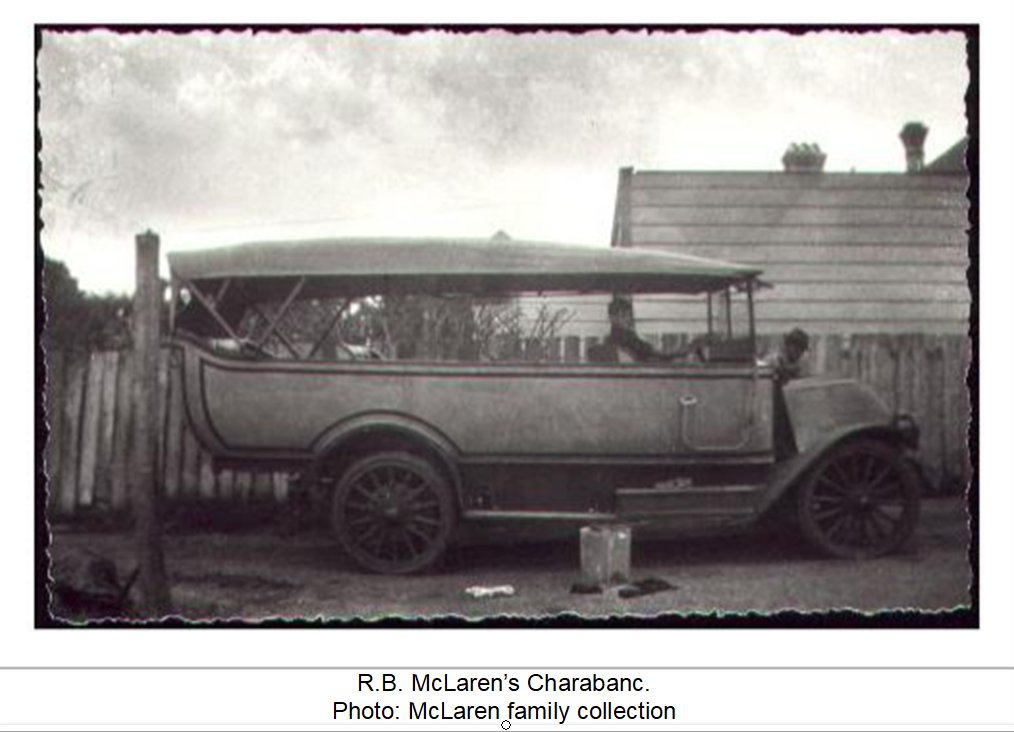
As the carrying business grew, Ben bought a bigger truck and as the business continued to expand they made a passenger carrier and also took picnic groups on outings.
Ben made his first passenger carrier by building a removable body over the deck of a flat bed truck. When the truck wasn’t being used for carting they fitted the structure onto the truck deck and it became a passenger carrier. Ben ran this passenger carrying bus service to races at Ellerslie. He would go to the wharf and meet the incoming ferry where he would take passengers on to the Ellerslie races. Later Ben owned a proper Charabanc.
In June 1918, Ben advertised a Carrier’s Turnout for £30 cash in the Auckland Star.
Auckland Star – 12 Jun 1918, Page 3:
Specific details are not supplied, but many similar advertisements in 1918 for ‘Carrier’s Turnout’ included horse, cart and harness as well as business connections. It is not clear if Ben’s ‘Carrier’s Turnout,’ included a motorised vehicle at this stage. It is unknown if Ben’s Carrier’s Turnout was sold at the time as the McLaren’s remained at 7 New Bond street until 1935. It is possible that the ‘Carrier’s Turnout’ was only a part of Ben’s carrier’s business as he transitioned to motorised vehicles.
From 1919 onwards, after the First World War, the production of motor vehicles greatly increased and it likely that from this point Ben was able to add to his motorised fleet.
During 1919, Ben provided a service advertised as McLaren’s Motor Bus Service, running motor trips between Symonds street and Waikumete Cemetery each Sunday afternoon.
In March 1920, the McLarens put an advertisement in the Auckland Star advertising a section for sale in Mt Albert.
“Section Mt Albert, 50 x 180, fenced 3 sides, level elevated, no stone, double gate, unsurpassed view, great prospective value, £150 cash – McLaren 7, New Bond, St, Kingsland”
Auckland Star – 23 March 1920
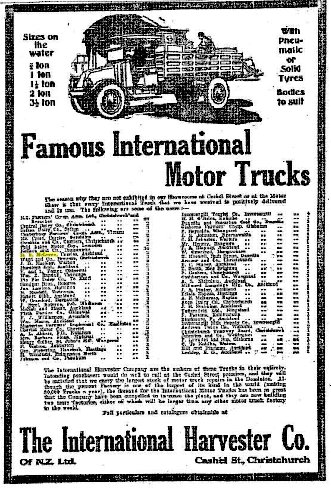
By the 1920s Ben McLaren, Auckland carrier, had purchased various trucks.
An advertisement in the Press on 10 November 1920, advertising the “Famous International Motor Trucks”, shows that R.B McLaren was an Auckland carrier, running two International Trucks bought from ‘The International Harvester company.’
By March 1921 Ben’s passenger carrying service was providing Motor Trips to a range of destination in wider Auckland.
Ben advertised picnic trips to locations including Titirangi, Muriwai and Nihotupu Dam.
The Muriwai Motor Races and beach picnics were a popular destination during 1921 and 1922.
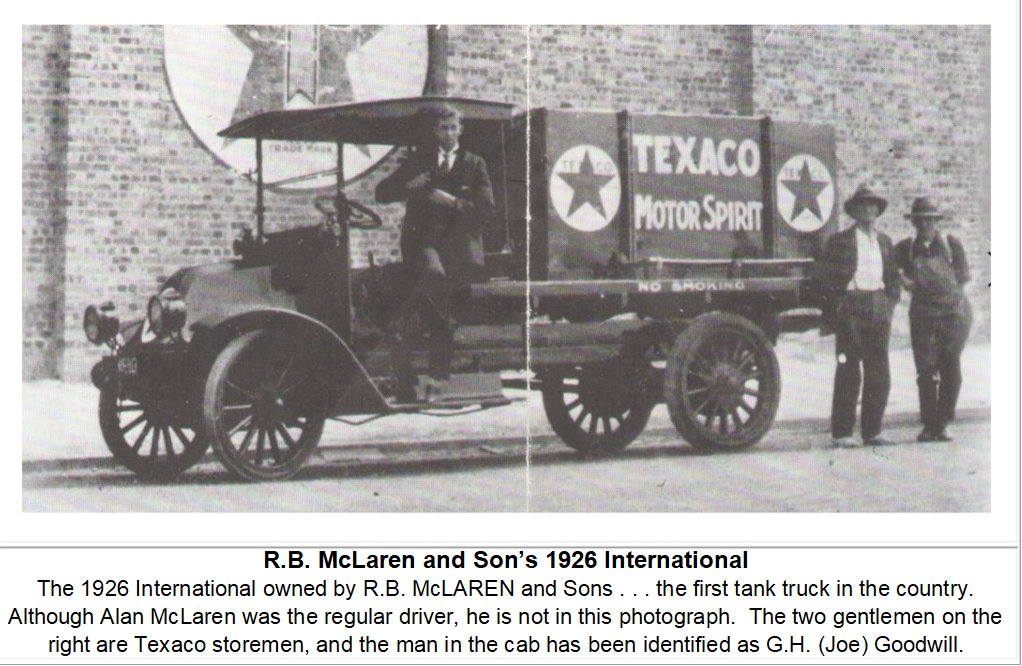
An extract from an article written in 1981, “New Station continues Long association,” supplies further details.
Ben is referred to as Bob McLaren in the article:
The opening of Doug McLaren’s latest service station, at Dinsdale in Hamilton, marked more than the opening of his fifth business venture in the city.
It also marked another phase in a more than 60-year association between Caltex and the McLaren family. In 1921 Bob McLaren started carrying packages of products for Texaco, the forerunner of Caltex. He was assisted by two of his four sons, Les and Alan. In those early days, petrol and other oil products were delivered in tins and cases to the wharves for coastal shipping, and to the railway station for destinations further afield.
By 1926, McLAREN and Sons were operating a daily return service between Auckland and Hamilton, carrying drums and cases of petrol.
By the mid-1920s, 500 gallon tanks were being introduced for underground storage at service stations, with the petrol being pumped by hand for gravity service to motor vehicles.
These tanks were filled by decanting 44 gallon drums imported from overseas. For the drivers this was some times a hazardous occupation, as early regulations were inadequate to control the groups of sightseers who would cluster around the truck to watch the procedure, and there was always a risk of fire from smokers near leakages or fumes!
Family recall that by 1926 Ben had acquired four trucks, two cars, two motorcycles and one Bear truck which cost £ 30-2-6 to register.
During Easter 1922, Ben McLaren provided a trip to Rotorua in the Touring Char-a-banc “The Royal.”
The advertisement featured at least 6 times, first appearing in the Auckland Star on the 18th of February 1922.
The eight-day tour left on Saturday the 15th of April, and returned on Monday the 24th.
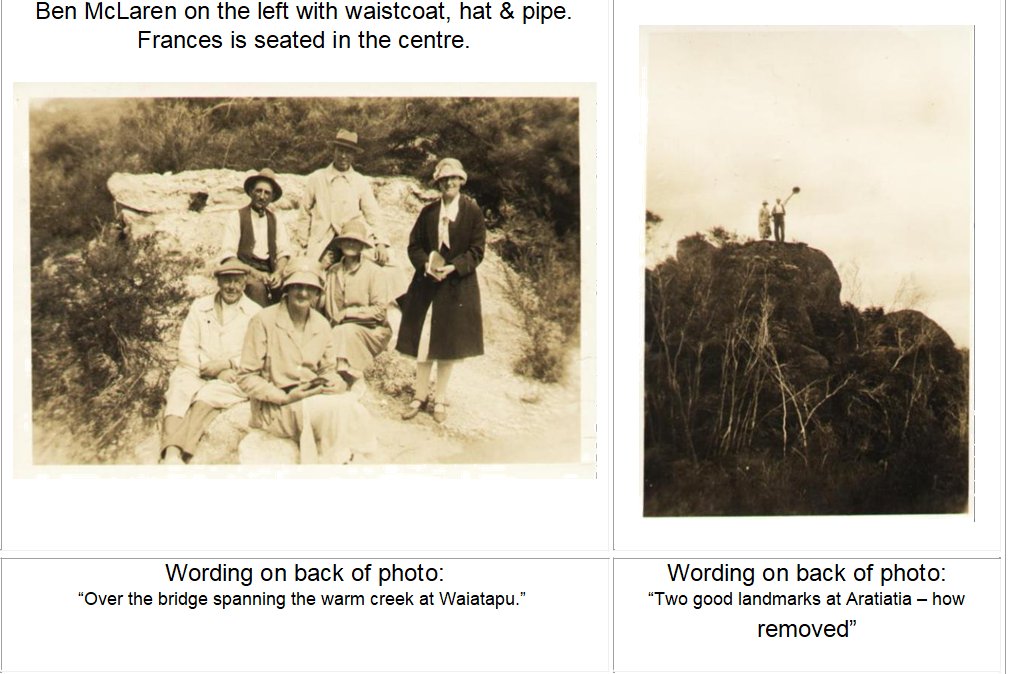
As well as a range of tourist attractions in the Waikato region, it is likely that they visited Waiatapu, near Rotorua and Aratiatia north-east of Taupo.
It is likely that the photos below were taken in 1922, during the eight-day Tour in the Charabanc.
Ben’s Truck Accident – 1929
In 1929, Ben aged 57, was involved in a horrific accident that he was not expected to survive. Severely burnt and almost drowned he was given just days to live.
At the wheel of his truck loaded with 4-gallon petrol cans, Ben was plugging along at about 17 miles per hour through Horotiu, located between Ngaruawahia and Hamilton. As he reached for his lunch on the floor, the truck lost control in loose metal, left the road and plunged into a stream. The complete load of cans was thrown forward over the cab and engine, sheering off part of the cab. As some of the cans burst open the cargo of petrol ignited.
Ben was caught up in the cab as the leaking petrol caught fire in the stream. He somehow managed to escape the cab wreck but has he tried to surface he discovered that the stream was alight. Ben relayed his story to the New Zealand Herald in 1972, saying: “Every time I bobbed to the surface I was burnt by the fuel.”
Ben’s grandson Owen Cleave recalls the story:
Grandad McLaren was in a horrific accident sometime in the late twenties, when his truck loaded with 4 gallon petrol cans, skidded in loose metal, off the road at Horotiu into a stream. Some of the cans burst open, Grandad was caught up somehow in the cab as the leaking petrol caught fire.
By the time he struggled free, he was horribly burned over much of his body and especially his face. Somehow he dragged himself out of the burning stream, up the bank on to the side of the road & someone took him to Waikato Hospital, where it was considered he had no chance of survival & was shoved into a room & left to die. But Frances found out, got to the hospital where she laid down the law. To her everlasting credit she refused to leave the place, she cleaned him up & nursed him back to life. So well did she look after him, that he survived another 45 years. His transparent skin provided the evidence of how close he had come to losing his life & but for the love of his wife, he must surely have done so.
Beryl Carswell nee Courtenay recalled her Grandma Frances McLaren telling her the nurse use to come every day and just
peel those bits of burnt skin off. “He was nursed at home, that’s why his face was scared.”
The accident was reported in the local papers for the next few days. The extent of Ben’s burns may not have been realised at the time of the accident, and were not reported in the papers, but the scars remained with him for the rest of his life.
New Zealand Herald – 7 Aug 1929
BENZINE LOAD CAPSIZED.
DRIVER THROWN INTO CREEK
HAMILTON. Tuesday.
A motor-lorry carrying a load of benzine from Auckland to Hamilton was destroyed by fire on the main Ngaruawahia Road, near Horotiu, early this afternoon. The driver, Mr. Robert Benjamin McLaren, aged 58, carrier, of New Bond Street, Glenmore, Auckland, was subsequently admitted to the Waikato Hospital suffering from a cut lip and abrasions on the legs and arms.
Mr. McLaren was driving the lorry toward Hamilton, when the vehicle ran into some loose sand on the road and skidded over a bank. It then burst into flames. The driver was thrown clear and fell into a creek. The load of benzine burned fiercely and the lorry was totally destroyed.
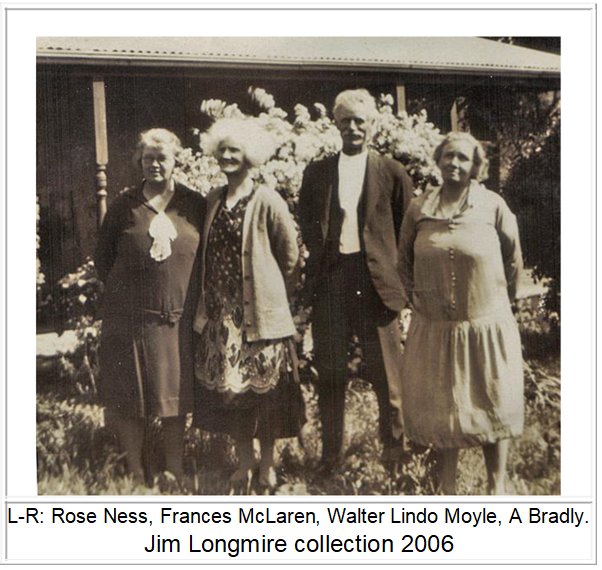
At some stage, in the 1930’s, possibly while living in Auckland, Frances, in her 50s, made a trip to South Australia to visit her brother, Walter Lindo Moyle. By all accounts Frances and her brother Walter got on very well. Family recall that Walter Lindo Moyle, had tremendous respect for Frances. Walter’s daughter, Kathleen Longmire, said she never forgot how excited her father Walter was when Frances came to visit him in South Australia.
The photo below is likely taken at Walter Moyle’s residence in South Australia, showing Frances and her brother Walter in the centre. Also with them are their half-sisters, Rose on the left and Alice on the right. Presumably Alice travelled from New Zealand with Frances.
Ngaruawahia 1932 – 1955
The McLaren’s eventually sold the carrying business and in 1932, Ben, age 60, and Frances 56, purchased the family farm near Ngaruawahia. The farm they named Greenmount, was located about 2 miles south of Ngaruawahia township, on Saulbrey Road. They lived at this property for the next 23 years, until Frances’ death in 1955.
An excerpt from an article in the New Zealand Herald in 1972 reads:
“I got on pretty well with machines but even better with animals,” said Mr McLAREN, who sold the carrying business
to go dairy and pig farming at Ngaruawahia.
There were two houses on the property at Saulbrey Road. Ben and Frances initially moved into the larger house further up the hill where they lived for the first three years. Living with them at the time, were three of their children; Beryl age 26; Ken age 22, and Don age 20.
Although it was the bigger house of the two, the house on the hill was originally only a small four-bedroomed house that the McLaren’s added on to. One of the larger rooms had a billiard table in it for many years. The house still had an old wash-house ‘out the back’ and a drop toilet like the smaller house.
Not long after Ben and Frances McLaren had moved to Ngaruawahia, their eldest daughter Eileen Courtenay also came to live with them along with her three young children: Beryl, age 8; Bert, age 6, and 4-year-old Ron. Eileen’s husband, Albert Courtenay had been severely injured in a lift accident and Eileen had been done out of her house by crooked insurance.
Only three years later, in 1935, Eileen Courtenay was walking to Ngaruawahia when she was knocked over and killed by a car.
Ben, 63, and Frances 59 at the time, decided that they couldn’t look after Eileen’s three young children. They would have liked the two boys to stay together but the Courtenay grandparents would only take the eldest boy Bert, who was nine at the time. So Beryl Courtenay, aged 11, and Ron Courtenay aged seven, remained in Ngaruawahia with Ben and Frances.
It was also in about 1935 that their son’s Ken and Don took over the Saulbrey road farm. At this time Ken and his wife Louie, moved from the smaller house with their two children, Marie age three, and one-year-old Bill, into the larger house.
Ben and Frances moved into the smaller house with their grandchildren Beryl and Ron. Their daughter Beryl McLaren may have also been living with them during this time. Beryl worked as a photographer’s assistant on lower Queen street in Auckland at some stage, but returned to live with her parents when she became unwell. By 1939 Beryl married and moved to the Nelson province in the South Island with her husband, John Christian.
Ben and Frances spent the next 20 years living in the old two-bedroom house, which was a very basic building in many ways. A bucket had to be used under the sink for many years before proper drains were installed. There was no bathroom, only a wash-house ‘out the back,’ with two tubs and a copper. The copper had to be filled and lit so that hot water could be poured into an old tin bath.
Frances was a keen bridge player and every Thursday she would walk about two miles into Ngaruawahia to play bridge and then walk the return trip. In her later years she had very few clothes, but she did have one nice outfit that she wore every time that she went out.
Ben had always had an interest in horse racing, his father broke and trained horses and he was around horses from an early age.
When Ben became a centenarian, stories of his life were shared in the local papers.
The Times, Hamilton, New Zealand – 25 May 1972
Looking back at 100 action-packed years – By Joan Kneebone.
He [Robert McLaren] arrived in New Zealand in 1890. A keen racing man, he remembers 1890 as “Carbine’s year” when the great New Zealand galloper won the Melbourne Cup.
A good rider himself, Mr McLaren can remember riding in eight races at a single picnic meeting.
“It was the McLaren love of speed showing through even before the first motor car,” said Mrs Cleave. Her father loved horses – once he worked for two years and accepted a horse as payment.”
During 1926 and 1927, Ben, in his mid-50s, owned a race horse called ‘War Officer’, together with Mrs J Henderson.
Ben and Frances’ sons Les, Alan, Ken and Don, the McLaren boys, were involved in motor cycle racing during the early 1920s to the late 1930s, and were strong contenders, winning many of the races they entered. All the boys were very successful on their motorbikes and McLarens were the boys to beat. Alan retained his interest in motorbikes for his whole lifetime, whereas Les changed to motor car racing, also for a lifetime.
In their early days the McLaren boys competed in a range of motor racing events held on Muriwai beach
In Ngaruawahia, Beryl Carswell nee Courtenay recalled the great interest the McLaren’s had in motor bikes, motor bike scrambles and motor bike rallies.
The McLaren’s often held motor cycle events on their Saulbrey road property. In the following meet, 20-year-old Don McLaren, won three of the events, the Peg race, Acceleration test and Steeplechase, on his Francis-Barnett.
New Zealand Herald, 30 Aug 1932
“The new season of the Hamilton Motorcycle Club was opened during the weekend with a sports meeting held at Mr. R. B. McLaren’s farm, Ngaruawahia. In spite of the unfavourable weather, there was a good attendance, the varied programme of events being well supported.”
Joan KneeBone’s, article in 1972, “Looking back at 100 action-packed years,” stated: “The whole family enjoys
motorcycle racing and takes an active interest in the sport. It will no doubt be one of the big talking points at Sunday’s reunion.”
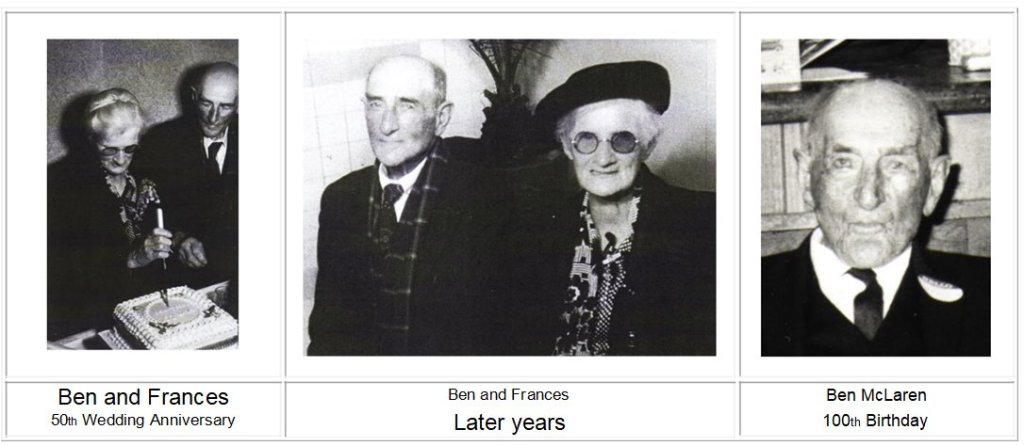
In 1955, while still living at ‘Green Mount’, Frances became unwell.
Frances died at Waikato Public Hospital in Hamilton, on the 20th of August 1955, aged 79.
Frances was buried at the Ngaruawahia Cemetery, were Ben was also later laid to rest.
Frances had spent the last month or two of her life at her daughter Dorothy (Dorry) Cleave’s home at 98 Naylor Street in Hamilton East.
After Frances passed away, Ben, age 83, moved to Hamilton where he stayed with Alan and Betty for about a month before moving across the road to live with his daughter Dorry. Ben lived with Dorry at 98 Naylor street, for over 17 years.
New Zealand Herald P. 18: “He never drew the old-age pension,” said Mrs Cleave. “He regards it as charity.”
Ben started playing lawn bowls later in life, and had played his first game of Lawn Bowls at Hillcrest, in his eighties.
Hamilton Times – May 1972
He took up bowls at the age of 80 and played until he was 96. Still a popular member of the Hillcrest and Hamilton Bowling Clubs, he is a keen spectator- and a critical one at that. NZ Herald – May 1972
Mr McLAREN took up bowls at the age of 80 and won many trophies until he had to yield to a bad knee three years ago. He was also very skillful with a billiard cue.
100th Birthday Celebrations
In May 1972, Ben reached the age of 100. His birthday was celebrated at Ngaruawahia where more than 120 family members and guests attended the occasion.
The Hillcrest Lawn Bowls Club provided a large birthday cake with one hundred candles.
An official photo of Ben’s family and friends was taken at the Ngaruawahia Hall.
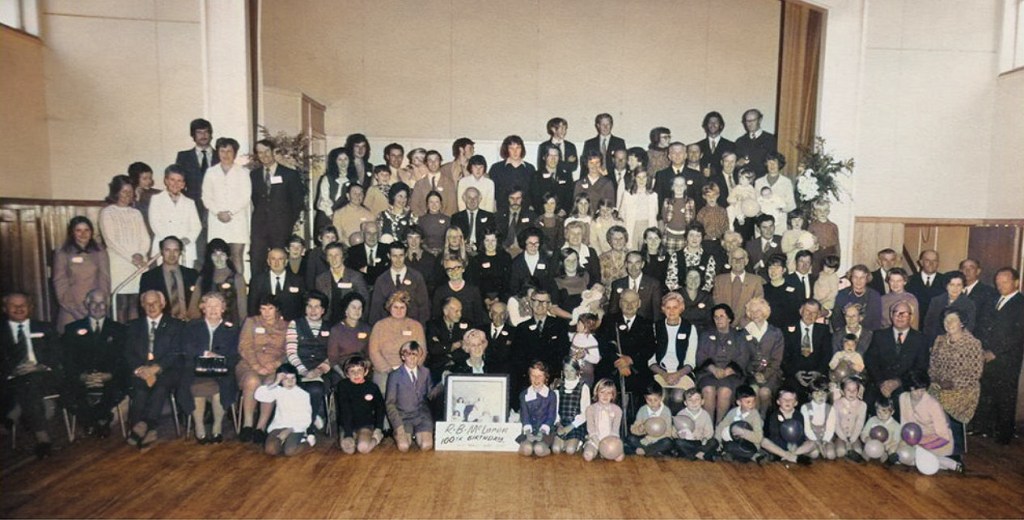
At his age of 100 all but one of Ben’s children were still living. His four sons: Les, Alan, Ken and Don and two daughters, Dorry and Beryl, were in their 60’s and 70’s. Ben had 21 grandchildren, 51 great-grandchildren and one great great-grandchild.
As well as receiving a telegram from the Queen, The New Zealand Herald and the Hamilton Times, shared events and stories of Ben’s life.
The Herald – 1972:
Apart from the accident, Mr McLaren always enjoyed good health.
His daughter, Mrs Dorothy Cleave has looked after her father at Hamilton for the past 16 years, and she points out that his pipe has been going almost all the time.
“He has smoked it ever since I can remember,” she says.
Looking fit and well for his age, Mr McLaren still enjoys a stroll with his daughter.
Death and Burial
Robert Benjamin (Ben) McLaren passed away in 1973, three months before his 101st birthday.
He died in New Zealand’s Waikato district on the 27th of February 1973.
The place of death on his death certificate is stated as Tokanui Hospital, Te Awamutu, however some family members recall that he died in Hamilton’s Waikato Hospital after a short illness.
Ben survived his wife Frances by 18 years, and was buried along side her in the Ngaruawahia Cemetery.
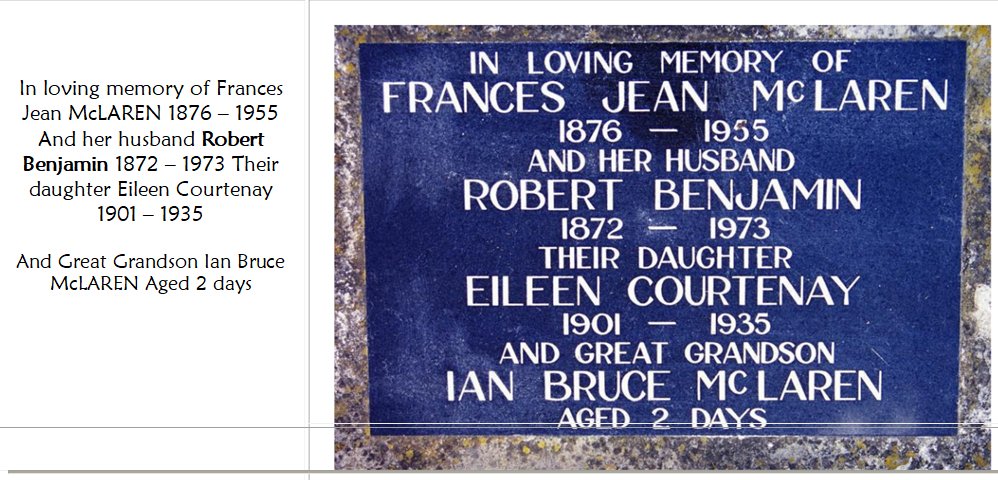
The McLaren family later placed a plaque to mark the burial site of Ben and Frances along with their daughter Eileen Courtenay and great-grandson Ian Bruce McLaren, born in 1960 to Bill and Jeanette.
#1 Benjamin HOWIE and #2 Frances Jane MOYLE – Story File 19 Michele Gregg 2021
Inscription on plaque at Ngaruawahia Cemetery.
Story File compiled from 2006 by Michele Gregg nee Flanagan [mzgregg1@gmail.com]
Research from 1980. Last revised 4 Jan 2021
Sources
Relatives and Researchers
Beryl Christian nee McLaren Personal recollection
Rosemary Flanagan Personal recollection
Pat Hunter McLaren Personal recollection and research
Jan Storr McLaren Personal recollection and research
Beryl Carswell Personal recollection
Owen Cleave Correspondence and family information
Colin Giles Letters 1977 – 1980 sent to Pat Hunter
Bradly family Personal recollection
Les Moyle Personal recollections
John Mervyn Bradly Personal recollection
Ian Longmire Family information and photos
Jim Longmire Family information and photos
Websites
Paper’s Past – New Zealand’s digitized newspapers
Trove – Australia’s digitized newspapers
New Zealand Cemetery Database
New Zealand BDM index
New Zealand electoral roll 1853 – 1981 (Ancestry.com)
Records from Willunga Library via Rosemary Flanagan
Books
The Bradly Line, 1993. Research by Mark Bradly, Narrative by Grant Howard
See Also: WikiTree Profiles for connections to ancestors, descendants and wider family:
Benjamin HOWIE (aka Robert Benjamin McLaren) (1872 – 1973) and Frances Jane MOYLE (1876 – 1955)
#1 Benjamin HOWIE and #2 Frances Jane MOYLE – Story File 20 Michele Gregg 2021

